
Listen to Episode 108 on PodBean, YouTube, Spotify, or your favorite podcasting app!
You might think that the ocean is no place for a bird, yet one group of birds has done remarkably well as marine divers. Their success is evident in their surprising diversity and wide geographic range both in modern times and over the past 60 million years. This episode, we talk about Penguins.
In the news
Mysterious fossil turns out to be part of a giant coelacanth
The oldest DNA ever sequenced: mammoths over one million years old
Lost and found: fossil of a vampire squid
Juvenile predatory dinosaurs filled middle-sized carnivore niches
Bonus: Perseverance is looking for signs of life on Mars!
Penguins: the Weirdest Birds?
Penguins aren’t the only flightless birds, nor the first diving birds, but they are certainly the most famous – and perhaps the most successful – birds to do both. There are around 20 living species of penguins found all across the Southern Hemisphere, from the ice shelves of Antarctica to the coasts of the southern continents, to the equatorial islands of the Galápagos. They range in size from foot-tall little blue penguins to meter-tall emperor penguins, but they all share a set of highly specialized features.

Bottom: Skeleton of a Magellanic penguin, showing off these birds’ bizarre anatomy. Image by H. Zell / CC BY-SA 3.0
Penguins are supremely adapted for swimming. Their wings have evolved into stiff paddle-like flippers supported by powerful chest and back muscles, their dense bones help them combat buoyancy in the water, their feathers are small and densely packed into an insulating coat, and even their circulatory system is reorganized to help them stay warm in the cold water. They can’t fly, and they’re not great at walking, but they’re experts at foraging for food underwater.
Paleo-Penguins
Unlike many birds, penguins have a surprisingly good fossil record, with over 50 extinct species known. It was Thomas Henry Huxley (an associate of Charles Darwin) who named the first fossil penguin in 1859 from a leg bone found in New Zealand. Since then, more have been found all over the Southern Hemisphere. Genetic and anatomical evidence suggests penguins are close relatives of Procellariiformes (petrels, shearwaters, and albatrosses), and their ancestors are thought to have split in the Cretaceous Period.

Image by Nobu Tamura / CC BY 3.0
The oldest known penguins come from the mid-Paleocene of New Zealand. At this time, they were already pretty penguin-like, clearly flightless and adapted for swimming, though their wings seem to have been more flexible than modern penguins, so they may have been swimming more like auks than their own living descendants. There are no known fossils of earlier penguins, but paleontologists suspect they evolved from ancestors that were similar to petrels or auks, seabirds that eventually became so specialized for diving that they left the sky altogether. The earliest penguins may have taken to the sea after marine predators like mosasaurs and plesiosaurs vanished during the K-Pg mass extinction.

Icadyptes was one of the first fossil penguins known from low latitudes, and Inkayacu was the first fossil penguin discovered with preserved remains of feathers, including evidence of coloration!
Image by Apokryltaros / CC BY-SA 3.0
Prodigious Penguins
Many ancient penguins were very large! Several extinct species are known to have reached 1.5 meters (5 feet) tall or even larger, with estimated weights up to 80-100kg (170-220lbs), quite a bit bigger than living emperor penguins. Their super-size might have allowed them to go after larger prey or to make deeper dives, but whatever they were doing, it was clearly successful: giant penguin fossils are found all over the Southern Hemisphere from the Paleocene to the Oligocene.
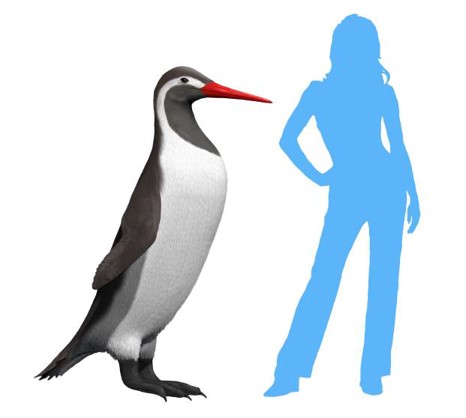
Image by Nobu Tamura / CC BY-SA 4.0
Intriguingly, while giant penguins roamed the south, another group of birds called Plotopterids were doing the same thing in the Northern Hemisphere. Plotopterids were flightless divers, extremely similar to penguins (a case of convergent evolution), and even reached the same impressive sizes! Around the Late-Oligocene to Early Miocene (as the Paleogene Period transitioned to the Neogene), plotopterids and giant penguins seem to have disappeared worldwide, possibly as a result of the rise of toothed whales and seals and sea lions.
Learn more
Penguins Past, Present, and Future: Trends in the Evolution of the Sphenisciformes (technical, paywalled)
2017 paper about Gigantism in Penguins (technical, open access)
Why Did Penguins Stop Flying? (non-technical)
March of the Fossil Penguins (blog by fossil penguin researcher Daniel Kspeka)
Learn more about Plotopterids with this paper (technical) and this video (non-technical)
—
If you enjoyed this topic and want more like it, check out these related episodes:
- Episode 37 – Evolution of Birds
- Episode 11 – Antarctica
- Episode 114 – Polar Life
- Episode 41 – The Evolution of Whales
We also invite you to follow us on Twitter, Facebook, or Instagram, buy merch at our Zazzle store, join our Discord server, or consider supporting us with a one-time PayPal donation or on Patreon to get bonus recordings and other goodies!
Please feel free to contact us with comments, questions, or topic suggestions, and to rate and review us on iTunes!

 The Common Descent Podcast
Leave a comment