
Listen to Episode 168 on PodBean, YouTube, Spotify, or wherever you listen to your favorite podcasts!
Several times throughout the ages, various branches of the crocodylomorph family tree have moved into the sea. This episode, we discuss the many forms of Marine Crocs.
In the news
A new dinosaur species from a time of ecological transition
This extinct dolphin had tusk-like teeth
Ancient bird-call instruments carved from bird bones
Parthenogenesis seen in a crocodile for the first time
Ocean-going Crocs
Crocodilians today – crocodiles, alligators, caimans, and gharials – are mainly freshwater animals, though most of them can handle saltwater to a degree. Most modern crocs have special glands for excreting excess salt, and certain species have even been known to spend days at sea, most famously estuarine crocodiles (Crocodylus porosus).
But in the past, there have been many groups within the greater croc family tree (Crocodylomorpha) that have evolved marine habits, usually living in coastal areas.
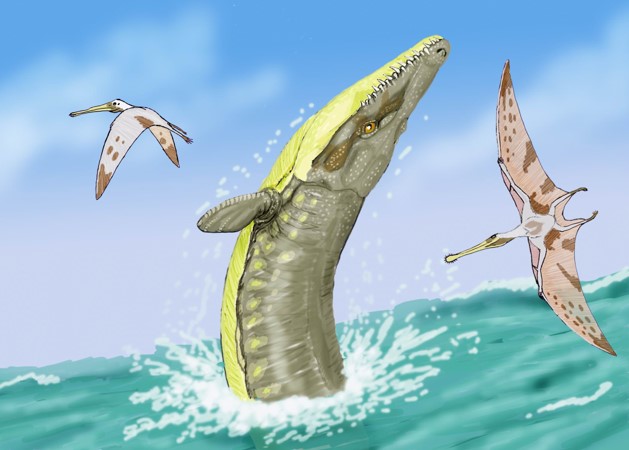
Image by Dmitry Bogdanov, CC BY 3.0
Some notable examples include:
Marine gharials like Sacacosuchus, which were most abundant along coastlines during the Miocene Epoch.
Pholidosaurs and dryosaurs, which were often gharial-shaped and which lived mainly during the Cretaceous and Paleogene Periods. Many members of these groups had marine habits, and this group includes some of the largest marine predators in the world following the end-Cretaceous mass extinction.
The Mesozoic teleosaurs, which occupied a variety of habitats all over the globe, including many that were highly adapted to oceanic life.
The Mesozoic metriorhynchosaurs, which evolved such dedicated marine lifestyles that they often resembled cetaceans or mosasaurs.
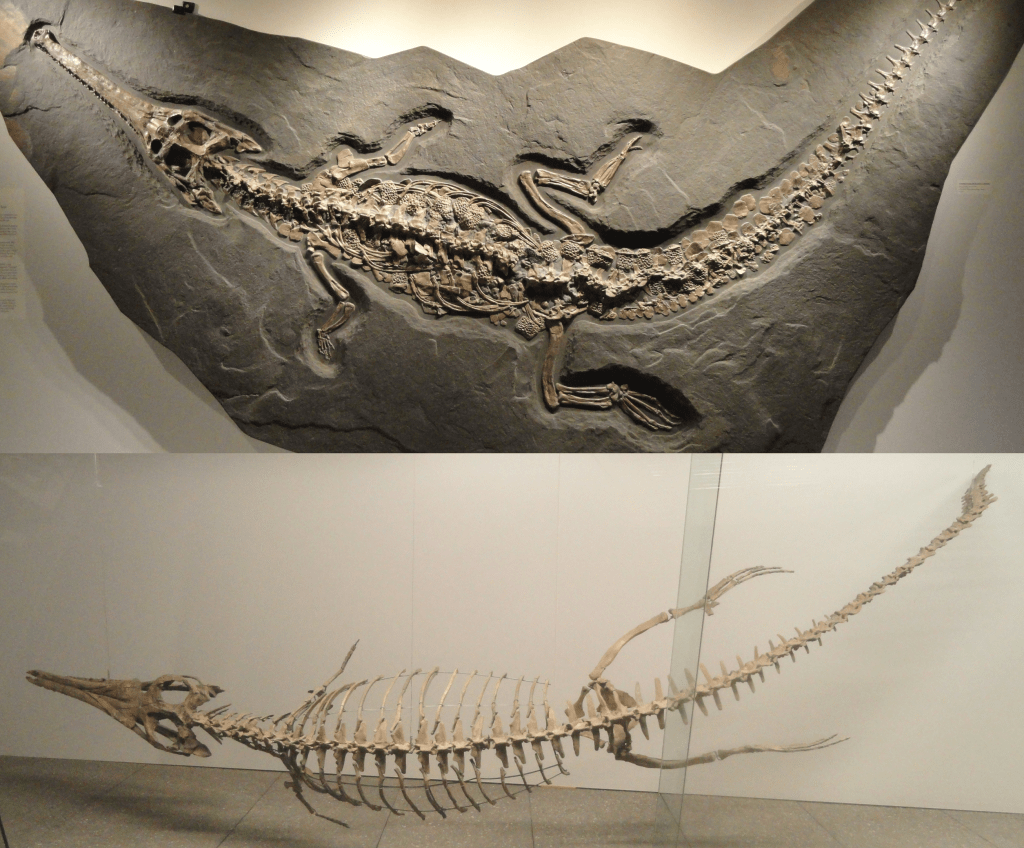
Bottom: Skeleton of the metriorhynchid Metriorhynchus. Image by Daderot
Life Aquatic
The many forms of marine crocs convergently evolved a variety of features that helped them to survive in the sea.
Salt glands are important for allowing animals to release excess salt absorbed from the surrounding water. These are found in modern crocs as well as many extinct groups.
Certain marine crocs, notably teleosaurs and metriorhynchids, are thought to have maintained warmer body temperatures than their cousins, another important adaptation for thriving in cold seawater.
Another feature that evolved many times in marine crocs is a long slender snout similar to today’s gharials. These snouts might be particularly well-suited for grabbing small fast-moving prey in the water. This repeated evolution of similar skulls also causes lots of confusion when scientists try to figure out the relationships of these various croc groups.

Image by M.T. Young et al, CC BY 4.0

Image by Dmitry Bogdanov, CC BY 2.5
Learn more
Phylogeny: Building a Phylogenetic Tree
Convergence and functional evolution of longirostry in crocodylomorphs (technical, open access)
Evolutionary structure and timing of major habitat shifts in Crocodylomorpha (technical, open access)
The evolution of Metriorhynchoidea (technical, open access)
The ecological diversification and evolution of Teleosauroidea (technical, open access)
__
If you enjoyed this topic and want more like it, check out these related episodes:
We also invite you to follow us on Twitter, Facebook, or Instagram, buy merch at our Zazzle store, join our Discord server, or consider supporting us with a one-time PayPal donation or on Patreon to get bonus recordings and other goodies!
Please feel free to contact us with comments, questions, or topic suggestions, and to rate and review us on iTunes.
 The Common Descent Podcast
Leave a comment