

Listen to Episode 169 on PodBean, YouTube, Spotify, or wherever you listen to your favorite podcasts!
Snakes have adapted surprisingly well to marine life, evolving a host of aquatic adaptations several times across many millions of years. This episode, we discuss the repeated evolution of Sea Snakes.
In the news
New theropod dinosaur had unusual hands
Massive genome analysis reveals genetic clues of snake evolution
Decapitated Triassic marine reptiles
A “cartwheeling” snake documented for the first time
Snakes in the Sea
Snakes do surprisingly well in the water. Most of the time, that’s freshwater, but several groups of snakes have adapted to spend part of their time – or, in certain cases, all of their time – in saltwater.
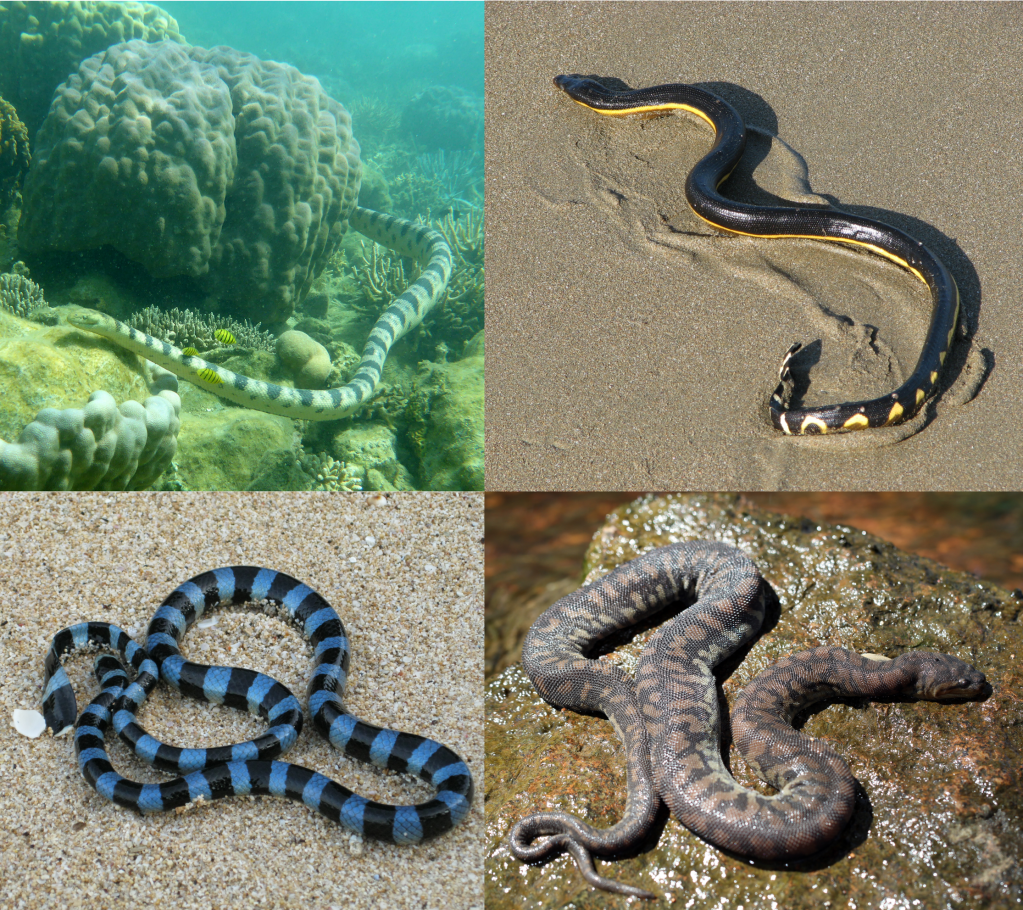
Top right: Yellow-bellied sea snake (Hydrophis platurus). Image by Aloaiza, CC BY 3.0
Bottom left: Blue-lipped sea krait (Laticauda laticaudata). Image by Bramadi Arya, CC BY-SA 4.0
Bottom right: File snake (Acrochordus arafurae). Image by Matt, CC BY 2.0
The most famous marine snakes are the aptly-named sea snakes, sometimes called the “true sea snakes” (all in a group called Hydrophiinae); this is a group that includes several dozen species, most of whom spend their entire lives in the coastal or brackish waters of Australasia. Also in that region are the semi-marine sea kraits, a separate group of saltwater-adapted serpents, as well as filesnakes, a group of highly specialized aquatic snakes that thrive in both fresh and saltwater. Besides those, there are a handful of other snake lineages with species that can tolerate some time in saltwater.
These snakes have evolved a variety of adaptations that allow this unusual lifestyle. They often have tall bodies and paddle-shaped tails that provide extra thrust while swimming; they tend to have special glands in the mouth for secreting excess salt; and they often have large lungs that allow for big gulps of air before long dives. Most aquatic snakes also give live birth, although sea kraits are a notable exception.

Bottom: The convergently evolved paddle-tail of a sea krait. Image by Elias Levy, CC BY 2.0
Sea Snakes of the Past
Genetic studies indicate that modern true sea snakes (Hydrophiinae) are a relatively recent radiation, reaching their current diversity only over the last few million years. But if we look further back in time, we find that there have been numerous highly successful groups of ancient marine snakes.
During the early Cenozoic Era, and especially during the Eocene Epoch (55-34 million years ago), the world was home to a stunning diversity of sea snakes. This included several species in the family Paleophiidae, as well as a handful of other groups. These fossil snakes tend to have tall vertebrae and straighter-than-usual ribs, suggesting a tall body (like modern sea snakes), and they also have dense bones, a feature commonly seen in aquatic vertebrates. Beyond that, their fossils are found in ancient marine deposits alongside fish and other sea creatures.

Right: Vertebra (illustration) of the Eocene snake Pterosphenus. These bones are quite tall for a snake. Image by J. C. McConnell
The early Late Cretaceous was also an age of sea snakes, especially during the Cenomanian (100-94 million years ago). At that time, the Tethys Sea was inhabited by a variety of snakes grouped together in the family Simoliophiidae. Like other marine snakes, they had tall bodies, dense bones, and they’re found in marine deposits. Also, these snakes had legs! Several species are known to have had small back legs, leftovers from their limbed ancestors, although whether these legs were helpful with swimming is unclear.

Right: Skeleton of the Cretaceous marine snake Pachyophis. Image by Tommy, CC BY 2.0
Learn More
The Adaptations of Sea Snakes (video)
Why Are There No Sea Snakes in the Atlantic? (video)
Why Are There No Sea Snakes in the Atlantic? (technical paper, open access)
Australian snakes might have evolved from marine ancestors
Cretaceous hind-limbed snakes (technical, open access)
Paleogene snakes (technical, book excerpts)
Multiple evolutions of paddle-shaped tails (technical, open access)
__
If you enjoyed this topic and want more like it, check out these related episodes:
We also invite you to follow us on Twitter, Facebook, or Instagram, buy merch at our Zazzle store, join our Discord server, or consider supporting us with a one-time PayPal donation or on Patreon to get bonus recordings and other goodies!
Please feel free to contact us with comments, questions, or topic suggestions, and to rate and review us on iTunes
 The Common Descent Podcast
Leave a comment