

Listen to Episode 180 on PodBean, YouTube, Spotify, or wherever you listen to your favorite podcasts!
In the oceans and waterways of the world, it is one of the most common and successful feeding strategies, and it has been for hundreds of millions of years. This episode, we discuss the details and diversity of Filter Feeding.
In the news
A rich assemblage of trilobites in Thailand, with several new species
New hypothesis suggests mammals’ distinctive aging pattern started in the Mesozoic
Some creature left bird-like footprints long before birds evolved
Ancient cetaceans provide clues to the evolution of echolocation
Feeding with Filters
Filter feeding is the habit of gathering tiny food particles from water using some sort of sieve or filter. This is, by some definitions, a specific form of suspension feeding, which is more broadly the habit of feeding on food particles suspended in water.
This dietary strategy is extremely common among life on Earth. It is one of the leading forms of feeding in the ocean, seen in everything from sponges to clams to giant sharks and whales, but is also used by various freshwater animals like insect larvae and flamingos.

Top left: A group of tube sponges (Callyspongia). Image by Nick Hobgood, CC BY-SA 3.0
Top middle: A giant clam (Tridacna gigas). Image by Janderk, Public Domain
Top right: Lesser flamingo (Phoeniconaias minor). Image by H. Zell, CC BY-SA 3.0
Bottom left: Manta ray (Mobula). Image by Gordon Flood, CC BY 2.0
Bottom right: Basking shark (Cetorhinus maximus) Image by Greg Skomal, Public Domain

Image by Jay Nadeau et al., CC BY-SA 4.0
Filter feeding animals are equipped with a variety of strategies for filtering food from water. For example, many arthropods use bristle-like limbs; bivalves and fish often filter food with their gills; some worms and jellies use tentacles to grab food particles; and whales and flamingos have bristle-like structures in their mouths. Some filter feeders sit still while water flows over them, while others have strategies for getting the water moving, such as pumping it through their bodies or simply moving themselves through the water column.

Top left: The skull of a baleen whale (in this case, a southern right whale) features an impressive set of baleen in a massive mouth cavity. Image by Thesupermat, CC BY-SA 3.0
Top right: The skull of a flamingo is tall and arched and full of fine lamellae for filtration, highly convergent with baleen whales. Image by Wagner Souza e Silva, CC BY-SA 4.0
Bottom left: The skull of a crabeater seal, showing off those remarkable teeth that help filter krill from water. Image by Pepijn Kamminga, CC BY-SA 4.0
Bottom right: The gill rakers of a mackerel. In many filter feeding fish, these catch food particles as water flows over the gills. Image by Wibowo Djatmiko, CC BY-SA 3.0
This dietary strategy has evolved over and over again in all corners of the animal kingdom, and evolution has provided a long list of convergent solutions to the challenges of filtration. It is undoubtedly a successful life strategy, allowing animals to gather plenty of food with very little extra effort.
The fossil record is full of filter feeders. Many of these are familiar animals that probably fed very much like their living cousins, such as the abundant bivalves, brachiopods, and crinoids of the ancient oceans. Others are unusual animals with specialized anatomical structures that seem well-suited for filter feeding, such as plesiosaurs with exceptional, closely-spaced teeth or pterosaurs with distinctly flamingo-like faces.
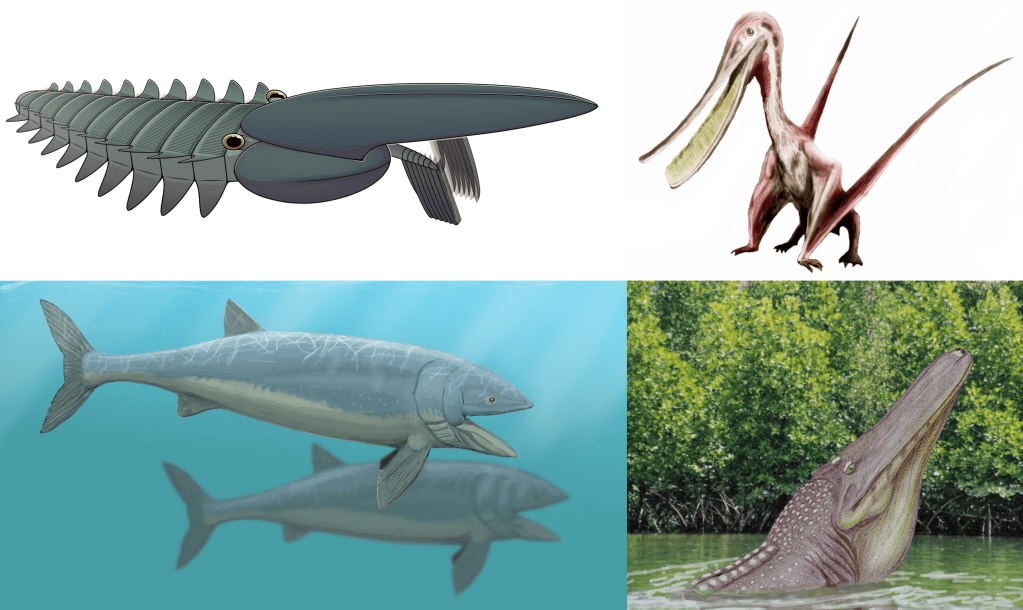
Top right: The pterosaur Pterodaustro has a long snout with hundreds of bristle-like teeth, strikingly similar to flamingos. Image by Nobu Tamura, CC BY-SA 3.0
Bottom left: Pachycormid fish, including the enormous Leedsichthys, have long toothless jaws and large gill rakers, similar to many modern filter feeding fish. Image by Dmitry Bogdanov, CC BY 3.0
Bottom right: The croc-cousin Stomatosuchus has long slender jaws with tiny teeth. Its diet is unclear, but filter feeding has been suggested as an option. Image by Dmitry Bogdanov, CC BY 3.0
Learn more
A filter feeding anomalocarid (non-technical)
Jurassic Pterosaurs Were Filter-Feeders (non-technical)
Gigantism Precedes Filter Feeding in Baleen Whale Evolution (technical)
Filter Feeding in Marine Mammals (technical, paywall)
100-Million-Year Dynasty of Giant Planktivorous Bony Fishes in the Mesozoic Seas (technical, paywall)
If you enjoyed this topic and want more like it, check out these related episodes:
- Episode 128 – The Deep Sea
- Episode 134 – Sanguivores (Blood-Eaters)
- Episode 173 – Herbivores (Plant-Eaters)
We also invite you to follow us on Twitter, Facebook, or Instagram, buy merch at our Zazzle store, join our Discord server, or consider supporting us with a one-time PayPal donation or on Patreon to get bonus recordings and other goodies!
Please feel free to contact us with comments, questions, or topic suggestions, and to rate and review us on iTunes.
 The Common Descent Podcast
.jpg)


Leave a comment