
Listen to Episode 196 on PodBean, YouTube, Spotify, or wherever you listen to your favorite podcasts!
Two groups of snakes include some the most famous and most awesome species on the planet. This episode, we discuss the diversity and evolutionary history of Boas and Pythons.
In the news
A new species of giant salamander-like tetrapod from Permian Namibia
A new species of dinosaur from Utah seems to have been a digger
A new species of early croc-cousin from the Panthalassic coastline
Snakes have different teeth for different striking methods
Boidae and Pythonidae
Boas include around 60 living species in the family Boidae, with close cousins in the superfamily Booidea. Pythons include around 40 living species in the family Pythonidae, with close cousins in the superfamily Pythonoidea. Both groups are highly successful, early-diverging lineages of snakes.

Top right: Children’s python (Antaresia childreni). Image by Matt, CC BY 2.0
Bottom left: Rainbow boa (Epicrates cenchria). Image by Damien Farrell, CC BY 3.0
Bottom right: Angolan dwarf python (Python anchietae). Image by Tigerpython, CC BY-SA 3.0
Boas and pythons have a lot in common: they are both found predominantly in the tropics (boas are mainly found in the Americas, while pythons live mainly in Australia, Asia, and Africa); both have heat-sensing pits on their lips; both exhibit a wide variety of lifestyles from terrestrial to arboreal to aquatic; and both range in size from tiny half-meter snakes to the largest snakes on Earth. Besides their differing distributions, one of the key differences between the groups is that boas tend to give live birth, while pythons are egg-layers.

Top left: Yellow anaconda (Eunectes notaeus). Image by Czeva, CC BY-SA 3.0
Top right: Water python (Liasis fuscus Jarek Tuszyński, CC BY-SA 3.0). Image by Sheba_Also, CC BY-SA 2.0
Bottom left: Emerald tree boa (Corallus caninus). Image by Jarek Tuszyński, CC BY-SA 3.0
Bottom right: Green tree python (Morelia viridis). Image by Micha L. Rieser
In terms of their size, most boas and pythons are pretty standard for snakes, around 1-2 meters (3-6 feet) long, with several species reaching impressive sizes of 4 meters (12 feet) or more. A handful of species have been documented to reach lengths near or exceeding 6 meters (20 feet), making them the largest snakes in the world. These gigantic sizes have evolved multiple times among modern pythons and once in modern boas.

Left: Green anaconda (Eunectes murinus). Image by Tserres34, CC BY-SA 4.0
Right: Reticulated python (Malayopython reticulatus). Image by Mariluna, CC BY-SA 3.0
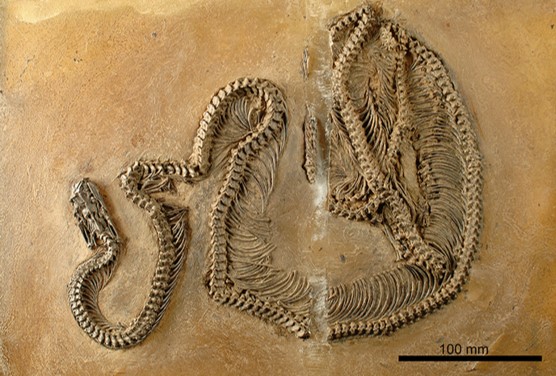
Genetic evidence indicates the boa and python lineages originated sometime during the Cretaceous Period, but the oldest known fossils are from the Paleocene and Eocene. Boa and python fossils are known from all over the world, and like most snakes, they are most commonly represented by isolated vertebrae, but there are exceptions. Some of the best-preserved fossil skeletons of these snakes and their relatives come from the Eocene of Europe, including sites like the Messel Pit which preserves members of both lineages in the same place.

Bottom: Palaeopython, an early relative of boas and pythons from Geiseltal, Germany.
Images from Georgialis et al. 2021
Several species of fossil boas and pythons were giants, estimated to reach over 6 meters (20 feet) in length, similar to the largest species today. These include the Oligocene-Miocene-aged Riversleigh python (Morelia riversleighensis) and the Pliocene Bluff Downs python (Liasis dubudingala) from Australia, as well as Chubutophis, a boa from Eocene Argentina, and of course, the enormous Titanoboa from Paleocene Colombia, possibly the largest snake in Earth history with several specimens estimated at around 13-14 meters (42-46 feet) long.
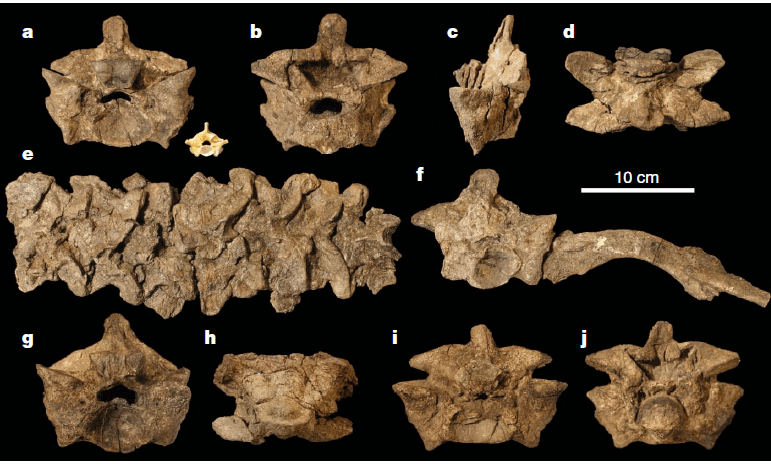
Image from Head et al. 2009
Learn more
World’s oldest python fossil unearthed (Messelopython)
How Titanoboa, the 40-Foot-Long Snake, Was Found
Giant Snakes A Natural History (first 25 pages are available to read)
Exquisitely Preserved Fossil Snakes of Messel: Insight into the Evolution, Biogeography, Habitat Preferences and Sensory Ecology of Early Boas (technical, open access)
Taxonomic revision of the snakes of the genera Palaeopython and Paleryx from Paleogene Europe (technical, open access)
Giant boid snake from the Palaeocene neotropics reveals hotter past equatorial temperatures (Titanoboa) (technical, open access)
Toward a Tree-of-Life for the boas and pythons (technical, paywall)
Parallel selective pressures drive convergent diversification of phenotypes in pythons and boas (technical, paywall)
__
If you enjoyed this topic and want more like it, check out these related episodes:
We also invite you to follow us on Facebook or Instagram, buy merch at our Zazzle store, join our Discord server, or consider supporting us with a one-time PayPal donation or on Patreon to get bonus recordings and other goodies!
Please feel free to contact us with comments, questions, or topic suggestions, and to rate and review us on Spotify or Apple Podcasts!
 The Common Descent Podcast
.jpg)
_(8692425238).jpg)

.jpg)

.jpg)


Leave a comment