
Listen to Episode 197 on PodBean, YouTube, Spotify, or wherever you listen to your favorite podcasts!
Lots of animals are specially adapted for eating tough foods: seeds, shells, bones, etc. This episode, we explore the many approaches to Duropagy.
In the news
New species of fossil boa described from several complete skeletons from Wyoming
Soft tissue adaptations for land-walking in mudskippers
Archaeological experiments reveal patterns of damage on butchered bird bones
Taco-shaped Cambrian arthropod was a large filter feeder
Firm Foods
Durophagous animals consume particularly tough foods; this can include hard-shelled prey, seeds and nuts, or bone. Durophagy is very common, and many animals eat tough foods on occasion. For example, plenty of herbivores will gnaw on bones to obtain additional minerals and nutrients, and lots of carnivores will crunch into bones from time to time.

On the other hand, many animals have particular adaptations for dealing with a diet of tough foods. Durophagous species often have powerful jaws and rounded or flattened teeth for crushing hard materials, as seen in hyenas and many fish, and many marine snails use their tongue-like radula as a drill to penetrate the hard shells of bivalves. And there are many more varied strategies: some sea stars use their arms to pry open clams and mussels; otters famously use rocks to smash open shelled prey; mantis shrimp literally punch their hard-shelled food; many birds drop shells or bones from the air to crack them on the ground; and some snail-eating snakes use their jaws like a saw to slice off the hard parts of their prey.

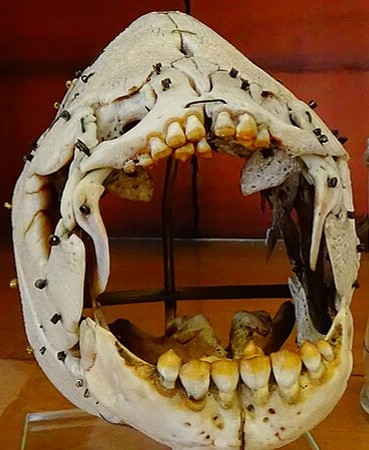
Right: Skull of a red-bellied pacu, showing large rounded teeth for crushing tough fruits and seeds. Image by Loury Cédric, CC BY-SA 4.0
Durophagy is an important concept in paleontology since adaptations for this feeding style are often easy to spot in fossils. Many ancient species features rounded crushing teeth or powerfully-built skulls and jaws for crunching hard food. Evidence for durophagy can also come from traces on prey, such as drill holes on fossil mollusks, or traces in coprolites, such as bone fragments in the fossil poop of borophagine dogs and tyrannosaurs.

Top right: Fossil teeth of the Cretaceous fish Ptychodus. Image by Ghedoghedo, CC BY-SA 3.0
Bottom: Fossil teeth of the durophagous mosasaur Globidens. Image by Greygirlbeast, CC BY-SA 3.0

Right: Drill holes from predatory snails in the fossil shell of a Miocene Turritella snail. Image by James St. John, CC BY 2.0
Durophagous adaptations have evolved many times in nearly all major groups of life. These adaptations are often responsible for major ecological shifts, including the rise of herbivory in early land ecosystems and the changing composition of the oceans during the Mesozoic Marine Revolution.
Learn more
VIDEOS
Sea Otter Using a Rock to Open Clams
Wild African vulture birds scavage bones of dead animals
Durophagy was in full swing half a billion years ago
What Fossilized Scat Shows About T. rex Bite
Skull Shape Evolution in Durophagous Carnivorans (technical, open access)
Bone Digestion and Intestinal Morphology of the Bearded Vulture (technical, open access)
Durophagy in Sharks: Feeding Mechanics of the Hammerhead Sphyrna tiburo (technical, open access)
Mandibular sawing in a snail-eating snake (technical, open access)
The Biomechanics Behind Extreme Osteophagy in Tyrannosaurus rex (technical, open access)
Tyrannosaurid-like osteophagy by a Triassic archosaur (technical, open access)
Biomechanical analyses of Cambrian euarthropod limbs reveal their effectiveness in mastication and durophagy (technical, open access)
__
If you enjoyed this topic and want more like it, check out these related episodes:
- Episode 88 – Evolution of Teeth
- Episode 134 – Sanguivores (Blood-Eaters)
- Episode 173 – Herbivores (Plant-Eaters)
- Episode 174 – The Mesozoic Marine Revolution
We also invite you to follow us on Facebook or Instagram, buy merch at our Zazzle store, join our Discord server, or consider supporting us with a one-time PayPal donation or on Patreon to get bonus recordings and other goodies!
Please feel free to contact us with comments, questions, or topic suggestions, and to rate and review us on Spotify or Apple Podcasts!
 The Common Descent Podcast


_(Sanibel_Island,_Florida,_USA)_5_(49769038921).jpg)
_(Early_Miocene;_near_Bordeaux,_France)_2_(39712249773).jpg)
Leave a comment