

Listen to Episode 198 on PodBean, YouTube, Spotify, or wherever you listen to your favorite podcasts!
These are famously long-bodied fish with a knack for complex environments, an unusual life cycle, and a fascinating evolutionary past. This episode, we’re discussing Eels.
In the news
Research finds small brains aren’t unique to domestic dogs
Giant fossil beans provide clues to Asian-Australian interchange
Cretaceous marine croc was among the latest of its group
Rock outcrops in Angola document the opening of the southern Atlantic Ocean
Long, long fish
True eels are fish within the group Anguilliformes. These are ray-finned bony fishes with characteristically elongate bodies. True eels generally have a high number of vertebrae (hence their long, serpentine shape) and a reduction of the fins – most species have lost the pelvic fins and fused the caudal, dorsal, and anal fins into a continuous hind-end fin. While swimming, most fish propel themselves mainly with their tails, but eels swim using undulating movements of the whole body; this is called anguilliform locomotion).
There are around 1,000 living species of anguilliform eels. Most of them are predators as adults and live in shallow ocean habitats, although there are deep sea and freshwater species as well. Adult body sizes range from tiny deep sea eels only 5 centimeters long to massive conger and moray eels up to 4 meters in length. Their elongate body shape seems to be quite good for maneuvering through tight spaces like reefs and burrows.

Top middle: Garden eels. Image by Fawiki, CC BY-SA 3.0
Top right: Witch eel. Image by NOAA/MBARI
Middle left: African conger eel. Image by Philippe Bourjon
Bottom left: New Zealand longfin eel. Image by Wild_wind, CC BY 4.0
Bottom right: Snipe eel. Image by NOAA, CC BY 2.0
One famous and unusual feature found in eels is the set of pharyngeal jaws seen in morays. In these species, gill arches have been modified into a mobile “second set” of jaws that work in concert with the main jaws during feeding.
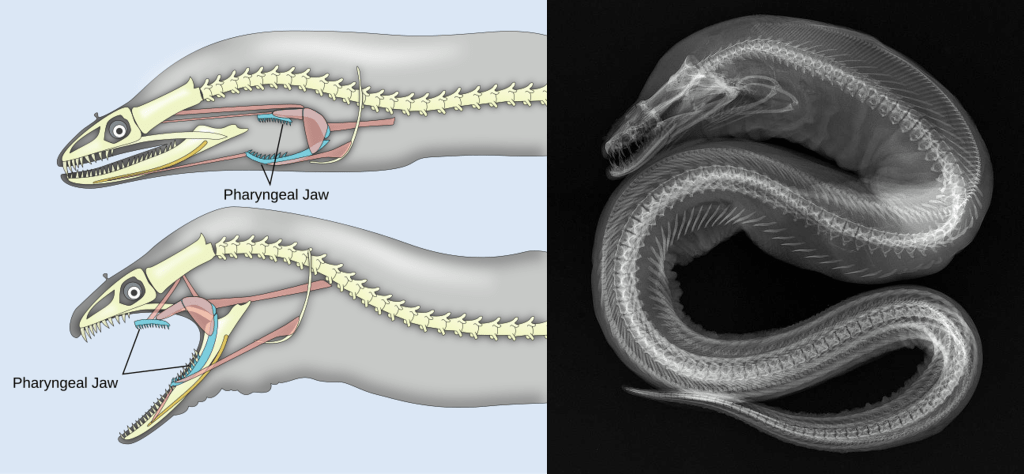
Right: X-ray of a viper moray, showing the pharyngeal jaws. Image from EOL.
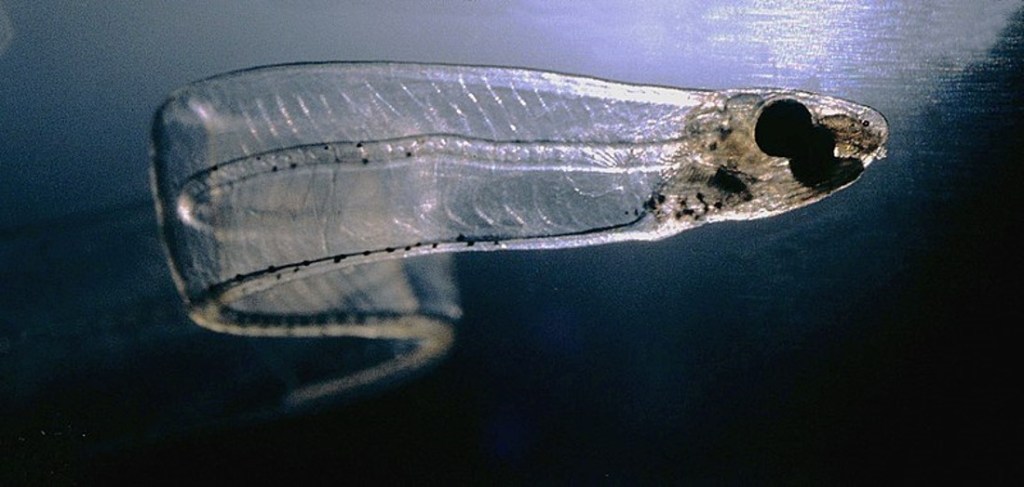
Eels (and their cousins in the group of fish called Elopomorpha) start out their lives in a distinctive larval form called a leptocephalus. These are flat, transparent forms that generally drift along in the open ocean. As they age, they go through a “glass eel” stage where they are more eel-shaped but still transparent, before achieving their adult form. Some eels are diadromous, migrating between freshwater and saltwater during their life cycle.
The fossil record of eels extends back to the Cretaceous Period, and then there’s an expansion of eel diversity after the end-Cretaceous mass extinction. Eel fossils are often fragmentary, although there are a few places with exceptionally well-preserved body fossils, such as the Messel Pit.

Bottom: Fossil Anguillavus from Cretaceous Lebanon. Image by JMGuyon, CC BY-SA 4.0
Of course, there are many fish commonly called “eels” which are not members of Anguilliformes. These include the genus Electrophorus (electric eels), which are part of Gymnotiformes (knifefish); swamp eels, sometimes called fire eels, which are Synbranchiformes; and the deep-sea spiny eels in the group Notacanthiformes, which are closely related to true eels.

Middle: Fire eel. Image by Llandor, CC BY-SA 3.0
Bottom: Smallmouth spiny eel. Image from Goode and Bean, 1896
Learn more
Scientists solve the riddle of eel evolution
Evolutionary history of elongation and maximum body length in moray eels (technical, open access)
A multi-locus molecular timescale for the origin and diversification of eels (technical, paywall)
__
If you enjoyed this topic and want more like it, check out these related episodes:
We also invite you to follow us on Facebook or Instagram, buy merch at our Zazzle store, join our Discord server, or consider supporting us with a one-time PayPal donation or on Patreon to get bonus recordings and other goodies!
Please feel free to contact us with comments, questions, or topic suggestions, and to rate and review us on Spotify or Apple Podcasts!
 The Common Descent Podcast


.jpg)


Leave a comment