

Listen to Episode 200 on PodBean, YouTube, Spotify, or wherever you listen to your favorite podcasts!
This episode, by extremely popular demand, we explore our often-overlooked eukaryote cousins: Fungi.
In the news
Fossil teeth reveal the evolution of diet and dentition in ornithopod dinosaurs
Wing bones show different flight styles among pterosaurs
This dugong was eaten by crocs and sharks
Ancient thylacines exhibited a diversity of diets
Fungi
Like plants and animals, fungi are eukaryotes, organisms with complex cells. Like animals, fungi get their food by breaking down organic matter. Like plants, fungi are generally immobile. Like both other groups, fungi are found in virtually every habitat on Earth, with over 100,000 identified species and at least a million more estimated to be yet undescribed.
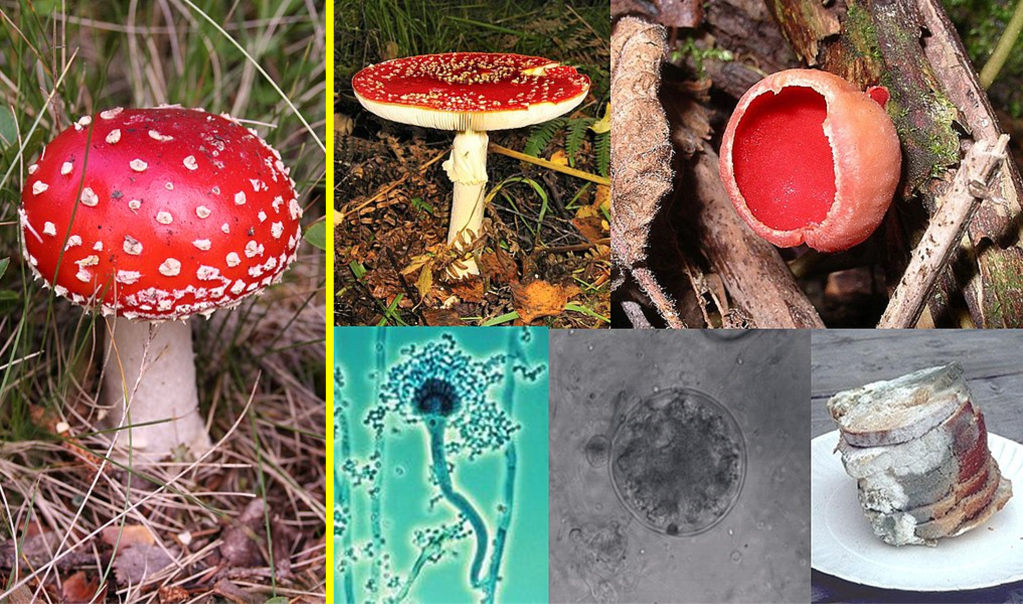
Right: Collage of fungi, including a fly agaric mushroom, a scarlet cup, Aspergillus, a chytrid, and some mold growing on bread. Image by BorgQueen, CC BY-SA 2.5
Fungi are often microscopic. They can be single-celled (unicellular fungi are often called yeasts) but they are also commonly multicellular, with a body made up of thin filaments called hyphae. A network of hyphae makes up a fungal body called mycelium. Fungi are most often saprotrophic, breaking down dead organic matter in their environment, and fungi tend to live inside their food. Their hyphae spread out inside soil or plant matter, secreting enzymes that digest organic molecules and absorbing the resulting nutrients.

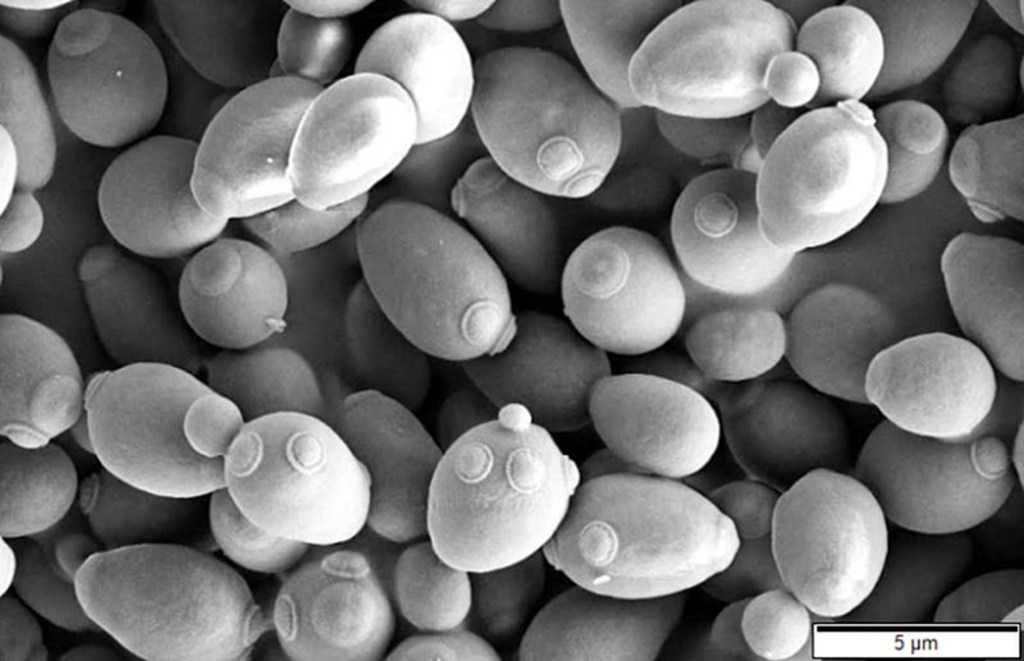
Fungi are majorly important decomposers, breaking down organic material in their environments. Fungi are especially adept at breaking down plant matter, and indeed, plants are the most common food for fungi. Besides being decomposers, many fungi are parasites of plants and animals and other fungi, some live in symbiotic relationships – such as the mycorrhizal root fungi of plants or the gut fungi of animals – and some are significant pathogens of plants or animals.
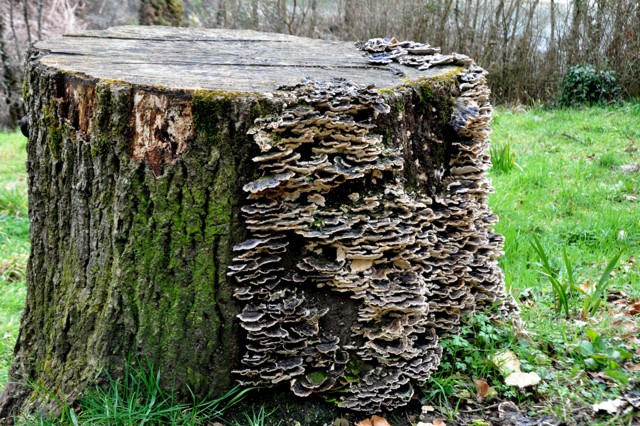
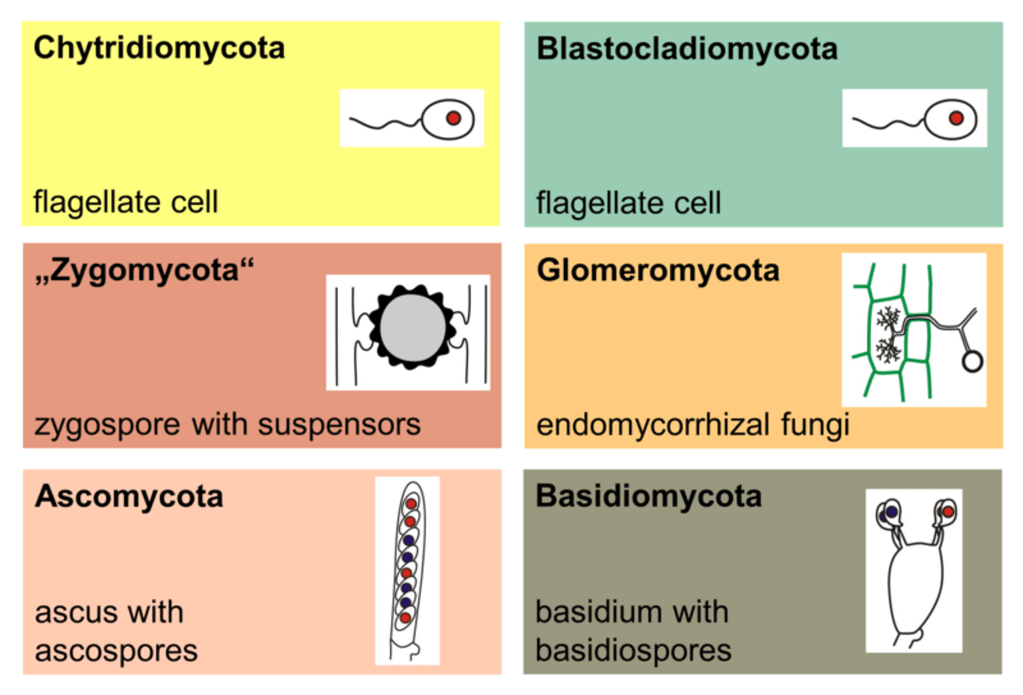
There are several major groups of fungi, and they are typically distinguished by their reproductive habits. Most fungi can reproduce asexually or sexually, producing spores that grow into more fungi. The various types of fungi produce a diversity of reproductive structures which produce, protect, and disperse spores. The most famous of these spore-producing structures are the mushrooms grown by basidiomycete fungi.
Fungus Fossils
Fossil fungi don’t receive anywhere near as much attention as fossil plants and animals, but fungal fossils are quite common. Most often, these are microscopic remains of spores or hyphae preserved within sediment, wood, or amber. The fossil record of fungi extends at least as far back as the Silurian Period, over 400 million years ago, and there have been several reports of possible fungus fossils as old as one billion years or more.
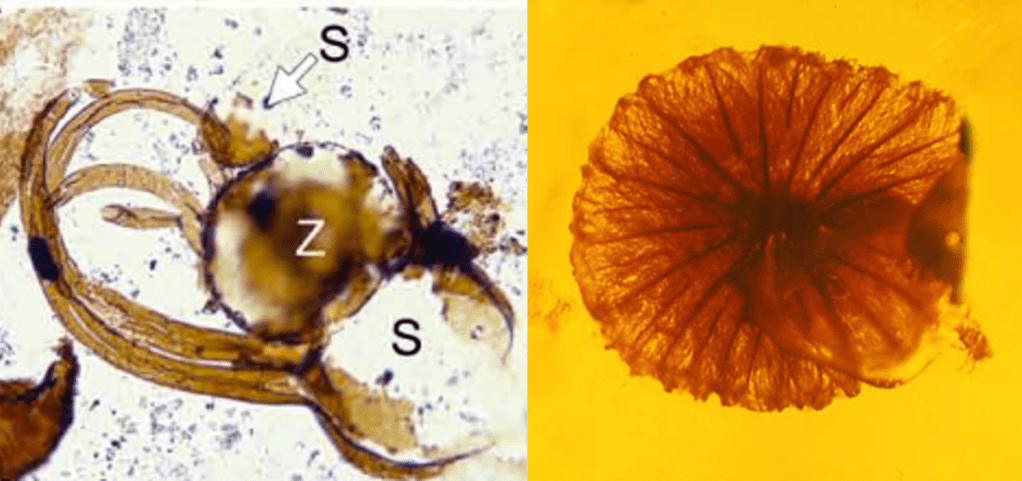
Right: Coprinites dominicana, a mushroom preserved in Dominican amber. Image from Poinar 2016.
By far the most famous fossil fungi are those of the genus Prototaxites, which is a large structure made up of hyphae-like filaments, known from fossil sites of the Devonian and Silurian. Prototaxites is often depicted as a vertical structure like a tree trunk, growing up to 30 feet (9 meters) tall, although whether they truly grew vertically has been questioned.

Right: Microscopic anatomy of Prototaxites. Image by K2727, Public Domain
Learn More
Discovering the world of fossil fungi
635 million-year-old fossil is the oldest known land fungus
Fungal evolution: major ecological adaptations and evolutionary transitions (technical, open access)
Prototaxites reinterpreted as mega-rhizomorphs (technical, open access)
__
If you enjoyed this topic and want more like it, check out these related episodes:
We also invite you to follow us on Facebook or Instagram, buy merch at our Zazzle store, join our Discord server, or consider supporting us with a one-time PayPal donation or on Patreon to get bonus recordings and other goodies!
Please feel free to contact us with comments, questions, or topic suggestions, and to rate and review us on Spotify or Apple Podcasts!
 The Common Descent Podcast
.JPG)


.png)


Leave a comment