

Listen to Episode 204 on PodBean, YouTube, Spotify, or wherever you listen to your favorite podcasts!
Six million years ago, the Mediterranean Sea dried up, wreaking havoc on marine life and leaving an incredible legacy in the geologic record. This episode, we tackle the Messinian Salinity Crisis.
In the news
Marine crocs’ salt glands might have kept them out of deeper waters
Giant cicadas became better fliers in the Early Cretaceous
The oldest known tadpole is a giant specimen from the Jurassic
Bats drowning in swimming pools offer insights into Messel Pit fossils
Med-Life Crisis
The modern shape of the Mediterranean Sea formed during the early Miocene Epoch as continental movement separated it from the Indian Ocean and left only a small link with the Atlantic via the Strait of Gibraltar.

Bottom: Artist’s reconstruction of the Mediterranean with dramatically lower sea level during the Messinian Salinity Crisis. Image by Paubahi, CC BY-SA 3.0
In the late Miocene, during the Messinian age, 5.97 million years ago, continuing tectonic activity closed the Strait of Gibraltar, isolating the Mediterranean. Now cut off from the rest of the ocean, the waters of the Mediterranean gradually evaporated faster than they were replenished. By 5.6 million years ago, the sea level of the Mediterranean had dropped approximately 2,000 meters.
The main geologic evidence for this event comes from evaporite minerals – salt deposits. As salty water evaporates, dissolved salts eventually precipitate out of solution. The geology around and beneath the Mediterranean Sea features “salt giants,” huge deposits of gypsum and halite hundreds to thousands of meters thick. Fossil evidence documents changing salt levels in the water, and ancient river channels track the fall of the sea level.
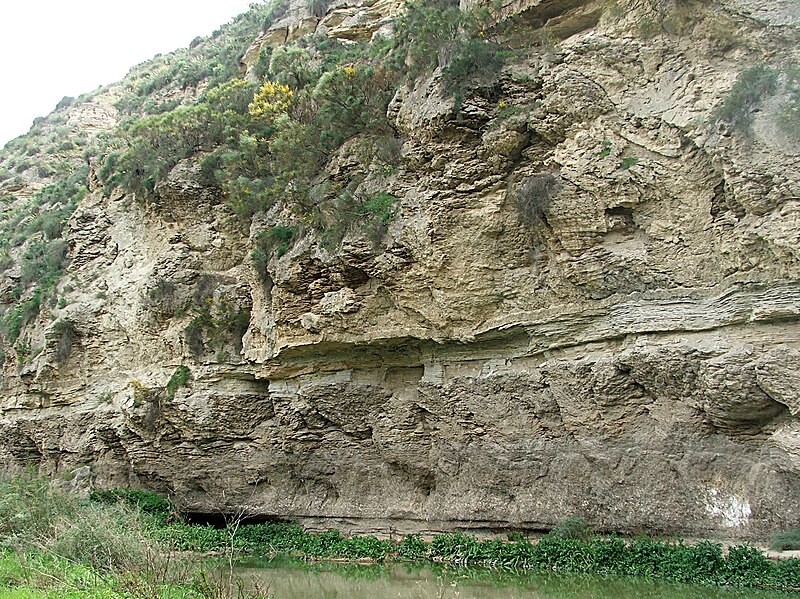
The Messinian Salinity Crisis lasted from 5.97 to 5.33 million years ago, during which time the sea level and salt content of the Mediterranean fluctuated, at times apparently reducing the Mediterranean to a series of isolated briny lakes. The crisis ended when continuing tectonic activity and sea level changes allowed the Atlantic to breach the Strait of Gibraltar once again. Massive sediment deposits and a huge erosion channel suggest the Mediterranean was refilled by one or more enormous flooding events at the start of the Zanclean age.

Unsurprisingly, this whole event was bad news for life in the Mediterranean. Changes to water circulation, salt content, sea level, and the shapes of coastal and deep water habitats led to massive local extinctions in plankton, gastropods, bivalves, fish, corals, and more. When the Mediterranean finally re-connected with the Atlantic and returned to typical ocean conditions, most of the species living in it were newcomers.
Learn More
The Messinian Salinity Crisis – GondwanaTalks
The marine biodiversity impact of the Late Miocene Mediterranean salinity crisis (technical, paywall)
Causes and consequences of the Messinian salinity crisis (technical, paywall)
The Zanclean megaflood of the Mediterranean (technical, open access)
__
If you enjoyed this topic and want more like it, check out these related episodes:
We also invite you to follow us on Facebook or Instagram, buy merch at our Zazzle store, join our Discord server, or consider supporting us with a one-time PayPal donation or on Patreon to get bonus recordings and other goodies!
Please feel free to contact us with comments, questions, or topic suggestions, and to rate and review us on Spotify or Apple Podcasts!
 The Common Descent Podcast


Leave a comment