

Listen to Episode 207 on PodBean, YouTube, Spotify, or wherever you listen to your favorite podcasts!
This episode, we explore the fascinating evolutionary history – and the equally fascinating scientific history – of perhaps the strangest theropods: Therizinosaurs.
In the news
Models predict the sound-carrying capability of Parasaurolophus crests
Some Scottish bears had a mostly marine diet during the Ice Age
Anglerfish evolution got a boost when they made it to the deep sea
Isotopes indicate the earliest American humans ate mostly mammoths
Dino Scissor-Hands
In many ways, therizinosaurs are similar to most of their fellow theropods: they walk on two feet, they have long arms, and they were likely covered in feathers. They’re also very unusual. Unlike most theropods, therizinosaurs were apparently very specialized herbivores, and many of their anatomical features reflect this: they have long necks and small heads (not unlike sauropods); they often had toothless beaks; and their wide bodies were supported by short, stocky legs.
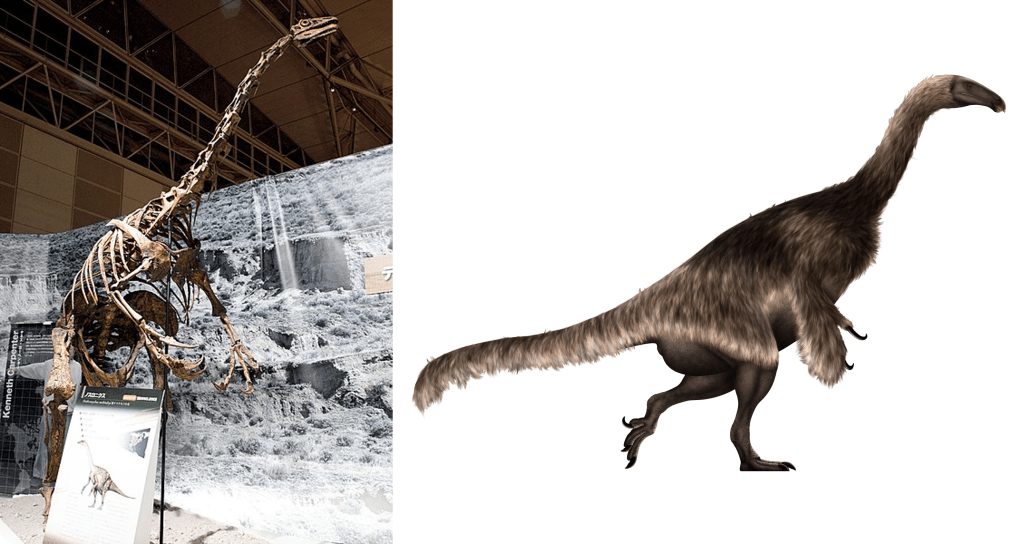
Right: Artist’s reconstruction of Nothronychus mckinleyi. Image by PaleoNeolitic, CC BY 4.0
It took paleontologists a long time to figure out where therizinosaurs belonged on the dinosaur family tree. This was partly due to their unusual anatomy and partly due to a lack of good fossil remains before the late 1900s. Researchers suspected they might be prosauropods or even ornithischians before finally recognizing them as coelurosaurian theropods alongside tyrannosaurs and dromaeosaurs.
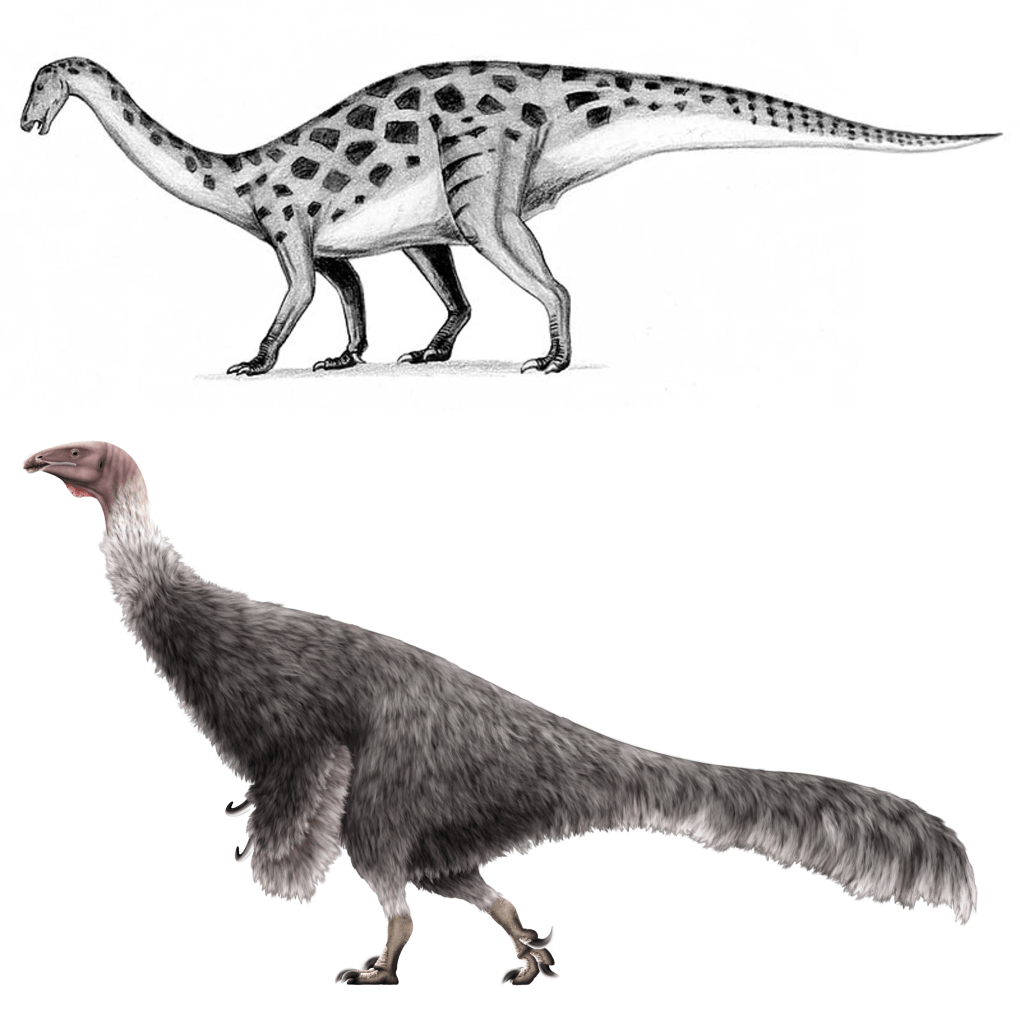
Bottom: A modern, up-to-date depiction of Erlikosaurus. Image by PaleoNeolitic, CC BY 4.0
These days, over a dozen species of therizinosaurs are known to science. They range from the size of a small bear to the size of an elephant, and they’re found in Cretaceous sediments across North America and Asia, and perhaps beyond. Many therizinosaurs are known from very incomplete fossil material (including Therizinosaurus itself), but several are known from nearly complete skulls and skeletons.

While most theropods were fast-moving predators, therizinosaurs were slow herbivores, and their anatomy shows it: blunt teeth and beaks for snipping plants, wide hips and ribs for an expanded plant-fermenting gut, and stocky legs. Therizinosaurs even walked on all four toes (most theropods only walk on three) to support their bodies.
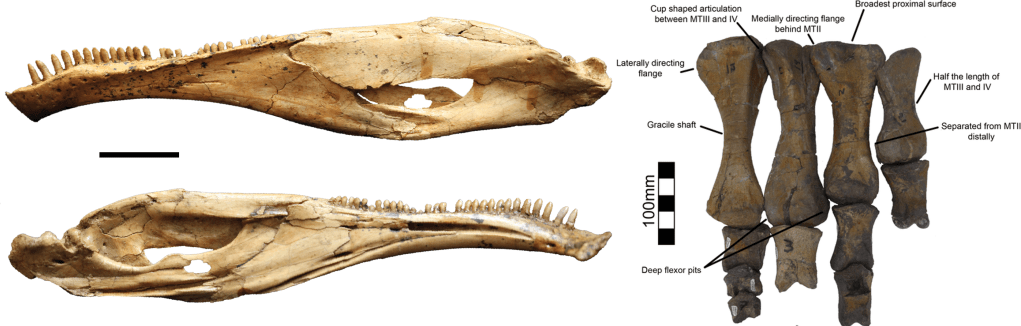
Left: The lower jaw of Erlikosaurus, with blunt rounded teeth and a down-turned end, similar to other herbivorous dinosaurs. Image from Zanno et al 2016
Right: The right foot of Nothronychus, with four short, broad toes (most theropods walk on only three toes) for supporting a wide, stocky body. Image from Hedrick et al 2015
When Therizinosaurus was first described in the 1950s, all that was known of it were its claws. All therizinosaurs had large hand claws, but Therizinosaurus had the largest of all, up to a meter long. Therizinosaur claws vary from species to species, and they might have been used variously for pulling down vegetation, grasping prey (in omnivorous species), or defending against rivals and predators. Biomechanical research has found that the enormous claws of Therizinosaurus were surprisingly weak, and they might have primarily served to show off for mates or intimidate opponents.
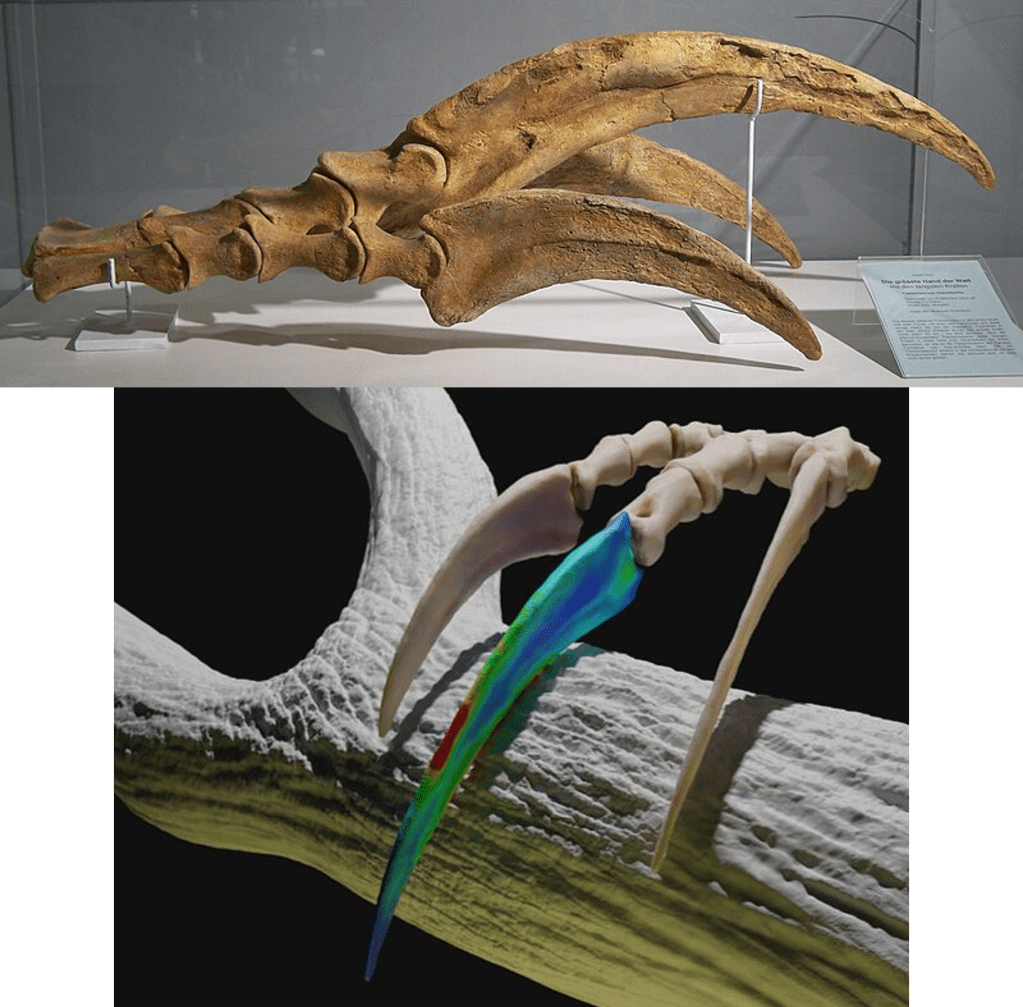
Bottom: Biomechanical analysis of Therizinosaurus claws, showing the response of the claw to physical stress. Image from Qin et al 2023
Learn More
Therizinosaurus had surprisingly weak claws. Popular article; paper
Therizinosaur nesting site. Popular article; paper
In Cretaceous Alaska, therizinosaur and hadrosaur tracks side-by-side. Popular article; paper
The skull of Erlikosaurus (technical, open access)
Biomechanics of therizinosaur claws (technical, open access)
__
If you enjoyed this topic and want more like it, check out these related episodes:
We also invite you to follow us on Facebook or Instagram, buy merch at our Zazzle store, join our Discord server, or consider supporting us with a one-time PayPal donation or on Patreon to get bonus recordings and other goodies!
Please feel free to contact us with comments, questions, or topic suggestions, and to rate and review us on Spotify or Apple Podcasts!
 The Common Descent Podcast
.jpg)


Leave a comment