

Listen to Episode 209 on PodBean, YouTube, Spotify, or wherever you listen to your favorite podcasts!
These cousins of sharks are rare and poorly understood today, but their fossil record is rich with their ancestors and strange cousins. This episode, we explore the past and present of Chimaeras.
In the news
Recent evolution of large, fish-eating Baltic herring
Damaged shells provide direct evidence of Cambrian arms race
New insights into the tail vanes of early pterosaurs
Wyoming fossils suggest dinosaurs spread north early on
Sharks’ Mysterious Cousins
Chimaeras, also known as ghost sharks or rat fish, are cartilaginous fish in a group called Holocephali, closely related to sharks and rays. They differ from true sharks in many ways: most of them live in deep waters, their bodies tend to be long and tapering rather than torpedo-shaped, and they have a very different arrangement of teeth and reproductive organs.
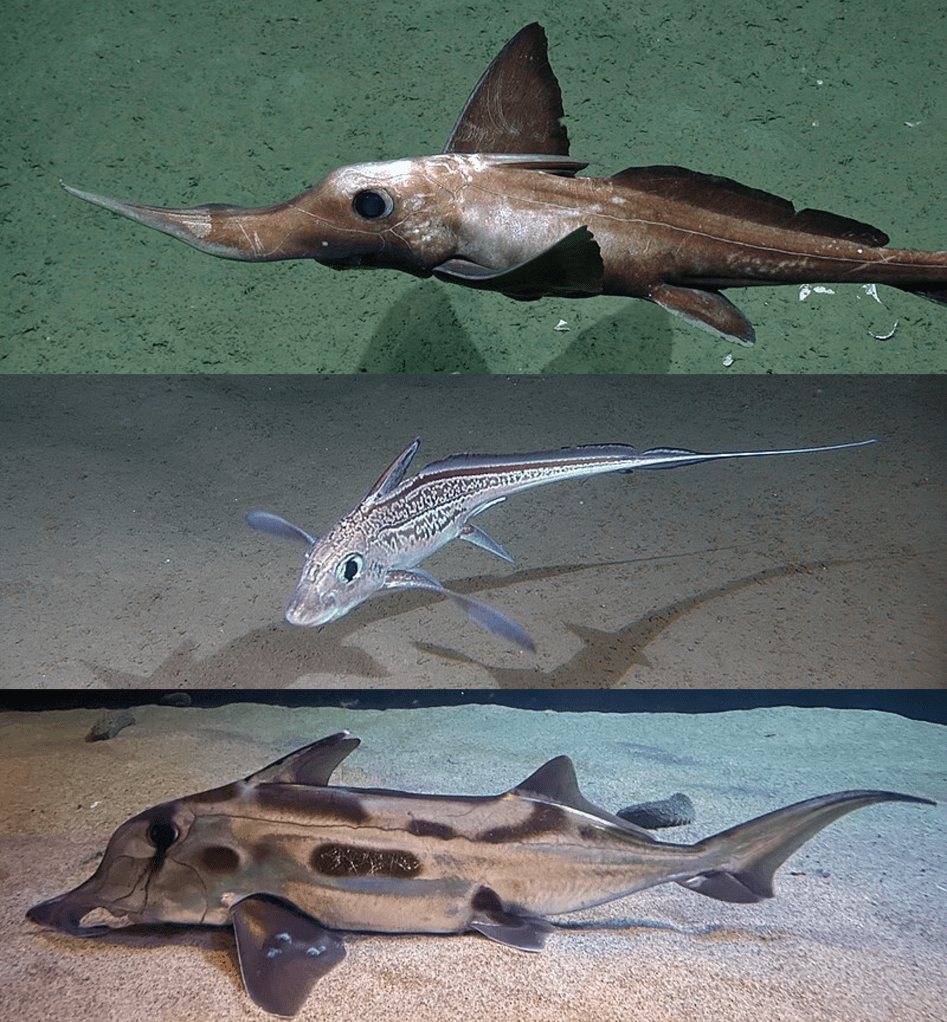
Top: Long-nosed chimaera (Rhinochimaeridae). Image by MARUM, CC BY 4.0
Middle: Rabbit fish (Chimaera monstrosa). Image by MAREANO, CC BY-SA 4.0
Bottom: Elephantfish (Callorhinchus milii). Image by Totti, CC BY-SA 4.0
Chimaera mouths contain three pairs of ever-growing tooth plates useful for cutting and crushing prey. Unlike typical shark teeth, these teeth are not replaced if lost, and they have a different physical structure than any other animal teeth.

Top: Chimaera displaying its head clasper (black arrow). Image by Emőke Dénes, CC BY-SA 4.0
Middle: Chimaera egg case. Image by Wild_wind, CC BY 4.0
Bottom: Closeup of chimaera teeth. Image by Heming Zhang, CC BY-SA 4.0
Chimaera fossils are known as far back as the Carboniferous Period, over 330 million years ago. Many of the characteristic features of the group apparently evolved very early on, including their tooth plates and fin spines, as well as their distinctive egg cases, which are known from the fossil record as early as the Triassic Period.
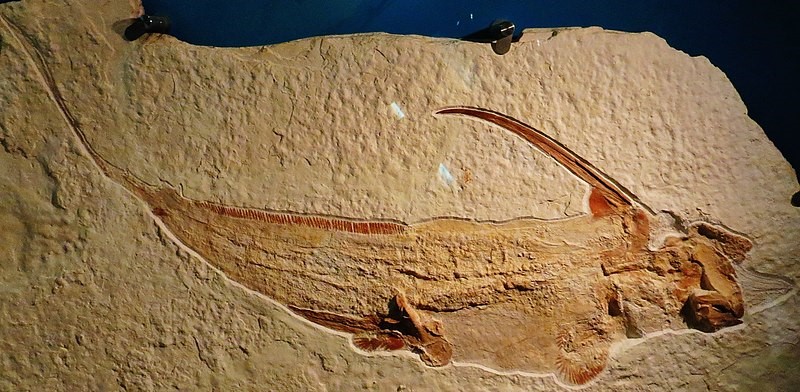
Today, chimaeras are the only living members of their group, Holocephali, but in the distant past, this lineage included a much wider variety of species. These were among the most diverse and distinctive fish of the late Paleozoic Era, featuring an array of lifestyles and unusual physical adaptations.

Top left: Artist’s reconstruction of Falcatus, an Early Carboniferous holocephalan with unusual antenna-like fin spines. Image by Smokeybjb, CC BY-SA 3.0
Bottom left: Artist’s reconstruction of Stethacanthus, a Late Devonian-Early Carboniferous holocephalan with strange brush-like dorsal fins. Image by Dmitry Bogdanov, CC BY-SA 3.0
Right: Artist’s reconstruction of Strigilodus, an Early Carboniferous holocephalan shaped sort of life a modern skate. Image by Benji Paysnoe, Public domain
Among the most famous ancient holocephalans are the eugeneodontids, known for their unusual jaw structure and in particular, their tooth whorls, spiraling rows of teeth. Many species, such as the Permian Helicoprion, are known almost entirely from these tooth whorls alone. For a long time, paleontologists were uncertain how these teeth were used by the fish, and many varied and creative hypotheses were proposed (see below). More recently, well-preserved fossils have revealed that the whorl of Helicoprion sat firmly within its lower jaw, providing a complex and multi-purpose feeding apparatus. And other eugeneodontids have been discovered with their own unusual jaw anatomy.
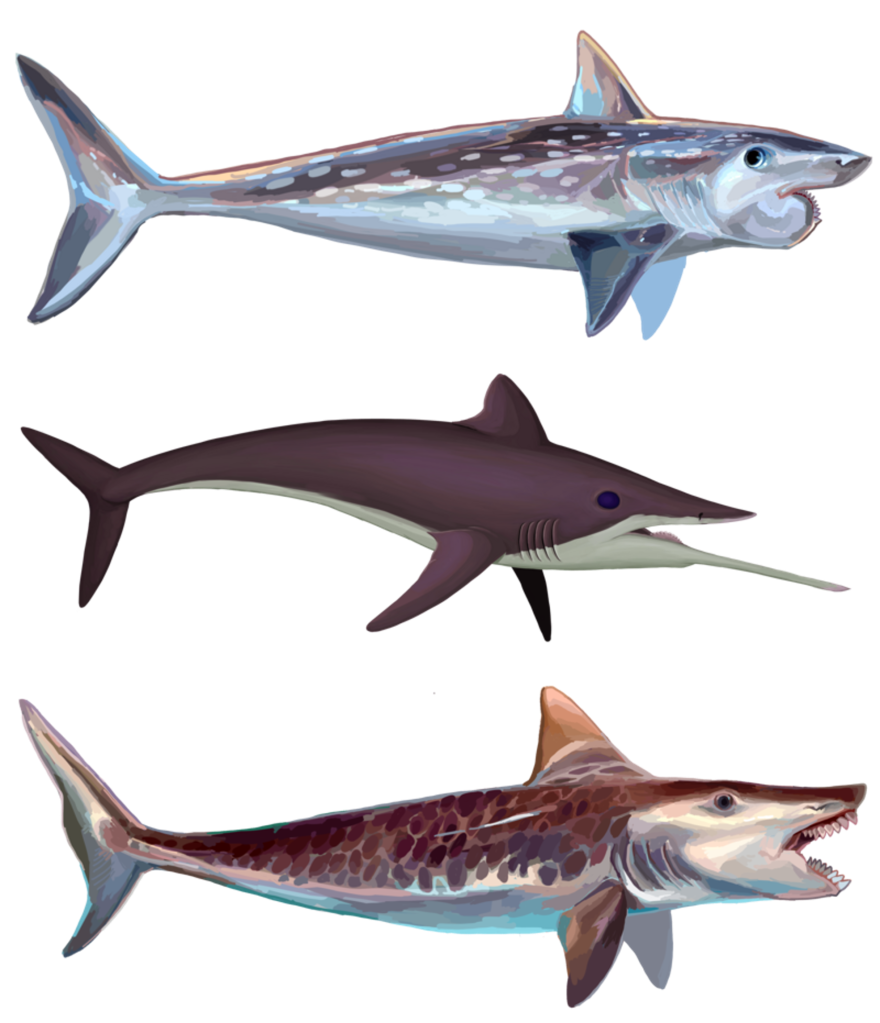
Top: Artist’s reconstruction of Helicoprion with its distinctive tooth whorl. Image by Entelognathus, CC BY-SA 4.0
Middle: Artist’s reconstruction of Ornithoprion, with its unusual long lower jaw. Image by Gasmasque, CC BY-SA 4.0
Bottom: Artist’s reconstruction of Edestes with its outward-facing front teeth. Image by Entelognathus, CC BY-SA 4.0
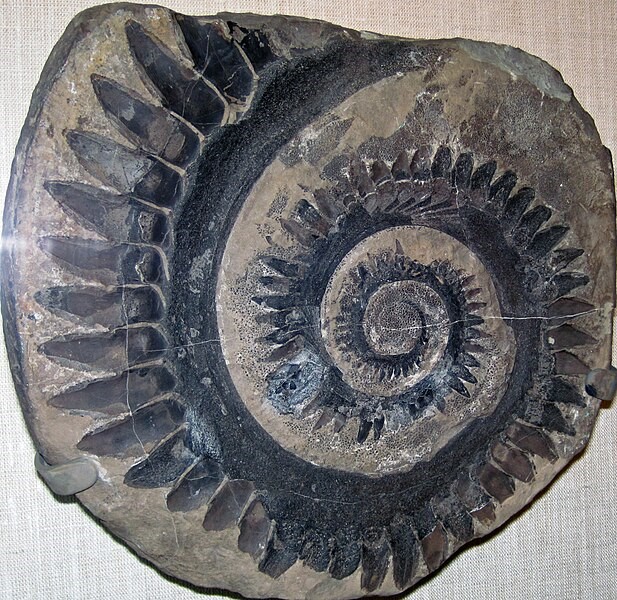
Helicoprion became famous for the many and varied artistic interpretations of how it might have used its tooth whorl. Here are some outdated and incorrect suggestions from the past.

Top: Helicoprion depicted with its tooth whorl curling under its lower jaw. Image by James St. John, CC BY 2.0
Middle: Helicoprion depicted with its tooth whorl like a buzz-saw at the end of its lower jaw. Image by Dmitry Bogdanov, CC BY 3.0
Bottom: Helicoprion depicted with its tooth whorl curling up from the upper jaw. Image by Alexander Karpinsky, public domain
Learn More
Paleontologists Discover New Species of Ancient Petal-Toothed Shark, 2023
Phylogeny and Classification of Extant Holocephali (technical, open access)
Biomechanics of the jaws of spotted ratfish (technical, open access)
Saws, Scissors, and Sharks: Late Paleozoic Experimentation with Symphyseal Dentition (technical, open access)
Paleozoic evolution of holocephalan body plan (technical, open access)
__
If you enjoyed this topic and want more like it, check out these related episodes:
- Episode 29 – Placoderms, the Armored Fish
- Episode 48 – Sharks
- Episode 65 – The Late Devonian Extinctions
We also invite you to follow us on Facebook or Instagram, buy merch at our Zazzle store, join our Discord server, or consider supporting us with a one-time PayPal donation or on Patreon to get bonus recordings and other goodies!
Please feel free to contact us with comments, questions, or topic suggestions, and to rate and review us on Spotify or Apple Podcasts!
 The Common Descent Podcast

_over_havbotn.jpg)


.jpg)


Leave a comment