

Listen to Episode 212 on PodBean, YouTube, Spotify, or wherever you listen to your favorite podcasts!
For over 100 million years, some of the most successful and influential land vertebrates were amphibians. This episode, we discuss the diverse shapes and styles of Temnospondyls.
In the news
Model investigates the feasibility of dogs having self-domesticated
Baminornis is the oldest known short-tailed bird by 20 million years
Patterns in the evolutionary history of colorful display
Research explores how herbivore extinctions affect forest seeds
When Amphibians Ruled the Earth
After vertebrates first moved onto land, they quickly gave rise to a variety of amphibious tetrapods. Among these, the most diverse and successful were the temnospondyls.
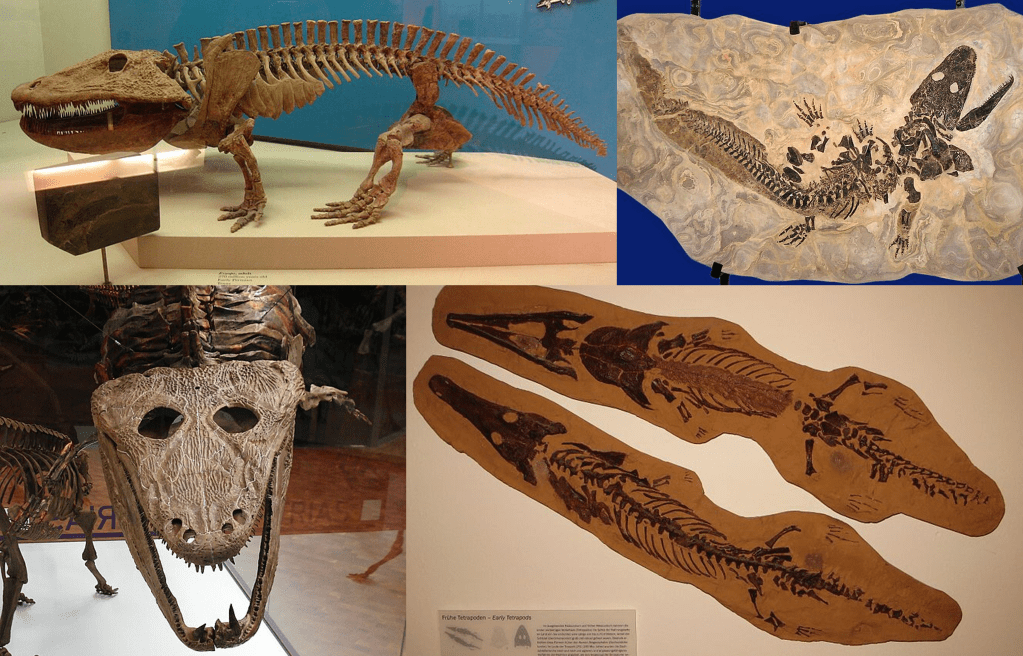
Top left: Fossil of Eryops. Image by Daderot
Top right: Fossil of Sclerocephalus. Image by Dr. Günter Bechly, CC BY-SA 3.0
Bottom left: Fossil of Mastodonsaurus. Image by Ghedoghedo, CC BY-SA 3.0
Bottom right: Fossil of Archegosaurus. Image by Ghedoghedo, CC BY-SA 3.0
Around 300 species of fossil temnospondyls have been identified, found on every continent and dating as far back as the Early Carboniferous Period, around 330 million years ago. Many species were well-adapted for terrestrial life in ancient forests and coastlines, with powerful skulls and sturdy limbs. Even more were aquatic, dwelling mainly in freshwater habitats, with small legs, strong propulsive tails, and well-developed gills.

Bottom: Artist’s reconstruction of the small (~20cm) Zygosaurus. Image by Dmitry Bogdanov, CC BY-SA 3.0

Top left: Artist’s reconstruction of the semi-aquatic crocodile-like Cyclotosaurus. Image by Dmitry Bogdanov, CC BY 3.0
Top right: Artist’s reconstruction of freshwater eel-like Dvinosaurus. Image by Dmitry Bogdanov, CC BY-SA 3.0
Bottom left: Artist’s reconstruction of lake-bottom-dwelling Plagiosternum. Image by ДиБгд, CC BY-SA 4.0
Bottom right: Artist’s reconstruction of the open ocean swimmer Trematosaurus. Image by Dmitry Bogdanov, CC BY 3.0
One especially notable group of temnospondyls are dissorophoids, which comprise a variety of land- and freshwater-dwelling insect-eaters, including the very smallest temnospondyls, aquatic species only 5-10 centimeters long. These were especially successful during the Late Paleozoic, and they’ve received lots of attention as the most likely ancestors of modern Lissamphibians (frogs, salamanders, and caecilians).

Fossil of Branchiosaurus. Image by Ghedoghedo, CC BY-SA 3.0
Another particularly interesting group are the stereospondyls, which were very diverse and successful in aquatic habitats in the Early Mesozoic. These included the short-skulled, armor-backed plagiosaurs that hung out on lake bottoms; the croc-like capitosaurs that included the largest temnospondyls of all, 5-or-6-meter-long predators like Mastodonsaurus; and the slender-snouted ocean-dwelling trematosaurs.

Bottom: Fossil of larval Micromelerpeton. Image by Ghedoghedo, CC BY-SA 3.0
Many temnospondyls are known from fossils of all developmental ages, which reveal that many of these species underwent metamorphosis. Most commonly, their metamorphosis was similar to modern-day salamanders, with aquatic larvae giving rise to land-dwelling adults, though in some cases adults remained aquatic even after metamorphosis.
Learn More
Paleontologists Uncover Fossil Impressions of Giant, Alligator-Like Amphibians
Early amphibians evolved distinct vertebrae for habitat invasions (technical, open access)
Life cycles, plasticity, and paleoecology in temnospondyl amphibians (technical, open access)
The putative lissamphibian stem-group: phylogeny and evolution of the dissorophoid temnospondyls (technical, open access)
The evolution of metamorphosis in temnospondyls (technical, open access)
Modeling the physiology of the aquatic temnospondyl Archegosaurus (technical, open access)
First direct evidence of a vertebrate three-level trophic chain in the fossil record (technical, open access)
__
If you enjoyed this topic and want more like it, check out these related episodes:
We also invite you to follow us on Facebook or Instagram, buy merch at our Zazzle store, join our Discord server, or consider supporting us with a one-time PayPal donation or on Patreon to get bonus recordings and other goodies!
Please feel free to contact us with comments, questions, or topic suggestions, and to rate and review us on Spotify or Apple Podcasts!
 The Common Descent Podcast


Leave a comment