
Listen to Episode 216 on PodBean, YouTube, Spotify, or wherever you listen to your favorite podcasts!
Despite their size, they’re a foundational part of worldwide food webs, global climate, the carbon cycle, and our understanding of Earth history. This episode, we explore Plankton.
In the news
Early lizard relative was a tree climber
Patterns of crocodylomorphs and extinctions over time
Nebraska rhinos didn’t move around much before being smothered by ash
Three-toed tracks are a rare case of ankylosaur footprints
Just Keep Drifting
Plankton is not a single type of organism. Any organism that drifts in water currents is considered planktonic or planktic, as opposed to nektonic creatures which swim and benthic creatures which crawl on the seafloor. Just about every body of water on Earth, from the oceans to lakes to temporary pools, has some sort of plankton floating in it.

Image by Jay Nadeau et al, CC BY-SA 4.0
Plankton are generally split into two main categories. Phytoplankton are photosynthetic, providing energy from the sun to the rest of their aquatic ecosystems; these include various forms of algae, cyanobacteria, diatoms, and more. Zooplankton are all the rest, the tiny floating organisms that eat other tiny floating organisms; these include single-celled foraminifera and radiolarians, tiny crustaceans and fish larvae, even some organisms that both eat and photosynthesize. While most plankton is microscopic, some drifting species such as krill can measure multiple centimeters long, and gelatinous animals like jellies can be positively enormous yet still subject to the flowing currents of the ocean.
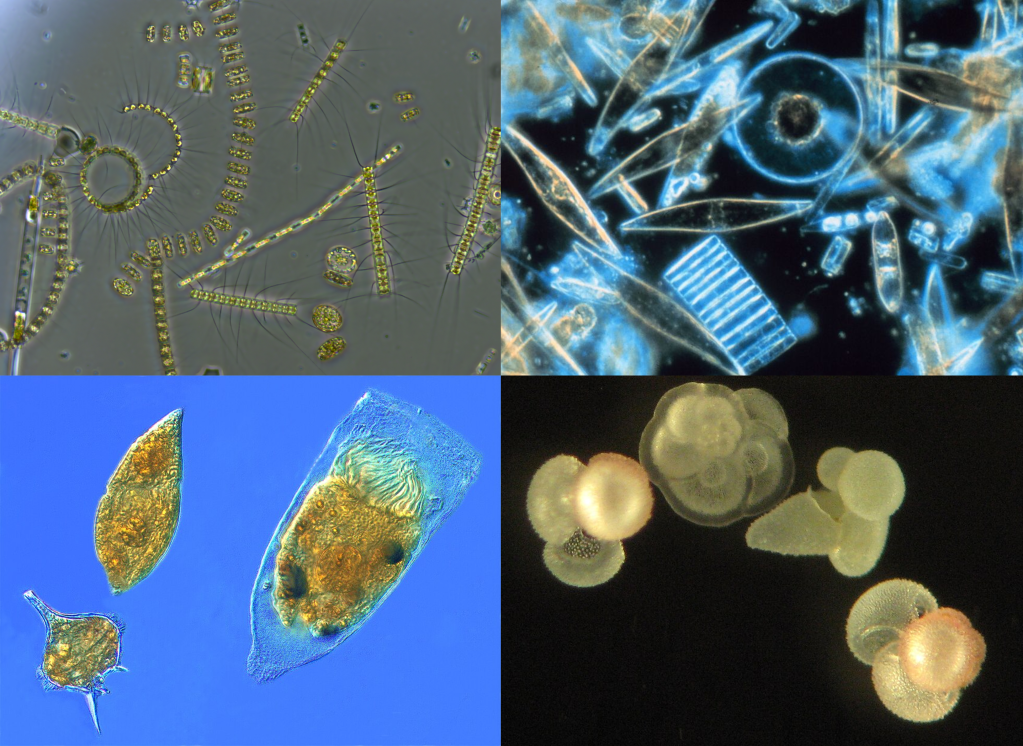
Top left: A mixed phytoplankton community. Image from NASA Earth Expeditions.
Top right: Assorted diatoms from Antarctic waters. Image from NOAA.
Bottom left: A pair of dinoflagellates (left) and a ciliate (right) from Thau Lagoon, France. Image by Tintinnidguy, CC BY-SA 4.0
Bottom right: Foraminifera caught in the Gulf of Mexico. Image from USGS.
Despite their typically small size, plankton are immensely influential. Much like plants do on land, plankton form the foundation of aquatic food chains, especially in the ocean, taking in sunlight and converting it into nutrients that can be used by all other marine life. Phytoplankton also have a significant impact on the atmosphere, releasing oxygen during photosynthesis. And when plankton die, they sink to the seafloor, depositing their organic remains into sediment and locking away huge amounts of carbon. Sinking plankton is one of the most important ways that carbon gets drawn out of the atmosphere and oceans. It isn’t an exaggeration to say that plankton shape the world.
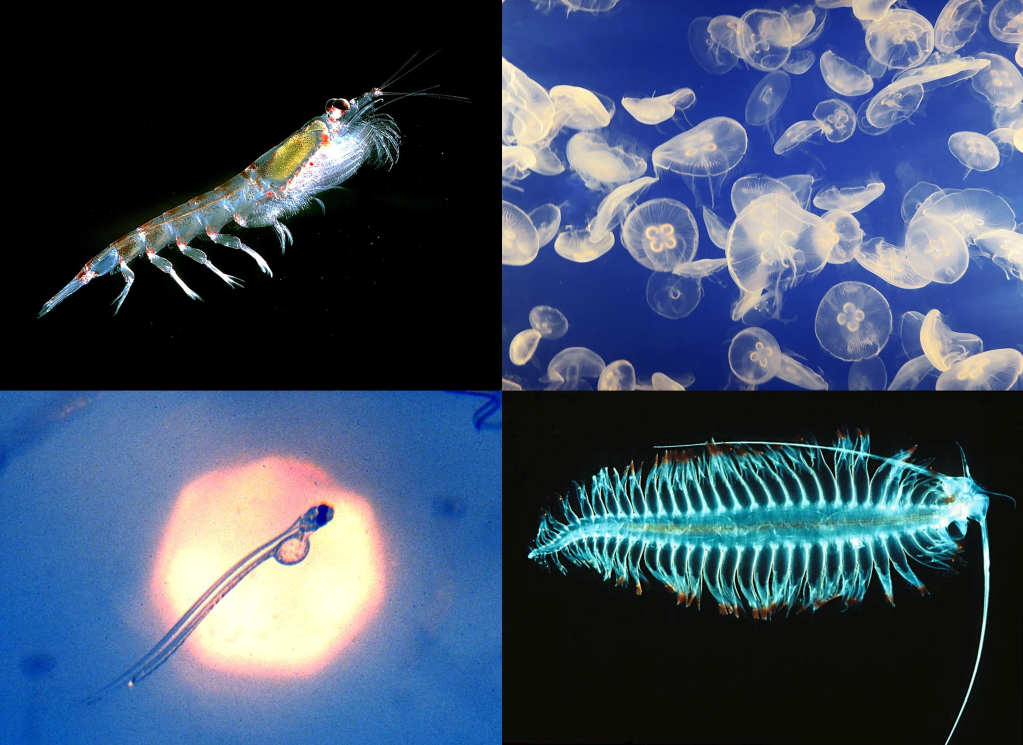
Top right: Jellyfish swarm. Image by FF16
Bottom left: Herring larva under a microscope. Image by Uwe Kils, CC BY-SA 3.0
Bottom right: Planktonic polychaete worm Tomopteris. Image by Uwe Kils, CC BY-SA 3.0
Plankton are extremely valuable for paleontologists. For one thing, many of our favorite rocks are made of plankton. The calcium carbonate that makes up limestone is largely derived from the microscopic shells of ocean plankton. And if you’ve ever heard of diatomaceous earth – well, guess what it’s made of.
Plankton are also incredibly abundant fossils. A sample of seafloor sediment can contain millions of planktonic organisms. And since plankton are so sensitive to environmental changes and reproduce so quickly, they’re excellent indicators of the conditions of their habitats. Micropaleontologists use fossil plankton such as foraminifera to identify the boundaries between time periods, to isolate extinction events, and to interpret ancient temperatures and atmospheric composition from the chemical makeup of their fossilized shells.
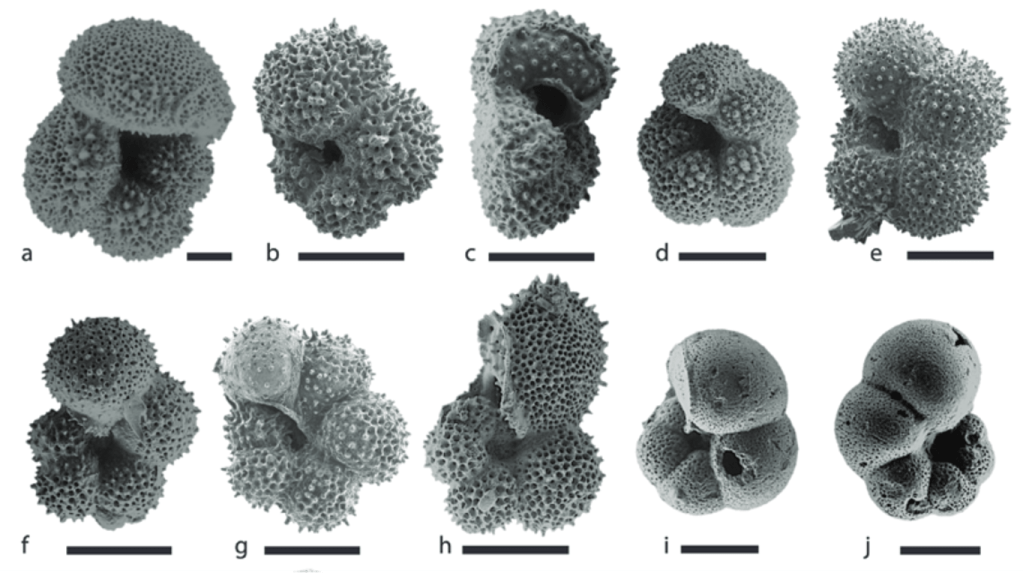
Image by Marci Robinson, USGS.
Learn More
What are plankton? NOAA
Ocean science: the power of plankton
Plankton
Discovered in the deep: the ancient plankton that fill a major evolutionary gap
Fossil plankton may be the key to understanding prehistoric climate change
Diversity and evolution of marine phytoplankton (technical, open access)
Climate change and marine plankton (technical, open access)
Origins, Evolution, and Diversification of Zooplankton (technical, paywall)
__
If you enjoyed this topic and want more like it, check out these related episodes:
We also invite you to follow us on Facebook or Instagram, buy merch at our Zazzle store, join our Discord server, or consider supporting us with a one-time PayPal donation or on Patreon to get bonus recordings and other goodies!
Please feel free to contact us with comments, questions, or topic suggestions, and to rate and review us on Spotify or Apple Podcasts!
 The Common Descent Podcast


Leave a comment