
Listen to Episode 220 on PodBean, YouTube, Spotify, or wherever you listen to your favorite podcasts!
Today’s crocs are iconic semi-aquatic predators, but their extended evolutionary history includes repeated ventures into land-based lifestyles. This episode, we explore the many faces of Terrestrial Crocs.
In the news
In Australia, the first-ever sauropod gut contents
Ancient collagen reveals patterns of Australian megafauna evolution
The oldest butterfly fossils have been discovered in a pile of poop
Distribution of ancient archosaurs shows they traversed the tropics
Crocs of the Land
Today’s crocodilians (alligators, caimans, gharials, and crocodiles) are semi-aquatic, and most are at least mildly capable of moving on land. Some, like Cuban crocodiles, are particularly good out of the water, able to hold their bodies high off the ground and even run in a bounding gallop. But throughout the evolutionary history of crocodyliformes, land-living species have evolved many times and left behind many fossils.

The ancestors of the croc lineage were the diverse Pseudosuchia of the Triassic. This group featured a variety of terrestrial species, including bipedal runners, armored herbivores, and large apex predators.
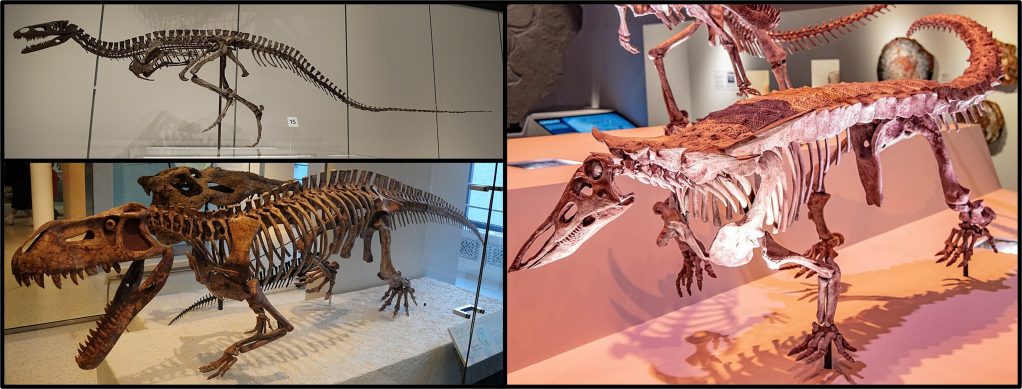
Top left: Skeleton of Poposaurus. Image by Skye McDavid, CC BY 4.0
Bottom left: Skeleton of Prestosuchus. Image by Vince Smith, CC BY-SA 2.0
Right: Skeleton of Desmatosuchus. Image by Evolutionnumber9, CC BY-SA 4.0
Those early pseudosuchians gave rise to Crocodylomorpha, close cousins of true crocodilians. As early as the Triassic Period, this group also included land-lubbers. The shape of these animals’ skulls, jaws, legs, and even some footprints all provide evidence of them living, moving, and feeding out of the water.

Bottom: Artist’s reconstruction of Hesperosuchus by Nobu Tamura, CC BY-SA 3.0
The most diverse assemblage of terrestrial crocodylomorphs are those within Notosuchia. These appeared in the Jurassic and persisted all the way until the Miocene, and along the way they developed terrestrial and semi-aquatic forms, carnivores, herbivores, and insectivores.

Top left: Skull of Kaprosuchus. Image by Carol Abraczinskas, CC BY 3.0
Top right: Skull of Araripesuchus. Image by Sereno and Larsson, CC BY 3.0
Bottom left: Skull of Sebecus. Image by Smokybjb, CC BY-SA 3.0
Bottom right: Skull of Baurusuchus. Image by Marco Aurélio Esparz, CC BY-SA 3.0
Among the most distinctive of the notosuchians – and Will’s favorite extinct croc – was Simosuchus. Living in Madagascar at the end of the Cretaceous Period, Simosuchus was small, terrestrial, herbivorous, and covered in bony armor.

Even among modern crocs’ closest relatives, within the group Eusuchia, there have been terrestrial examples, such as the planiocraniid “hoofed crocs” with their extensive armor and hoof-like claws, and the Australian mekosuchines, which survived until just a few thousand years ago.
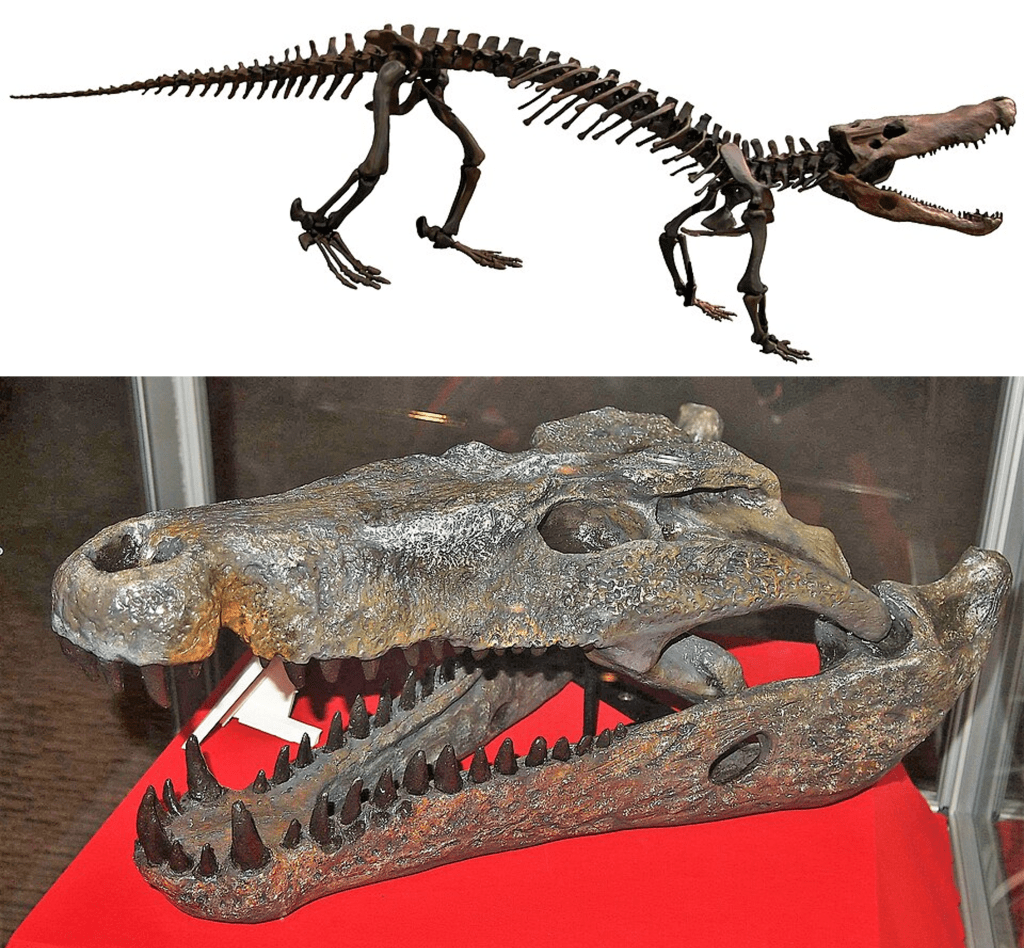
Bottom: Skull of the mekosuchine croc Quinkana. Image by Mark Marathon, CC BY-SA 4.0
Learn more
Repeated evolution of herbivorous crocodylomorphs (technical, open access)
Evolution of terrestrial locomotion in living crocodilians (technical, open access)
Were notosuchians warm-blooded? (technical, open access)
Large terrestrial crocs across the end-Cretaceous mass extinction (technical, open access)
Crocodylomorph resilience to mass extinctions
A review of the non-semiaquatic adaptations of crocodylomorphs (technical, paywall)
__
If you enjoyed this topic and want more like it, check out these related episodes:
- Episode 2 – Crocodilians Past and Present
- Episode 168 – Marine Crocs
- Episode 194 – Alligators and Caimans
We also invite you to follow us on Facebook or Instagram, buy merch at our Zazzle store, join our Discord server, or consider supporting us with a one-time PayPal donation or on Patreon to get bonus recordings and other goodies!
Please feel free to contact us with comments, questions, or topic suggestions, and to rate and review us on Spotify or Apple Podcasts!
 The Common Descent Podcast


_1.jpg)


Leave a comment