
Listen to Episode 221 on PodBean, YouTube, Spotify, or wherever you listen to your favorite podcasts!
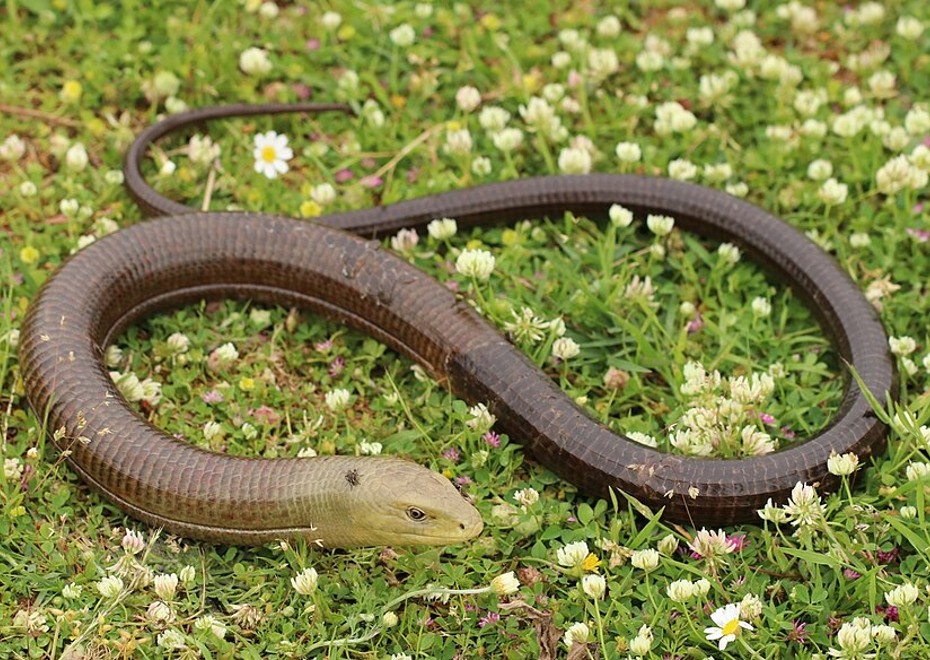
Reptiles are the absolute champions of evolving snake-shaped bodies. This episode, we explore the lifestyles and evolution of the extraordinary variety of Legless Lizards.
In the news
A giant dusky salamander from the Gray Fossil Site
Footprints of mysterious walkers from the Ediacaran
The Harbin Skull seems to be the first known skull of a Denisovan
From Poland, a mammoth tusk boomerang
Night lizards survived the end-Cretaceous asteroid impact
Snake-Shaped
Long, limbless (or nearly limbless) bodies have evolved many times in many groups of animals, including caecilians, eels, temnospondyls, and more. But the absolute champions of this body form are lizards, who have evolved this way at least two dozen different times.
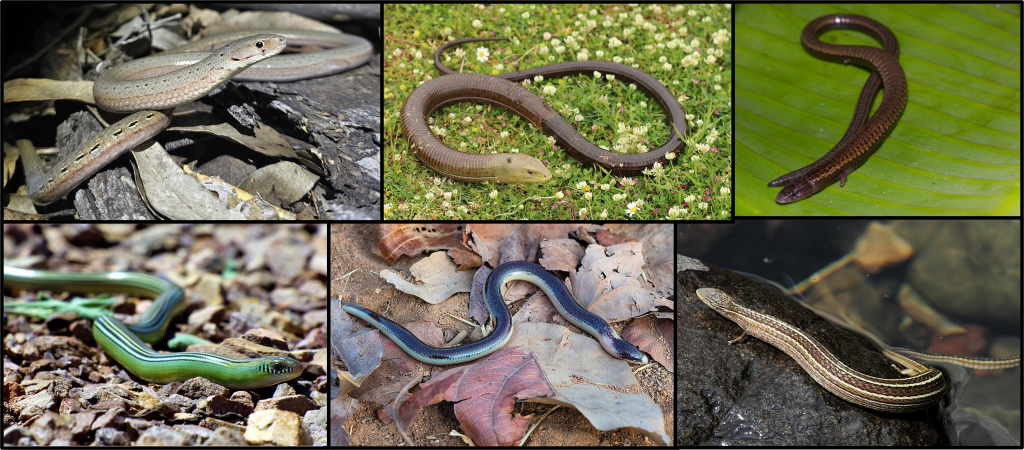
Top left: Scaly-foot lizard (Pygopodidae, Gekkota). Image by Max Tibby
Top middle: European glass lizard (Anguidae). Image by Ryan van Huyssteen, CC BY-SA 4.0
Top right: Two-colored bachia (Gymnophthalmidae). Image by Esteban Alzate, CC BY-SA 2.5
Bottom left: Striped worm lizard (Diploglossidae). Image by Enrique González, CC BY-SA 4.0
Bottom middle: Coppery grass lizard (Cordylidae). Image by Alandmanson, CC BY-SA 4.0
Bottom right: Serra da Neve lance-skink (Scincidae). Image by Tiutenko, CC BY 4.0
Most legless lizards spend their time on the ground or underneath it. Generally speaking, burrowing legless lizards have short tails and long bodies, while surface-dwelling legless lizards have long tails (and also long bodies).

Top left: Blind skink (not a skink, Dibamidae). Image by Rafe M. Brown, CC BY 4.0
Top right: American legless lizard (Anniellidae). Image by Chloe & Trevor Van Loon, CC BY 4.0
Bottom left: Florida worm lizard (Amphisbaenia). Image by Caudatejake, CC BY-SA 4.0
Bottom right: Blind legless skink (actually a skink, Scincidae). Image by Jacques van der Merwe, CC BY-SA 4.0
There’s a lot of variation in exactly how “legless” these lizards are. Many retain tiny vestiges of all four limbs, while many others retain only vestiges of the hindlimbs, and some are truly completely limbless. Some lizard lineages, like skinks, exhibit every point in the spectrum from fully limbed to fully not – these lizards are commonly studied by researchers who want to understand the evolution of limblessness.

Top left: Lerista bougainvillii. Image by Matt, CC BY 2.0
Top right: Lerista dorsalis. Image by Matt, CC BY 2.0
Bottom left: Lerista cinerea. Image by Halvard Aas Midtun, CC BY-SA 4.0
Bottom right: Lerista praepedita. Image by EuanKettle, CC BY-SA 4.0
Among living species, the second-most successful group of legless lizards are the amphisbaenians, also called worm lizards. This group includes over 200 species around the world, most of which are small, highly specialized burrowers with blunt tails, earthworm-like rings along the body, and powerfully reinforced skulls. Most amphisbaenians are essentially fully legless, with the most notable exception being the Mexican mole lizards who retain powerful front legs for digging.

Top right: Checkerboard worm lizard. Image by Aissa Djamel Filali, CC BY-SA 4.0
Bottom left: Red worm lizard. Image by Diogo B. Provete, CC BY-SA 2.5
Bottom right: Skull of the worm lizard Blanus. Image by NickLongrich, CC BY-SA 4.0
By far the winners of the “best legless lizards” contest are snakes. They are true lizards, and with over 4,000 living species, they make up about one third of all modern lizard species. Most snakes are fully legless, with essentially no vestiges of fore- or hind-limbs, and they share a highly specialized skull anatomy that allows them to eat a huge variety of prey.

Top left: An aquatic Carolina watersnake. Image by Conway Hawn, CC BY 4.0
Top right: An arboreal brown tree snake. Image by Pavel Kirillov, CC BY-SA 2.0
Bottom left: A venomous king cobra. Image by Michael Allen Smith, CC BY-SA 2.0
Bottom right: A gigantic reticulated python. Image by Mariluna, CC BY-SA 3.0
Most legless lizard fossils are bits and pieces, scant vertebrae or skull bones that can be classified within modern legless lineages. But there are examples of fully-preserved skeletons of lizards with long bodies and highly reduced limbs.

Left: Fossil of the Early Cretaceous Slavoia darevskii, thought to be an early ancestor or cousin of amphisbaenians. Image by Mateusz Tałanda, CC BY-SA 3.0
Right: Fossil of the Late Cretaceous Primitivus manduriensis, an aquatic lizard, seen in normal light and UV light. Image from Paparella et al 2018.

Left: Sketch of a fossil of Dolichosaurus. Image by J. Erxleben
Top right: Two fossils of Adriosaurus. Image by Franz Nopcsa (Episode 106)
Bottom right: Fossil of Pontosaurus. Image by Ghedoghedo, CC BY-SA 3.0
The best preserved and best studied of fossil legless lizards are, unsurprisingly, snakes. Many Cretaceous fossils are known of early snakes that retain more of their ancestral legs than any living species.
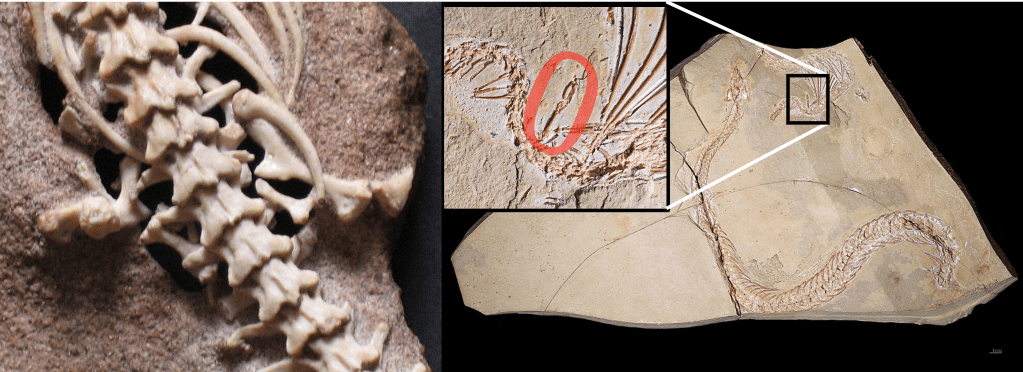
Right: Fossil of the aquatic Cretaceous snake Eupodophis with a close-up of the preserved hind limb. Image by Didier Descouens, CC BY-SA 4.0
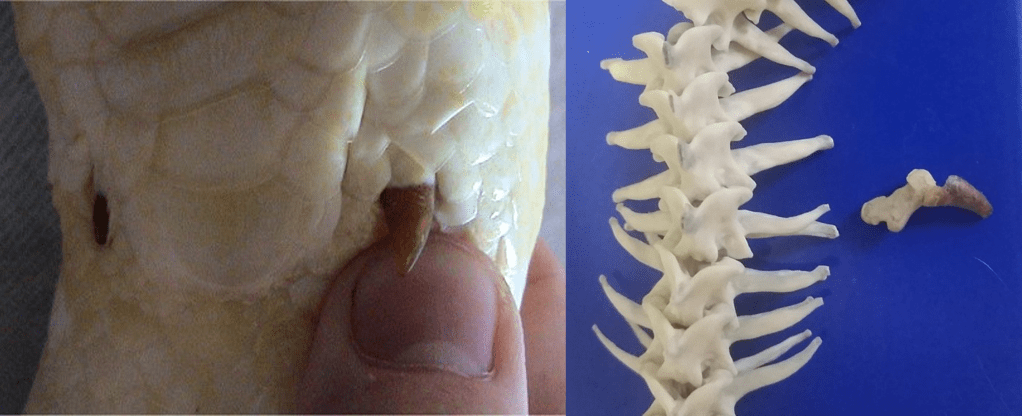
Left: Anal spurs (or pelvic spurs) of a Burmese python. Image by Dawson, CC BY-SA 2.5
Right: Close-up of the skeleton of a Burmese python, showing the remnant hind leg. Image by David Moscato.
Learn more
Wikipedia’s handy list of legless lizards
A farewell to arms and legs: a review of limb reduction in squamates (technical, paywall)
The convergent evolution of snake-like forms in squamate reptiles (technical, paywall)
Snake-like body form evolution in anguid lizards (technical, open access)
A database of the world’s limb-reduced skinks (technical, open access)
Primitivus, a new fossil marine lizard from Late Cretaceous southern Italy (technical, open access)
__
If you enjoyed this topic and want more like it, check out these related episodes:
- Episode 3 – Snakes
- Episode 143 – Monitor Lizards
- Episode 196 – Boas and Pythons
- Episode 206 – Vestigial Structures
We also invite you to follow us on Facebook or Instagram, buy merch at our Zazzle store, join our Discord server, or consider supporting us with a one-time PayPal donation or on Patreon to get bonus recordings and other goodies!
Please feel free to contact us with comments, questions, or topic suggestions, and to rate and review us on Spotify or Apple Podcasts!
 The Common Descent Podcast
.jpg)


,_Uruguay,_2021.jpg)


_(8636525905).jpg)
_(9388392641).jpg)
.jpg)


_(8387580552).jpg)


Leave a comment