
Listen to Episode 224 on Podbean, YouTube, Spotify, or wherever you listen to your favorite podcasts!
Most vertebrates on land get around on all fours, but a handful of lineages have committed to two-legged locomotion. This episode, we discuss the degrees and drivers of Bipedalism.
In the news
Potatoes originated with an ancient hybridization event
Insights into the capabilities of trilobite legs
Diverse communities of bone-eating worms in the Cretaceous
Surprising sexual dimorphism in Australopithecus
On Their Own Two Feet
Vertebrate animals on land tend to get around either on four feet (quadrupedal) or two feet (bipedal). Bipeds broadly come in three varieties: all-the-time (obligate) bipeds such as birds; most-of-the-time (habitual) bipeds such as humans; and occasional bipeds.
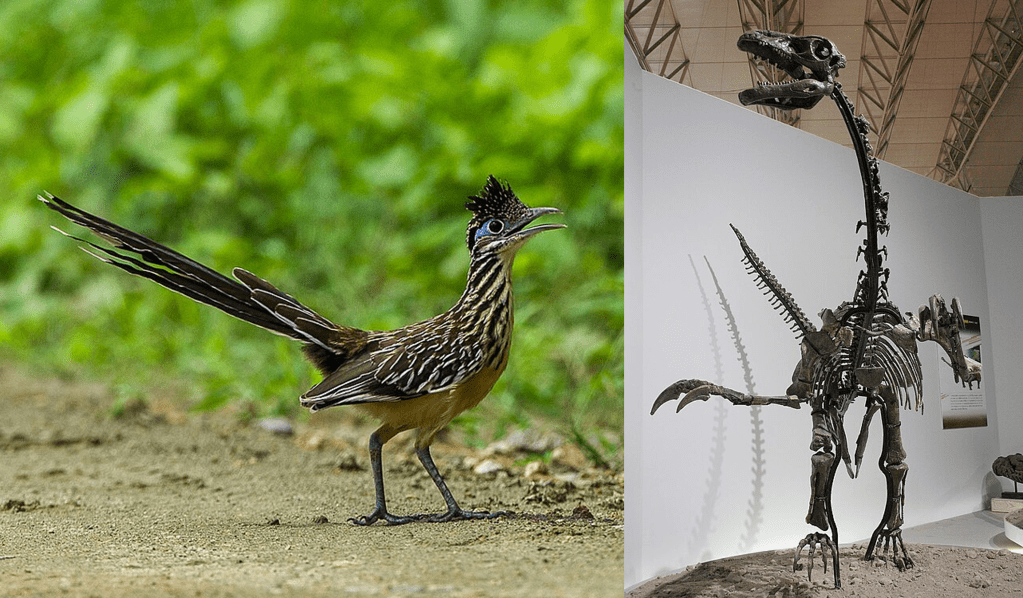
Left: Lesser roadrunner. Image by Francesco Veronesi, CC BY-SA 2.0
Right: Skeleton of the therizinosaur Erliansaurus. Image by Kabacchi, CC BY 2.0

Top left: South African Springhare, a bipedal hopping rodent. Image by Revolutionrock1976, CC BY-SA 4.0
Top right: Parent-joey pair of grey kangaroos, among the world’s largest bipedal hoppers. Image by JJ Harrison, CC BY-SA 4.0
Bottom left: Ground pangolins (Smutsia temminckii) typically walk on just their hind legs. Image by US Fish & Wildlife, CC BY 2.0
Bottom right: The unusual species Homo sapiens walks and runs bipedally with a fully upright stance. Image by Helgi Halldórsson, CC BY-SA 2.0
Most bipeds run, walk, or hop with bent legs and a forward-tilting posture. Humans are unusual in this regard; we walk with straightened legs and an upright posture.

Top left: Brown bear standing upright. Image by Malene Thyssen, CC BY-SA 3.0
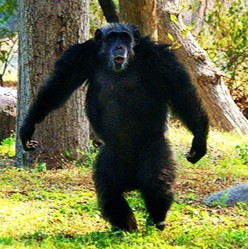
Top right: A chimpanzee walking on two legs. Image by Partha Sarathi Nath, CC BY-SA 4.0
Bottom left: Exhibit of a bipedal-running basilisk lizard. Image by Ryan Somma, CC BY 2.0
Bottom right: American beaver sits up with its front paws raised. Image by Steve, CC BY-SA 2.0
There are many reasons why a quadrupedal animal might move around briefly on the hind legs: displaying themselves as large and imposing; reaching for something high up; or carrying food or other items in the front arms. Unusually, many modern lizards tilt up onto two legs while running.
Identifying bipedalism in the fossil record can be difficult because it’s tricky to distinguish between what an ancient animal could have done and what it actually did do. Paleontologists study the anatomy of fossil animals to look for adaptations for bipedal locomotion in the proportions of the limbs or hips, and sometimes we get lucky enough to find sets of footprints that show two-legged locomotion; tracks like this are known for dinosaurs, hopping mammals, lizards, and human ancestors, among others.

Right: Lower leg of Ornithomimus, well-adapted for bipedal running. Image by Kenneth Carpenter, CC BY-SA 4.0
The most famous ancient bipeds are, of course, our own hominin ancestors. Clear evidence of two-legged locomotion is known from bones and footprints of Ardipithecus and Australopithecus over four million years ago. But the champions of bipedalism are archosaurs, the group of reptiles that includes crocodilians, pterosaurs, and dinosaurs. Fully bipedal locomotion evolved in this group at least six different times during the Mesozoic Era, with many more instances of partial bipedalism.
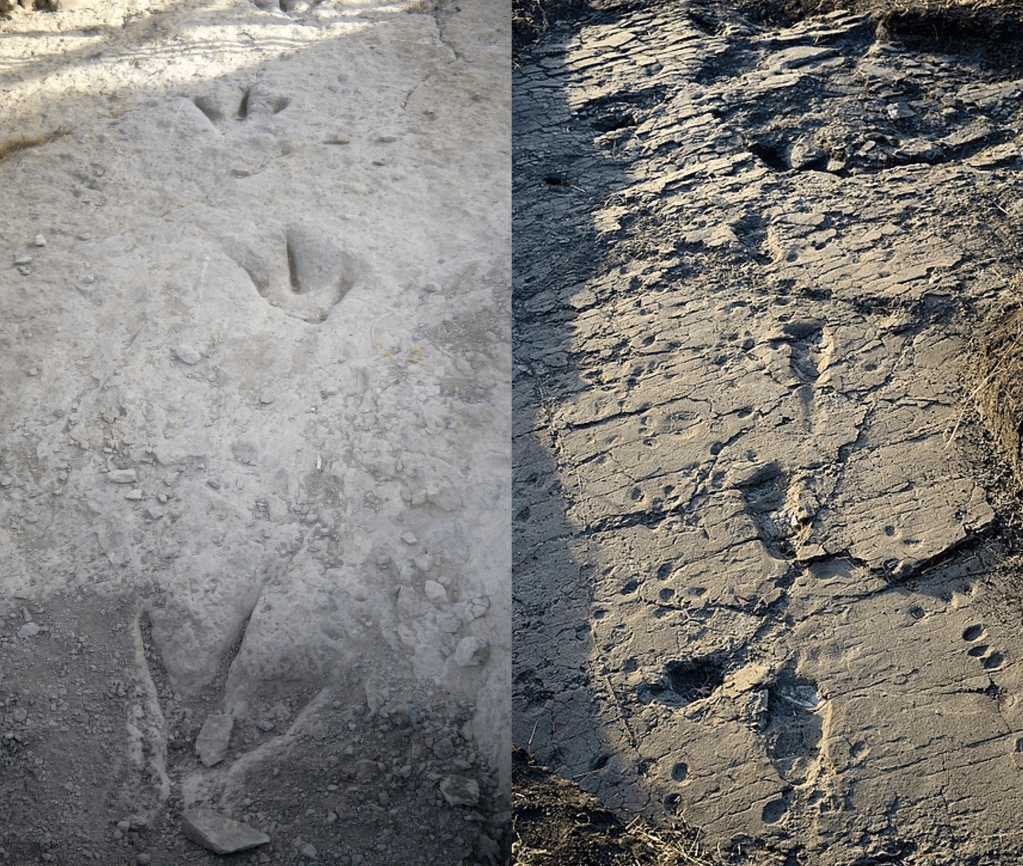
Right: Bipedal footprints of Australopithecus from the famous Laetoli site in Tanzania. Image by Masao et al, 2016
Learn More
Becoming Human: The Evolution of Walking Upright (non-technical)
How did humans acquire erect bipedal walking? (technical, open access)
The evolution of the upright posture and gait in humans (technical, open access)
Bipedal animals, and their differences from humans (technical, open access)
Why go bipedal? Locomotion and morphology in Australian agamid lizards (technical, open access)
The acquisition of archosaur bipedality (technical, open access)
Lizards ran bipedally 110 million years ago (popular article and open access paper)
__
If you enjoyed this topic and want more like it, check out these related episodes:
We also invite you to follow us on Facebook or Instagram, buy merch at our Zazzle store, join our Discord server, or consider supporting us with a one-time PayPal donation or on Patreon to get bonus recordings and other goodies!
Please feel free to contact us with comments, questions, or topic suggestions, and to rate and review us on Spotify or Apple Podcasts!
 The Common Descent Podcast


.jpg)

.jpg)
.jpg)


Leave a comment