

Listen to Episode 225 on Podbean, YouTube, Spotify, or wherever you listen to your favorite podcasts!
Put together a whole lot of trees, a certain amount of heat and precipitation, and a variety of animals and plants, and you’ve got one of the most important biomes on Earth. This episode, Aly joins us to explore the diversity and evolution of Forests.
In the news
How the environment of the seafloor has changed over 500 million years
New Zealand was home to a diverse community of the earliest penguins
Multiple evolutionary pathways in island foxes
Surprise fossil is the first known dragonfly from the Mesozoic of Canada
Deer from the Gray Fossil Site
For the Trees
There are various ways to define a forest, but generally speaking it’s a biome with enough trees to block out a good portion of the sky. Because of all these trees, forests tend to have a variety of habitats not only spread out horizontally, but also vertically, with each layer from the floor to the canopy receiving different amounts of light, water, and animal activity.

Middle left: Redwood forest (temperate rainforest) in northern California. Photo by Aly Baumgartner.
Middle right: Temperate deciduous forest in the Upper Peninsula of Michigan. Photo by Alison Harrington.
Bottom left: Tropical rainforest in Martinique, West Indies. Image by Phalafail, CC BY-SA 4.0
Bottom right: Tropical seasonal forest in Northern Thailand, at the end of the dry season. Image by Adbar, CC BY-SA 3.0
Broadly, there are five major categories of forests in the world today:
- Boreal forests are limited to high latitudes of the Northern Hemisphere, and sometimes high elevations. These are home to relatively few tree species, most of which are evergreen conifers. This is the most widespread terrestrial biome on our planet.
- Temperate forests come in wet (temperate rainforest) and dry (deciduous forest) varieties. These exist at various middle latitudes and contain a mixture of tree types, including in some cases the tallest trees on Earth.
- Tropical forests also come in wet (tropical rainforest) and dry/seasonal forest varieties. Found close to the equator, these are highly variable and often very biodiverse habitats, home to some 50% of living species.

Paleobotanists study the structure of ancient forests by examining the fossil animals that lived there, the fossil plants – features like leaves can be very useful for understanding ancient temperature and precipitation – and ancient soils (paleosols).
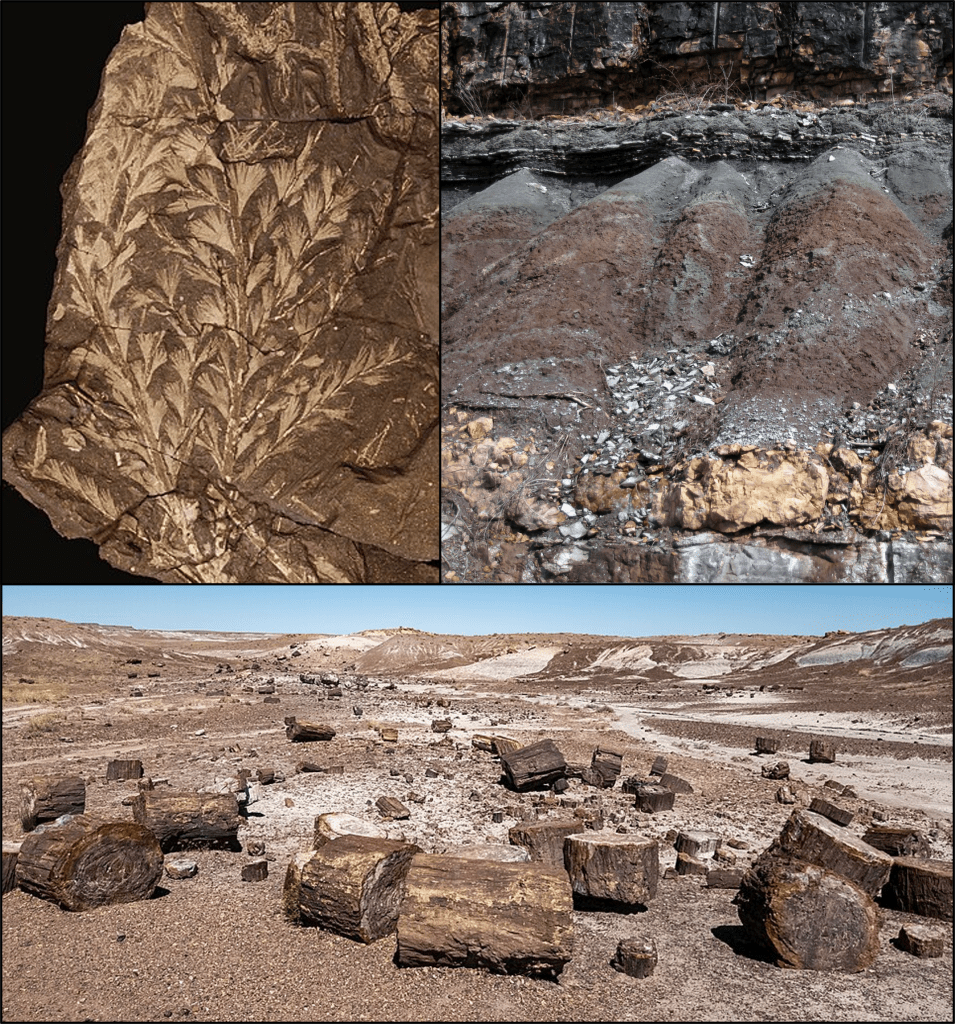
Top right: Paleosoil (fossil soil) from the Carboniferous of Kentucky. Image by James St. John, CC BY 2.0
Bottom: Fossil stumps of Triassic trees at Petrified Forest National Park in Arizona. Image by Alexander Hatley, CC BY 2.0
Earth’s first forests developed during the Devonian Period, more than 360 million years ago. These were sparse forests, home to a variety of unusual tree-like plants, and they ultimately gave way to the expansive forests of the Carboniferous Period, which spread across the globe and left behind extensive coal deposits.
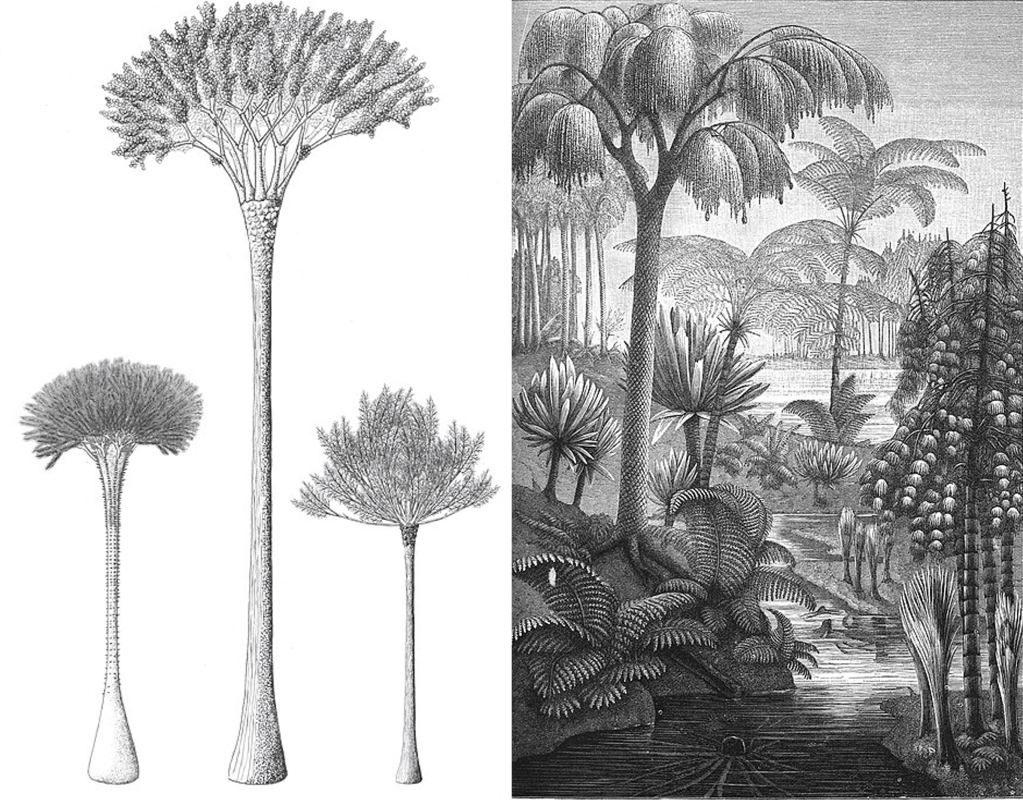
Right: Artistic depiction of a Carboniferous forest. Image from the National Library of Poland (1890)
Although the general shape of a forest has remained the same for the last 350 million years or so, the trees themselves have changed, from the early tree-like plants of the oldest forests to the gymnosperms of more familiar-looking habitats to the angiosperm-dominated forests that we still have today.
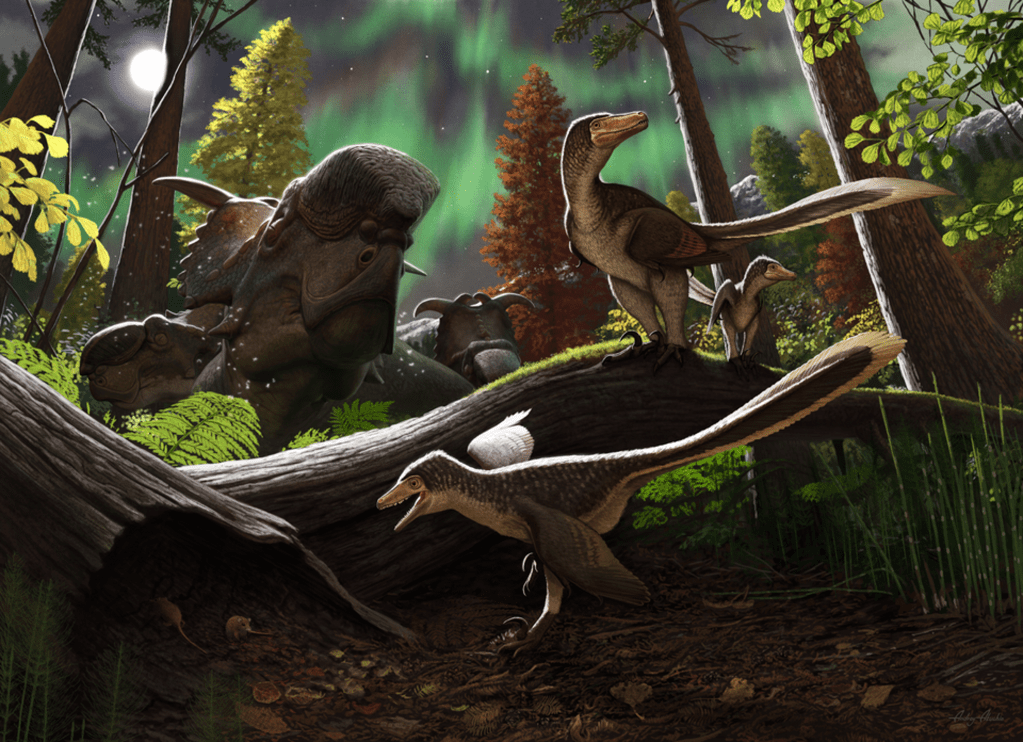
Through time, there have even been forest types that don’t exist today. Before modern tropical rainforests first appeared around 60 million years ago, earlier tropical forests were more open-canopy and with their own distinctive ecosystems. During the warm parts of the Mesozoic Era, dinosaurs and other species lived in polar forests that persisted at higher latitudes than any forest could exist today; exactly how these forest ecosystems functioned is still a bit of a mystery. And modern boreal forests couldn’t exist until the Earth cooled down closer to modern-day temperatures around 30 million years ago.
Learn More
Tropical rainforests and the need for cross-continental comparisons (technical)
Triassic climate and the rise of the dinosaur empire in South America (technical)
Biomes of Earth: Terrestrial, Aquatic, and Human-Dominated (technical)
__
If you enjoyed this topic and want more like it, check out these related episodes:
We also invite you to follow us on Facebook or Instagram, buy merch at our Zazzle store, join our Discord server, or consider supporting us with a one-time PayPal donation or on Patreon to get bonus recordings and other goodies!
Please feel free to contact us with comments, questions, or topic suggestions, and to rate and review us on Spotify or Apple Podcasts!
 The Common Descent Podcast


.jpg)

Leave a comment