

Listen to Episode 230 on Podbean, YouTube, Spotify, or wherever you listen to your favorite podcasts!
Among the famous groups of dinosaurs are the iconic but somehow poorly represented dome-headed species. This episode, we explore the many questions surrounding Pachycephalosaurs.
In the news
Our friends at I Know Dino published a book about dinosaurs!
Studies of alligator legs reveals a link between leg anatomy and body size in giant reptiles
Edmontosaurus “mummies” preserve spines and hooves
The Thick-Headed Dinosaurs
Pachycephalosaurs are a group of bipedal herbivorous dinosaurs from the Cretaceous Period. They range from tiny (only a meter long) to fairly large (4-5 meters long), with relatively simple teeth for a diet of mostly plants, though some evidence suggests these dinosaurs might have been omnivorous. Their most iconic feature is the thickened bone on the top of their skull, often dome-shaped and surrounded by knobs and spikes.

The fossil record of pachycephalosaurs is very patchy, consisting mostly of skull fragments. It was a long time before paleontologists were able to determine that these thick-headed dinosaurs formed a single lineage closely related to the horned ceratopsians. Still today, only about 15 genera are known and there’s a lot we still don’t understand about the diversity and early evolution of this group.

Right: Skull of Prenocephale. Image by Ghedoghedo, CC BY-SA 3.0
Until recently, all definitive pachycephalosaur fossils were known from the Late Cretaceous. The discovery of Zavacephale provided our first glimpse at Early Cretaceous members of the group. In some ways, Zavacephale represents an early stage in pachycephalosaur evolution – for example, its skull dome is formed slightly differently from other species. But in many ways, it is a full-fledged dome-headed dinosaur, leaving open many questions about the early evolution of this lineage.

Image by Eight heads serpent, CC BY 4.0
For many years, dome-headed forms and flat-headed forms were considered to be separate species, but more recent studies have found that this is actually how these dinosaurs changed as they aged. The famous species Dracorex, with its flat head and large skull spikes, has been revealed to be a juvenile Pachycephalosaurus. The species’ skull changed shape dramatically as it grew into an adult, going from flat and spiky to domed and knobbly.

The function of this skull dome has been the subject of much debate and discussion over the decades. The most famous interpretation is that these dinosaurs smashed their heads together like modern goats and sheep. This idea is supported by the physically reinforced structure of the skull, areas for large muscles in the neck, and the presence of injuries in the dome caused by physical trauma, all of which are features these dinosaurs share with modern head-butting mammals.

The details of these dinosaurs’ head-butting behavior are still unclear. The fact that the domes developed dramatically as the dinosaurs reached adulthood suggests they were using their thick heads in a way that related to mating, possibly in head-to-head competition with rivals, as seen in modern goats and sheep. But many questions remain: Was it a seasonal behavior? Was it something only young adults did? Did both sexes butt heads? Did they run up and crash into each other, or was it more of a shoving contest? More research may give us the answers someday.
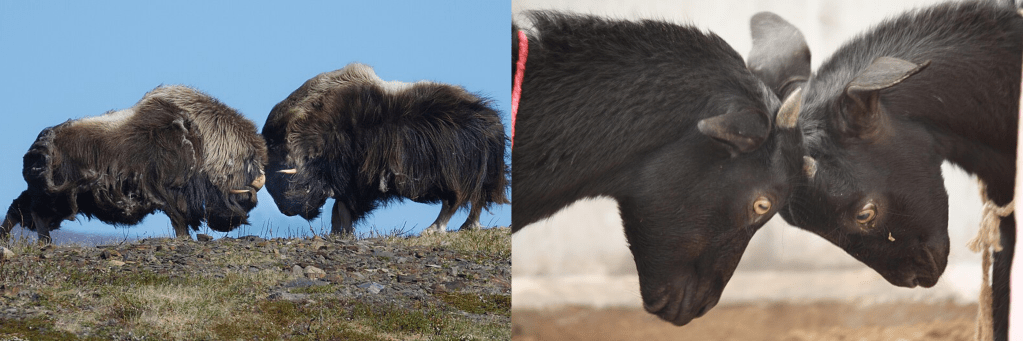
Right: Goats head-butting. Image by Mohanatnow, CC BY-SA 3.0
Learn More
The newly discovered oldest pachycephalosaur, Zavacephale
A Pachycephalosaurus skull with unexpectedly sharp teeth
Lesions in a pachycephalosaur dome (technical, open access)
Head-butting features in pachycephalosaurs and horned mammals (technical, open access)
__
If you enjoyed this topic and want more like it, check out these related episodes:
- Episode 87 – Ceratopsians (Horned Dinosaurs)
- Episode 127 – The Hell Creek Formation
- Episode 140 – Horns and Antlers
We also invite you to follow us on Facebook or Instagram, buy merch at our Zazzle store, join our Discord server, or consider supporting us with a one-time PayPal donation or on Patreon to get bonus recordings and other goodies!
Please feel free to contact us with comments, questions, or topic suggestions, and to rate and review us on Spotify or Apple Podcasts!


 The Common Descent Podcast


Leave a comment