

Listen to Episode 234 on Podbean, YouTube, Spotify, or wherever you listen to your favorite podcasts!
From deep-sea trenches to your home garden, gastropods are among the most diverse and successful animals in Earth history. This episode, we explore the incredible evolutionary story of Snails and Slugs.
In the news
Ants and the evolution of ‘squishability’
A new species of bone-cracking false saber-toothed cat
Ancient bee burrows in cave bones
The first known hatchling ankylosaur
Slime Time
Mollusks are a massive animal group that includes bivalves (clams, oysters, etc.) and cephalopods (octopus, squid, etc.), but the vast majority of living mollusks are gastropods – snails and slugs.
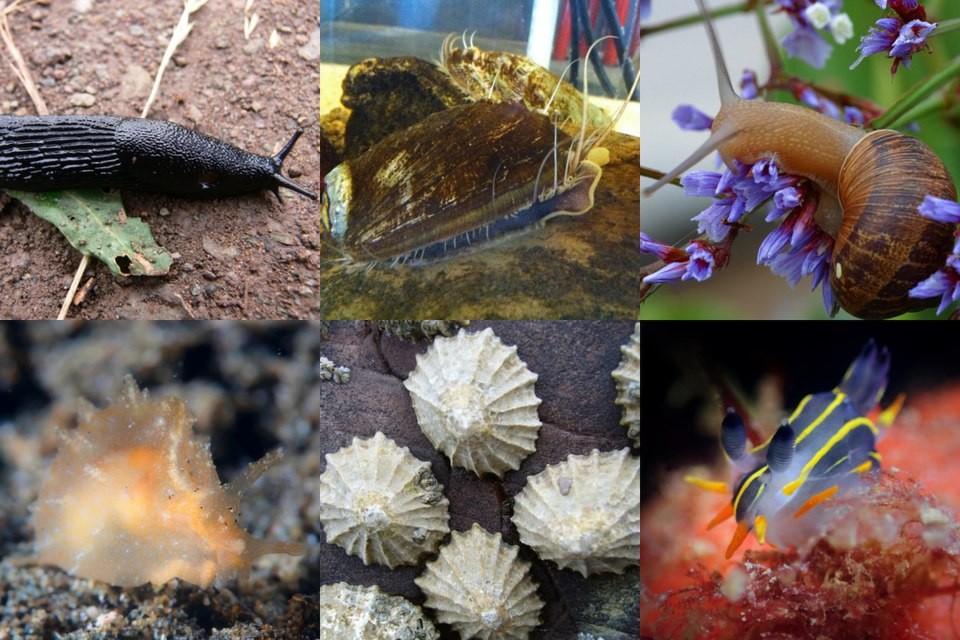
Top row: Black slug (Arion ater), Ass’s-ear abalone (Haliotis asinina), Garden snail (Cornu aspersum)
Bottom row: Indian seahare (Notarchus indicus), Common limpet (Patella vulgata), and the sea slug Polycera aurantiomarginata
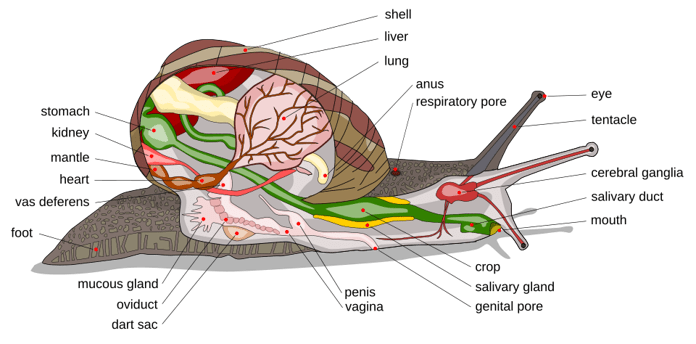
Snails and slugs are found in nearly every habitat on Earth, from the deepest ocean trenches to your backyard (probably). Gastropod anatomy is pretty straightforward: a visceral mass contains most of the internal organs; a head features eyes, sensory tentacles, and a mouth equipped with a tongue-like radula; and a muscular “foot” propels the body along.
Like their fellow mollusks, gastropods also have a mantle organ that secretes a mineralized shell. These shells come in a remarkable variety of shapes, from tightly coiled spirals to flat and clam-like, from smooth and simple to spiky and ornamented. Most snails have shells large enough to retract their entire body inside for safety, but many lineages on land and in the sea have lost their shell – we call these slugs.
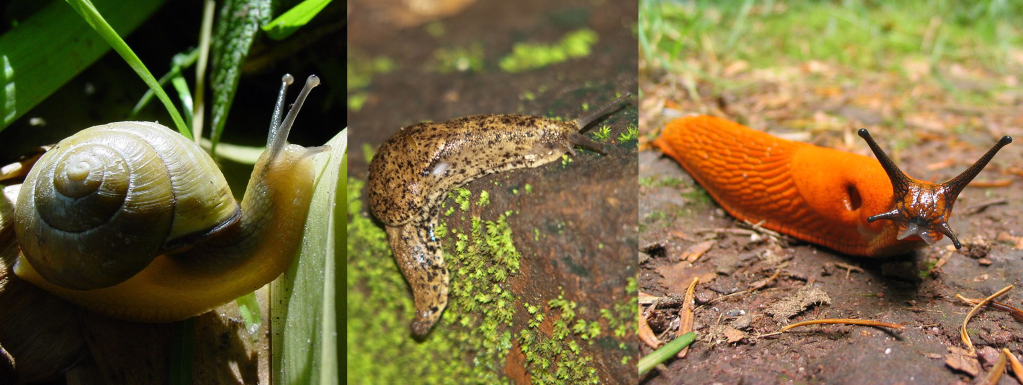
Middle: A semi-slug, with a small but visible shell. Image by Luis Daniel Carbia Cabeza, CC BY 2.0
Right: A European red slug, with no shell. Image by Guillaume Brocker, CC BY-SA 3.0
Most gastropods are aquatic – including the colorful and graceful sea slugs – but many lineages of both snails and slugs have evolved to live on land. Most gastropods eat plants or algae or organic detritus, but some lineages are carnivorous, using their radula to drill into the shells of other mollusks, or – in the famous case of cone snails – spearing prey with their venomous harpoon-shaped radula before devouring it whole.
Gastropods are extremely well-represented in the fossil record. In fact, many landmark studies of how life on Earth has changed over vast timescales have been based on the fossil record of snail shells. Nearly all of these fossils are the mineralized shells of marine snails, while freshwater and terrestrial snail fossils are more rare, and slug fossils are essentially unknown.
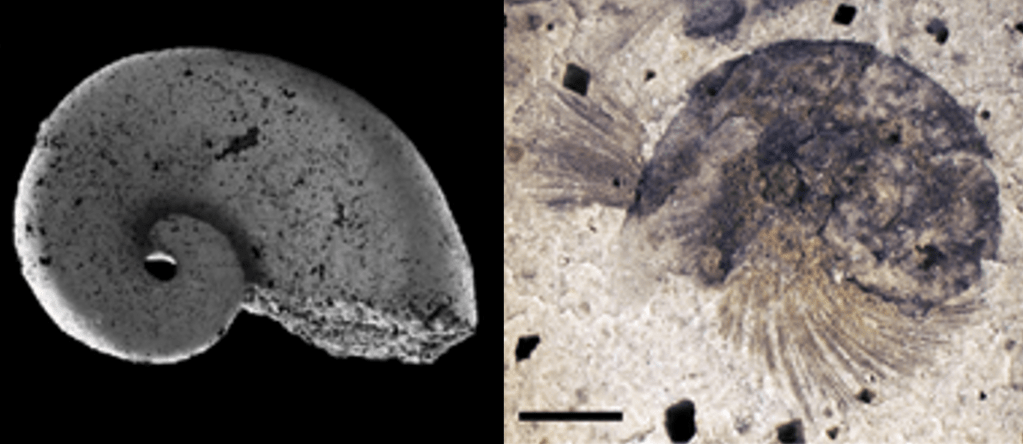
The earliest suspected gastropods in the fossil record come from the Cambrian Period, including the snail-like, spiral-shelled pelagiellids, more than 500 million years old. Throughout the rest of the Paleozoic Era, gastropods diversify into various shapes and sizes, including herbivores, suspension feeders, and possibly carnivores, and – by the Carboniferous Period – freshwater and terrestrial species. Genetic evidence suggests that shell-less species (slugs) had most likely evolved during this Era as well. The transition out of the ocean, and the transition from snail to slug, each seem to have happened many times independently over the long evolutionary history of gastropods.
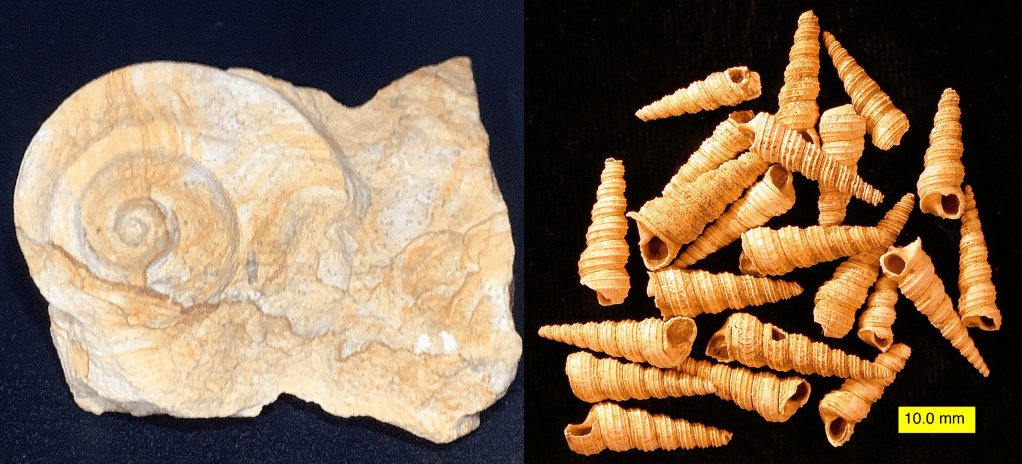
Right: Fossil shells of Turritella from Pliocene Cyprus. Image by Mark Wilson.
Gastropods become much more prominent in the Mesozoic Era. As ocean habitats were transformed by the Mesozoic Marine Revolution, snails were both victims and perpetrators of the diversification of durophagous (hard-food-eating) predators. To this day, gastropods are a major component of nearly every habitat on the planet.
Learn more
Digital Atlas of Ancient Life, Gastropoda
The fossil record of freshwater Gastropoda (technical, open access)
Terrestrialization in gastropods (technical, open access)
The early Cambrian stem gastropod Pelagiella (technical, open access)
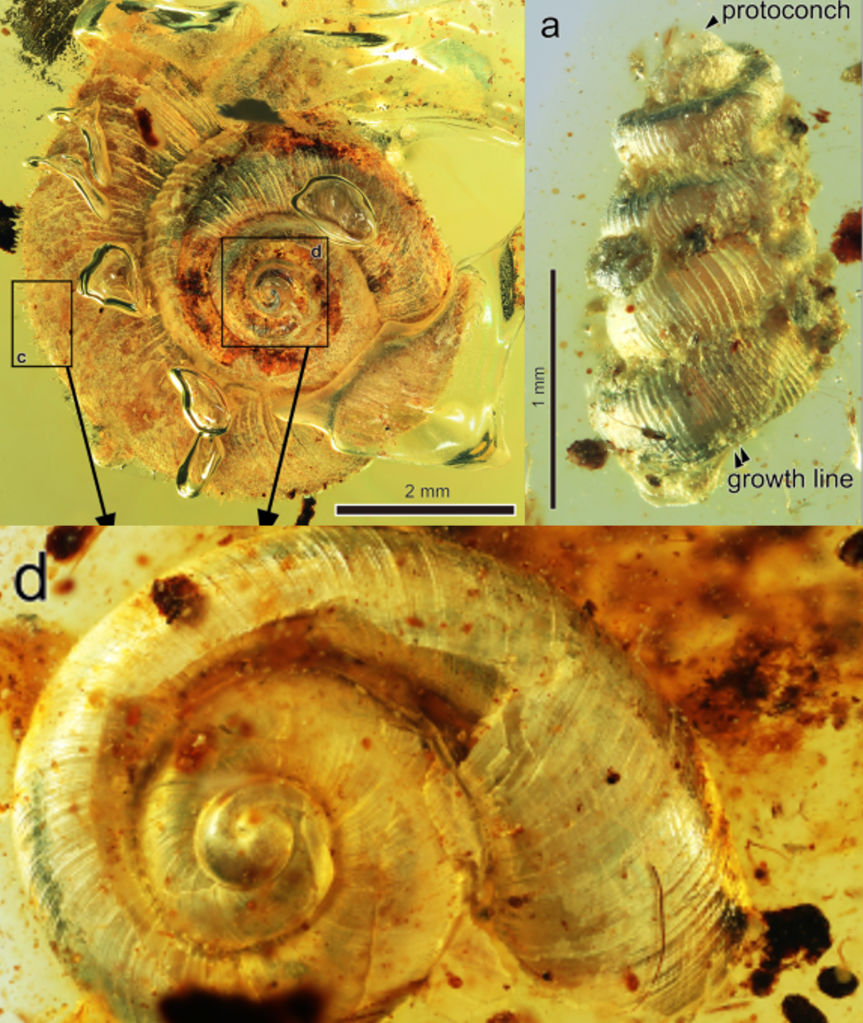
Land snails in Cretaceous amber (technical, open access)
__
If you enjoyed this topic and want more like it, check out these related episodes:
- Episode 16 – Cephalopods
- Episode 174 – The Mesozoic Marine Revolution
- Episode 197 – Durophagy (Eating Hard Stuff)
We also invite you to follow us on Facebook or Instagram, buy merch at our Zazzle store, join our Discord server, or consider supporting us with a one-time PayPal donation or on Patreon to get bonus recordings and other goodies!
Please feel free to contact us with comments, questions, or topic suggestions, and to rate and review us on Spotify or Apple Podcasts!
 The Common Descent Podcast


Leave a comment