
Listen to Episode 238 on Podbean, YouTube, Spotify, or wherever you listen to your favorite podcasts!
Some bones are only skin deep, serving as armor, support, or any number of other important functions. This episode, we discuss the diverse shapes and services of Osteoderms.
In the news
Skin impressions provide the oldest known look at reptile scales
New species of Cretaceous dinosaur was covered in spiny quills
This poor Edmonotosaurus got bit on the face by a tyrannosaur
Hundreds of case studies reveal patterns in snake cannibalism
Body Armor
Osteoderms are bones that grow within the skin, separate from the typical bones of the skeleton. These are found in a wide variety of living and extinct vertebrates, including amphibians, mammals, and lots of reptiles.
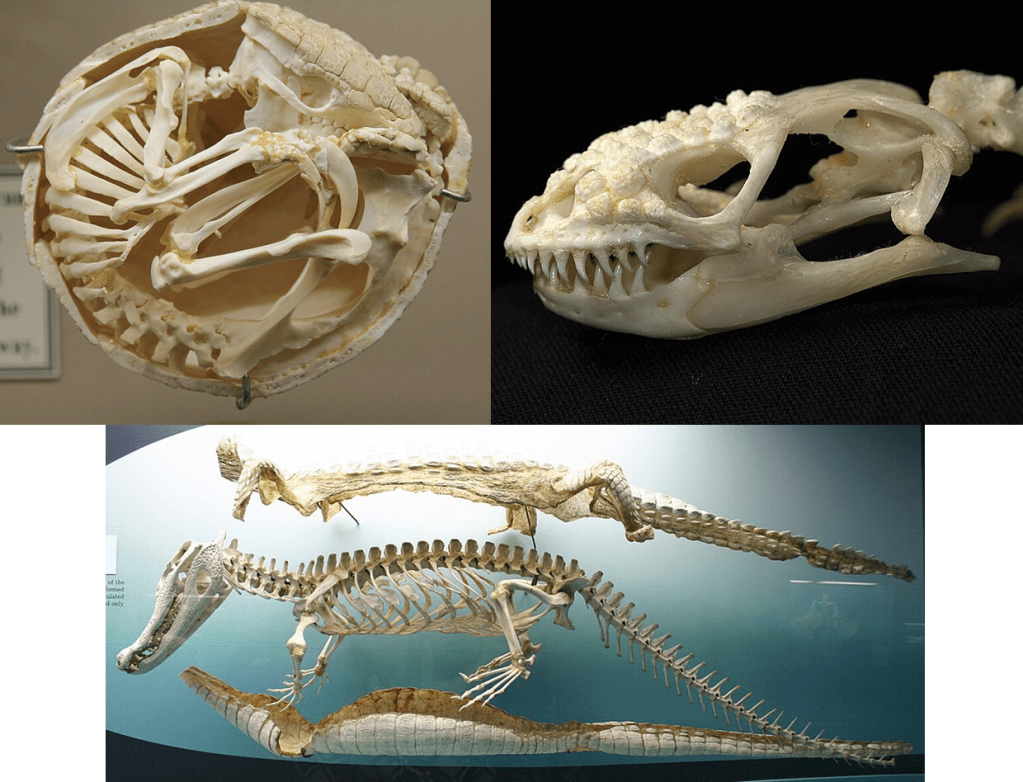
Top right: Skull of a beaded lizard, showing a coating of osteoderms. Image by MonsterDoc, CC BY-SA 4.0
Bottom: Caiman skeleton with bony armor suspended above and below. Image by Ryan Somma, CC BY-SA 2.0
Osteoderms are extraordinarily variable, coming in a huge range of sizes, shapes, and internal anatomy. Some species, like crocodiles and ankylosaurs, are covered in nearly full-body coatings of osteoderms, while others have them only on certain parts of the body. In some species, like many lizards, the osteoderms are barely visible, and in others, like armadillos, they form a full carapace.
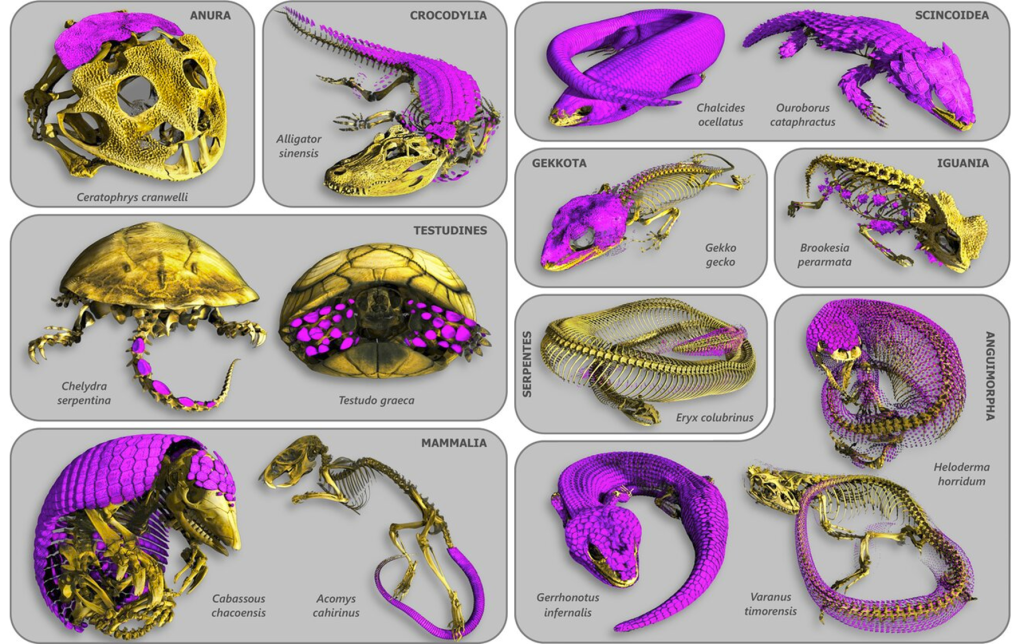
Scientists continue to discover osteoderms in new places. Only in the past few years have researchers published the first descriptions of osteoderms in living snakes and spiny mice, as well as several species of monitor lizards. Small osteoderms can be very easy to overlook.
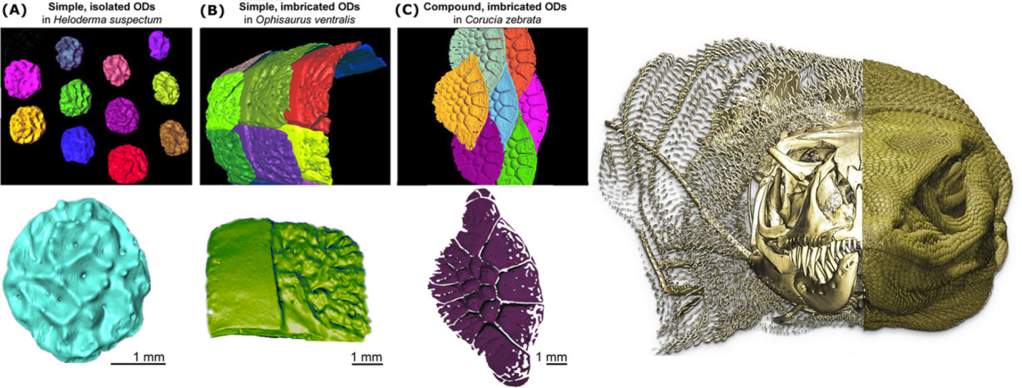
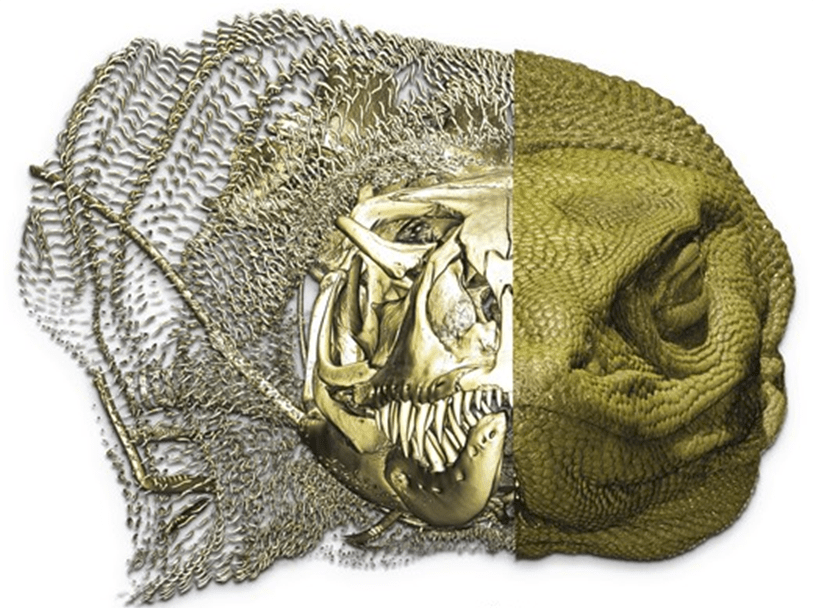
Right: Model of a monitor lizard head, showing the distribution of small worm-like osteoderms. Image from Ebel et al 2026
Among living and extinct species, osteoderms have been identified on numerous distantly-related branches of the animal family tree. Researchers estimate that osteoderms have evolved independently over two dozen times, mostly within reptiles. But all of these osteoderms have a similar composition and embryological origin, suggesting they’re built upon a physiological foundation that is shared across all tetrapods.
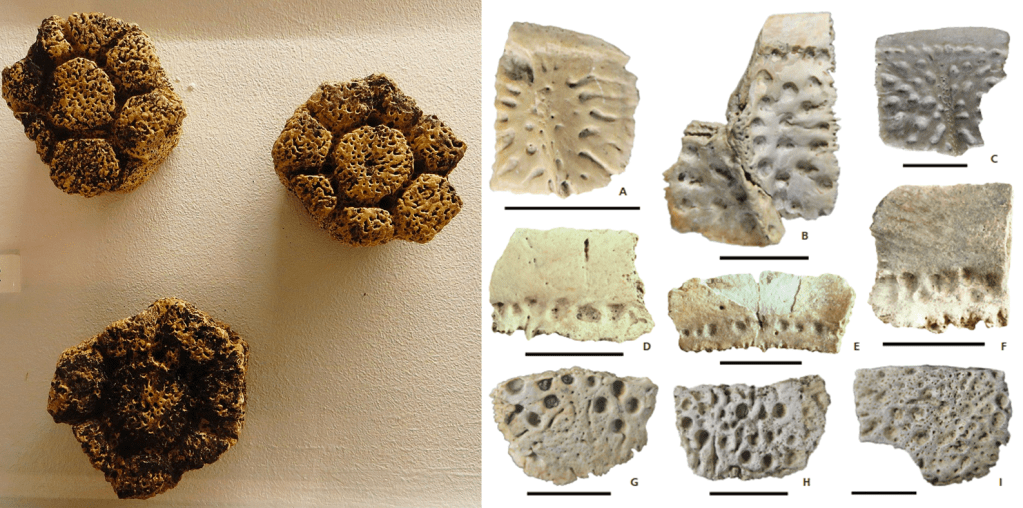
Right: Individual fossil osteoderms of the alligator Diplocynodon. Image from Chroust et al 2021
Many, many scientific papers have been written about the possible functions of osteoderms. In some cases, like armadillos and ankylosaurs, it seems pretty clear that these skin bones serve as defensive armor. But some osteoderms, like the giant spikes and plates of ankylosaurs and stegosaurs, might have been too flimsy for defense, and instead were possibly used for display. Some evidence suggests that crocodilians use their osteoderms to help absorb heat from the sun and to act as storage for calcium that they use to build their eggs, functions that have also been hypothesized for some extinct species. In the earliest land-dwelling vertebrates, osteoderms might have helped to brace and support the muscles of the body as these animals adapted to moving around on land.
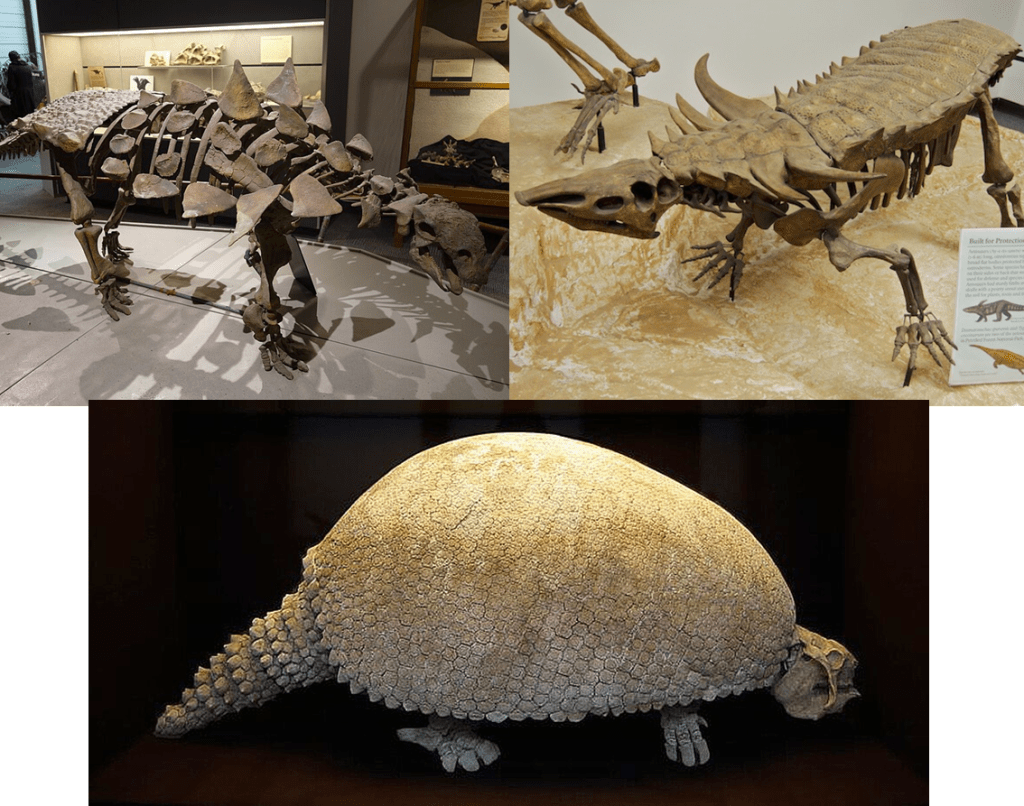
Top right: The early crocodylomorph Desmatosuchus. Image by Sam Wise, CC BY-NC-SA 2.0
Bottom: The ancient armadillo-cousin Glyptodon. Image by WolfmanSF, CC BY-SA 3.0
Learn More
Overview of osteoderm functions and research (technical, open-access)
Review of lizard osteoderms (technical, open-access)
Osteoderms in snakes (technical, open-access)
Survey of crocodylomorph osteoderms (technical, open-access)
Spiny mouse osteoderms (technical, open-access)
Ankylosaur armor (technical, open-access)
Sauropod armor (technical, open-access)
Lizard osteoderm evolution (article, paper)
__
If you enjoyed this topic and want more like it, check out these related episodes:
We also invite you to follow us on Facebook or Instagram, buy merch at our Zazzle store, join our Discord server, or consider supporting us with a one-time PayPal donation or on Patreon to get bonus recordings and other goodies!
Please feel free to contact us with comments, questions, or topic suggestions, and to rate and review us on Spotify or Apple Podcasts!
 The Common Descent Podcast


Leave a comment