
Listen to Episode 239 on Podbean, YouTube, Spotify, or wherever you listen to your favorite podcasts!
Many animals are active outside of daylight hours. This episode, we explore the adaptations and evolutionary trends that support a diversity of Nocturnality.
In the news
Missing hormones are key to snakes’ feeding-fasting lifestyle
Surprising diversity of early Australian amphibians
Oxygen-loving archea and the rise of eukaryotes
Tiny dome-headed dinosaur is the first known baby of the group
Creatures of the Night
Most modern animals are diurnal, meaning they’re mainly active during daylight hours. But many species are very successful during darkness (nocturnal), twilight (crepuscular), or even without a preference (cathemeral).
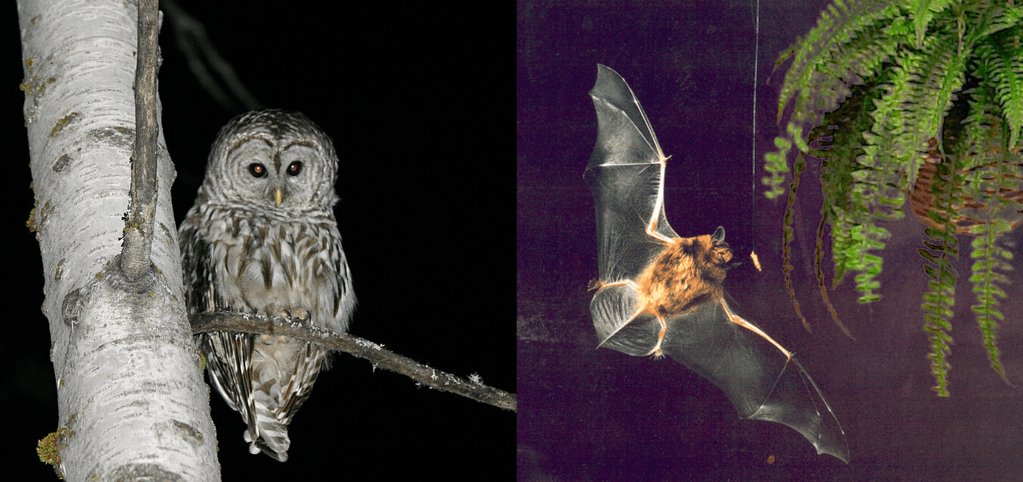
Right: Bat flying at night. Image from Chut 2006
Being active at night can be a useful way to avoid competition or dangers from predators and other animals which are awake during the day. For species living in particularly hot environments, like deserts, nocturnality can be an essential strategy for avoiding the heat of the sun.
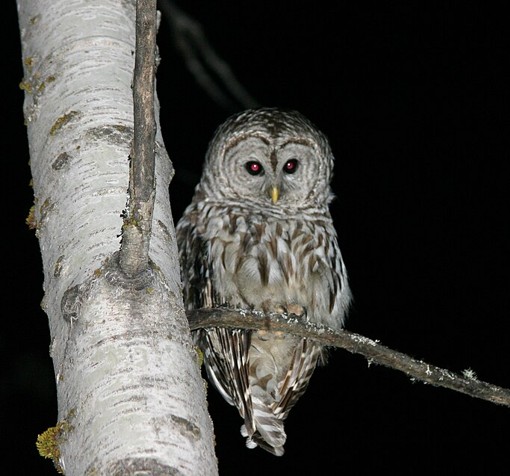
The main drawback of being nocturnal is the lack of light and thus the difficulty of seeing your surroundings. Many nocturnal species have especially strong senses of hearing, smell, or tactile sense (as with whiskers), while others have simply super-powered their eyes. Nocturnal species often have wide pupils that take in as much light as possible, and some have reduced their color-sensing eye cells in favor of even more light-sensing cells. And many famously have developed a reflective layer in the eye called the tapetum lucidum, which reflects light, giving their retinas a double-dose of light and making them look positively alien in photographs.

Identifying nocturnal habits in the fossil record is very tricky, but some studies have found support in the form of brain endocasts – the shape of the brain as recorded by the shape of the skull can provide insights into which sensory regions were expanded in extinct animals – and in the shape of the eye bones. Specifically, some research has inferred nocturnal habits for extinct species based on the relationship between the size and shape of the eye socket and the sclerotic ring, which is a bony scaffold that supports the eyeball in some species.
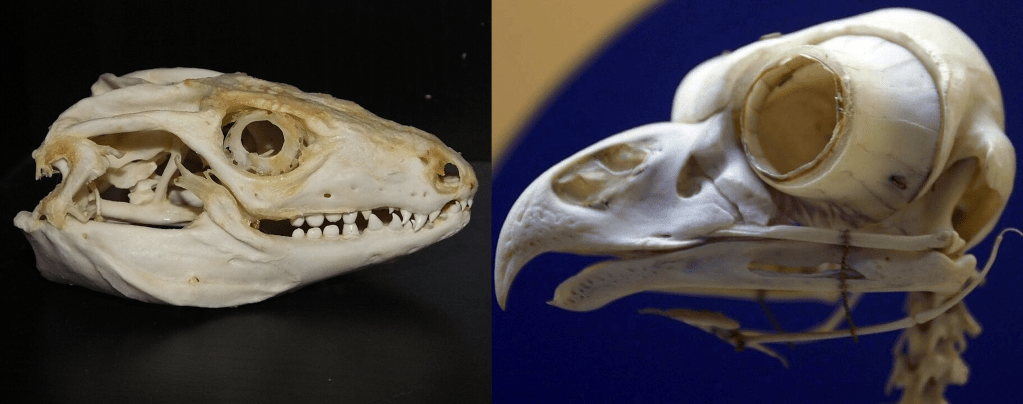
Left: Skull of a red tegu. Image by HCA, CC BY-SA 4.0
Right: Skull of a great horned owl. Image by David Stang, CC BY-SA 4.0
Mammals are especially good at being nocturnal. In fact, a majority of living mammals are active outside of daylight hours. Nocturnal habits have been inferred for mammalian ancestors as far back as 300 million years, and there is evidence to suggest that mammals spent all or most of the Mesozoic Era being largely nocturnal, leaving a whole host of nighttime adaptations as common traits across modern species, even diurnal ones – mammals’ universally reduced color vision being a notable example. This is known as the Nocturnal Bottleneck Hypothesis.
Learn more
The overlooked diversity of nocturnal pollinators (technical, open access)
Nocturnal-diurnal arms race in mammalian prey and predators (technical, open access)
Nocturnal features in extinct elephant birds (technical, open access)
Nocturnal features in Mesozoic dinosaurs (technical, paywall)
The nocturnal bottleneck and the evolution of activity patterns in mammals (technical, open access)
Eye shape and the nocturnal bottleneck of mammals (technical, open access)
__
If you enjoyed this topic and want more like it, check out these related episodes:
We also invite you to follow us on Facebook or Instagram, buy merch at our Zazzle store, join our Discord server, or consider supporting us with a one-time PayPal donation or on Patreon to get bonus recordings and other goodies!
Please feel free to contact us with comments, questions, or topic suggestions, and to rate and review us on Spotify or Apple Podcasts!
 The Common Descent Podcast


Leave a comment