
Listen to Episode 166 on PodBean, YouTube, Spotify, or wherever you listen to your favorite podcasts!
You’ll only find them living in Australia and New Guinea, and when you do, you might be surprised at the strange features that set them apart from all other mammals, like the fact that their babies hatch from eggs. This episode, we discuss the unique features and puzzling evolution of Monotremes.
In the news
New mosasaur has strange many-ridged teeth
Tibetan sabertooth cats adapted to open environments
Growth patterns of giant tree-climbing marsupials
Scant remains hint at a giant pliosaur from England
The Weirdest Mammals?
There are three major groups of mammals in our modern world: placental mammals, which include nearly all of us; marsupials, a smaller group of mammals that carry their young in pouches; and finally, the very rare, egg-laying monotremes.

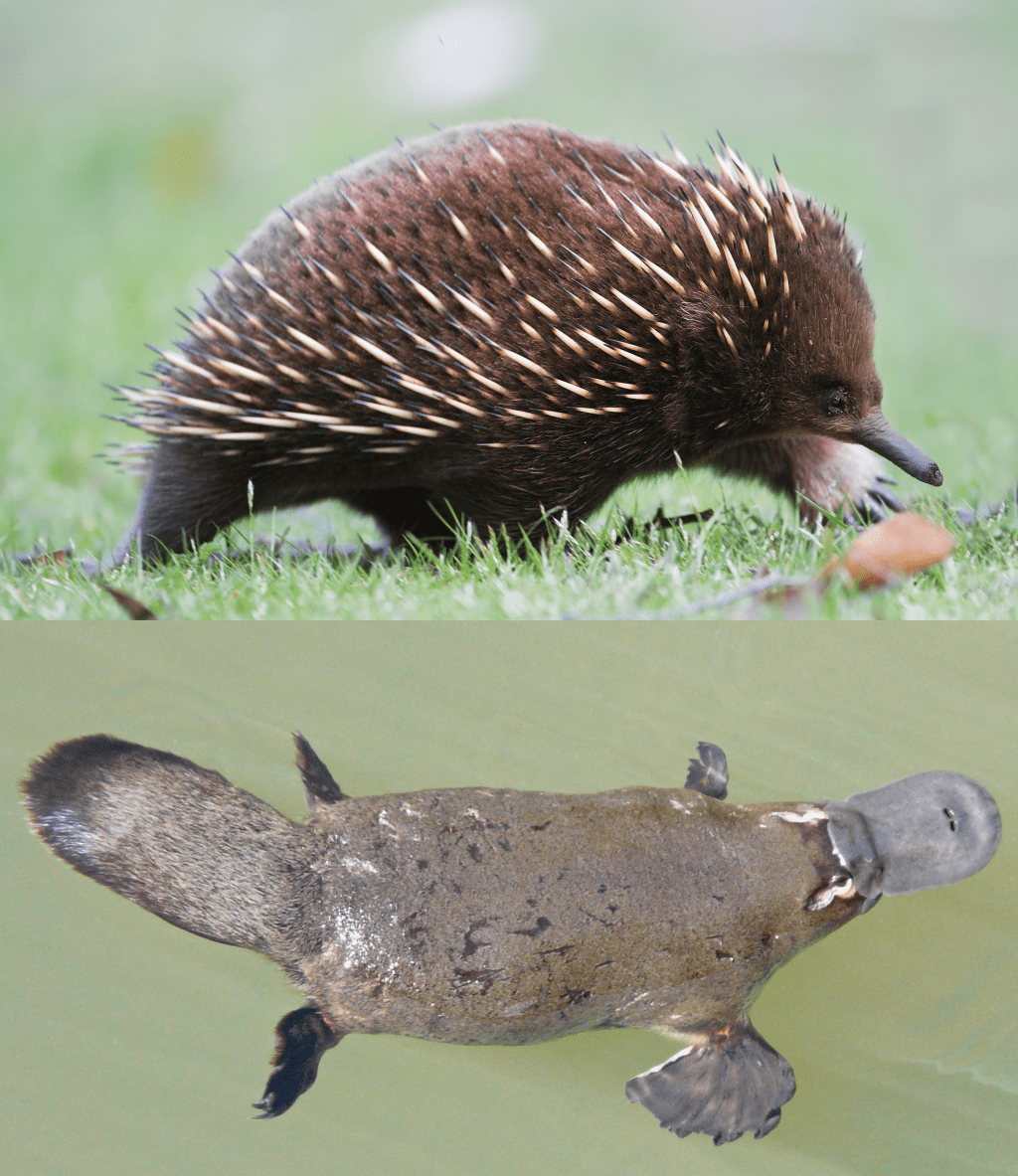
Top: Short-beaked echidna. Image by JJ Harrison, CC BY-SA 3.0
Bottom: Platypus. Image by Brisbane City Council, CC BY 2.0
There are only five living species of monotremes: echidnas are found in Australia and New Guinea in both short-beaked and long-beaked varieties, while the single species of platypus lives only in Australia. Monotremes share many features that they seem to have in common with ancestral mammals, including their lack of external ears, their lack of nipples (though they do produce milk), and their famous habit of laying eggs. On the other hand, living monotremes also share certain features that might be more recent specializations, such as their electroreceptive organs, their lack of adult teeth, and their highly unusual skulls.
It can be difficult to determine which monotreme features are ancient holdovers and which are specially-evolved adaptations of modern lineages.

Bottom: Skeleton of a platypus. Image by Peter Halasz, CC BY-SA 2.5
Notice the powerfully-built forelimbs and the strange skulls!
Ancient Monotremes
The earliest monotremes likely evolved during the Jurassic Period, over 150 million years ago. Whether these early monotremes were echidna-like or platypus-like or unlike either living group is unclear. It’s also unclear which group of ancient mammals were the closest relatives of early monotremes.
The monotreme fossil record is sparse, with only a short list of identified species mostly known from teeth and jaw fragments. Monotreme fossils nearly all come from Australia and New Guinea, with two extinct species known from South America.

Top: Artist’s reconstruction of Murrayglossus, a giant echidna from the Pleistocene of Australia with weight estimated at 30kg (66lbs). Image by Alex Uchytel, CC BY-SA 4.0
Bottom: Skull of Obdurodon, a platypus-like monotreme from the Oligocene and Miocene of Australia. Image by Skye McDavid, CC BY-SA 4.0
Monotremes are often studied by scientists trying to learn more about early mammal evolution. Since monotremes retain certain traits of early mammals, they can help us to understand such evolutionary trends as the loss of teeth, the development of milk glands, and the transition from egg-laying to live birth. But it’s important to remember that our living monotremes are highly specialized animals in their own right, not just relics of the distant past, so it would be incorrect to think of them as simple evolutionary leftovers.

Image by Ian Sutton, CC BY-NC-SA 2.0
Learn More
Recent news: Patagorhynchus, a fossil monotreme from South America, 2023
A review of monotreme evolution, 2022 (technical, open access)
Genetic evolution of monotremes, 2021 (technical, open access)
The platypus: evolutionary history, biology, and an uncertain future, 2019 (technical, open access)
__
If you enjoyed this topic and want more like it, check out these related episodes:
- Episode 47 – Early Synapsids (“Proto-Mammals”)
- Episode 50 – Australia
- Episode 92 – Eggs
- Episode 96 – Marsupials
We also invite you to follow us on Twitter, Facebook, or Instagram, buy merch at our Zazzle store, join our Discord server, or consider supporting us with a one-time PayPal donation or on Patreon to get bonus recordings and other goodies!
Please feel free to contact us with comments, questions, or topic suggestions, and to rate and review us on iTunes
 The Common Descent Podcast
Leave a comment