

Listen to Episode 176 on PodBean, YouTube, Spotify, or wherever you listen to your favorite podcasts!
They’re sometimes called “duckbills” or the “cows of the Cretaceous,” and they were among the most successful and social of dinosaurs. This episode, we discuss the evolution, diversity, and unique features of Hadrosaurs.
In the news
Analysis finds fluorescence is surprisingly common in mammals
The first known ancient snake trackway reported from southern Africa
Carboniferous leaves show the earliest known signs of leaf-mining
The first known terror bird footprints show two-toed walking
The “Duckbill” Dinosaurs
Hadrosaurs are famous for being among the most abundant and diverse dinosaurs of the Late Cretaceous. They belong to a broader group called ornithopods, which were quite diverse even outside of hadrosaurs themselves. Living all over the world throughout the Cretaceous Period and even earlier, ornithopods, and especially hadrosaurs, were some of the most successful herbivores of all time.
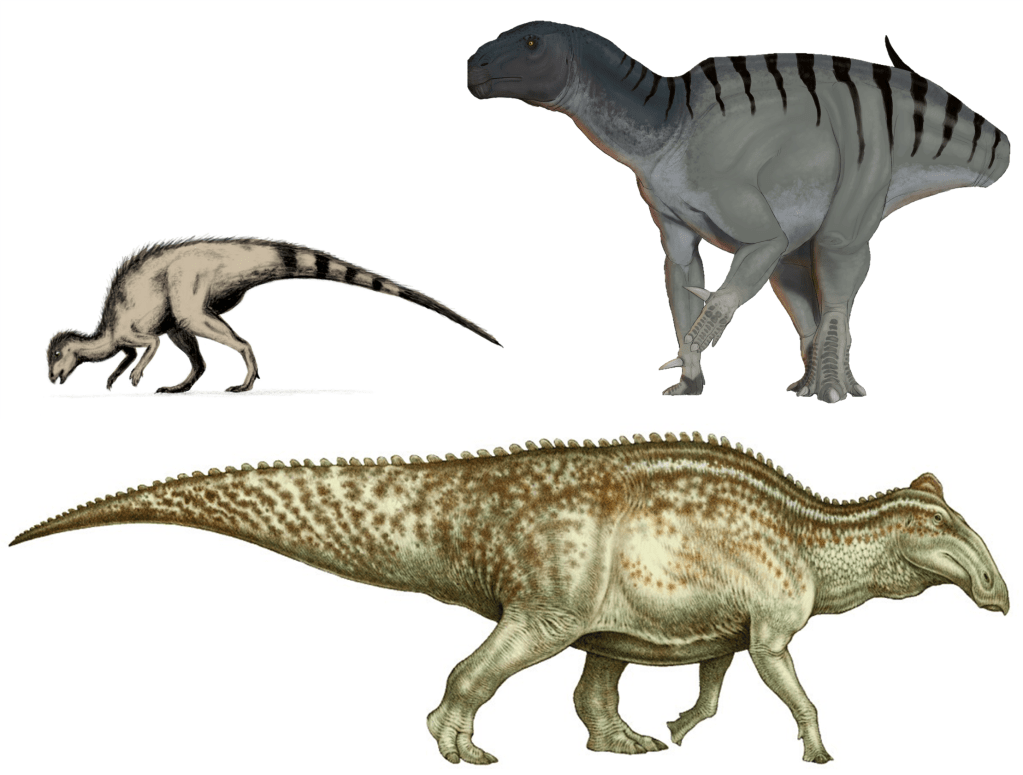
Top left: Hypsilophodon, an early branch of ornithopods. Image by Nobu Tamura, CC BY-SA 3.0
Top right: Iguanodon, an iguanodontian ornithopod. Image by Caz41985, CC BY-SA 4.0
Bottom: Edmontosaurus, a hadrosaur. Image by Natee Puttapipat, CC BY 4.0
Early ornithopods were relatively small, bipedal herbivores with narrow mouths. Over time, new lineages developed larger body sizes, more quadrupedal stances, and more complex teeth and jaws. Hadrosaurs emerged in the Late Cretaceous, evolving flared snouts (hence the name “duckbill,” though they didn’t actually have duck-like bills), dense batteries of teeth in their jaws, and in some cases, elaborate head crests.

Image by Nobu Tamura, CC BY-SA 3.0
Hadrosaurs have an incredibly rich fossil record, including many examples of complete skeletons, bonebeds, trace fossils, skin impressions, full growth series, and more. This wealth of evidence has allowed paleontologists to learn amazing details about these dinosaurs’ social lives. Some species are known to have lived in herds, and others are known to have nested in colonies and taken great care of their newborn offspring.

Perhaps the most incredible feature of hadrosaurs can be found in their jaws. They had dozens of small teeth that formed large tooth batteries whose chewing surfaces constantly replenished as they wore down. Between their complex teeth, their dense tooth batteries, and their flexible jaws, hadrosaurs had perhaps the most advanced chewing apparatus of any vertebrates (sorry, mammals!).
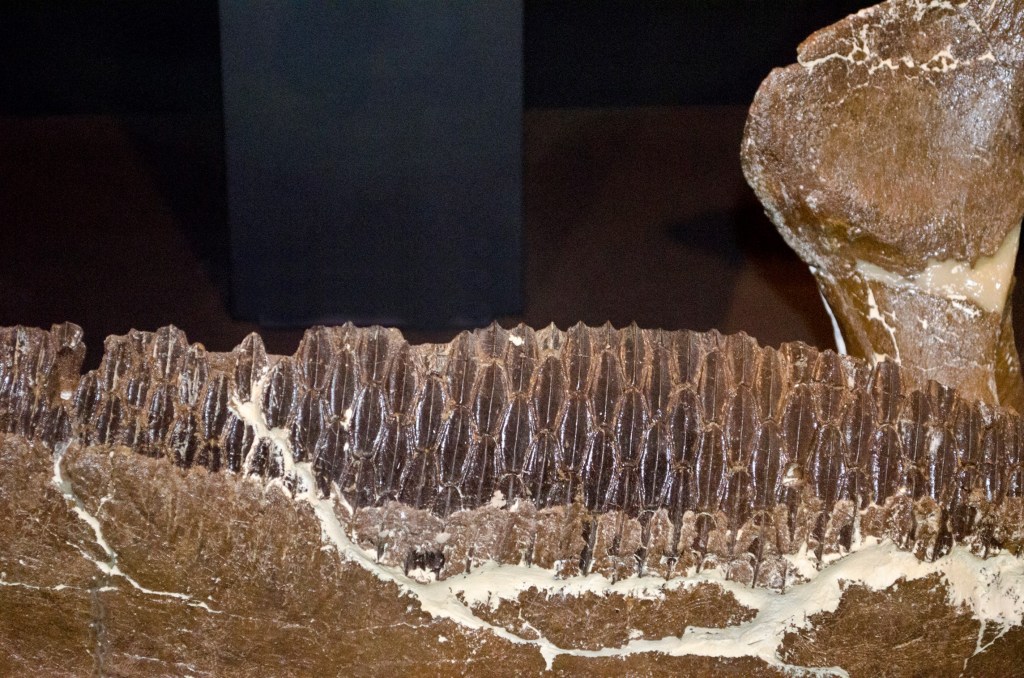
Image by Tim Evanson, CC BY-SA 2.0
On group of hadrosaurs – the lambeosaurines – sported ornate head crests. These crests were almost certainly used for visual display, but they also had extensive and often convoluted nasal passages running through them. There have been many hypotheses to explain these unique structures, but the most prominent one is that they served as resonating chambers to amplify sounds that these animals made.

Top left: Lambeosaurus. Image by Ryan Somma, CC BY-SA 2.0
Top right: Corythosaurus. Image by Christophe Hendrickx, CC BY-SA 3.0
Bottom: Parasaurolophus. Image by Zissoudisctrucker, CC BY-SA 4.0
Learn more
GEOL 104 Dinosaurs: A Natural History – Ornithopods
Leonardo: the famous hadrosaur “mummy”
“Duckbills” weren’t duck-billed
Maiasaura, a model organism for extinct vertebrate population biology
Skull anatomy and crest function of hadrosaurs (technical, open access)
Function and evolution of hadrosaur dental battery (technical, open access)
Non-technical article about this study
VIDEO: Visualizing hadrosaur chewing mechanisms
VIDEO: Nasal chambers within Corythosaurus skull
__
If you enjoyed this topic and want more like it, check out these related episodes:
- Episode 21 – Dinosaurs, an Introduction
- Episode 52 – Sounds of the Past (Fossil Bioacoustics)
- Episode 88 – The Evolution of Teeth
We also invite you to follow us on Twitter, Facebook, or Instagram, buy merch at our Zazzle store, join our Discord server, or consider supporting us with a one-time PayPal donation or on Patreon to get bonus recordings and other goodies!
Please feel free to contact us with comments, questions, or topic suggestions, and to rate and review us on iTunes.
 The Common Descent Podcast


Leave a comment