
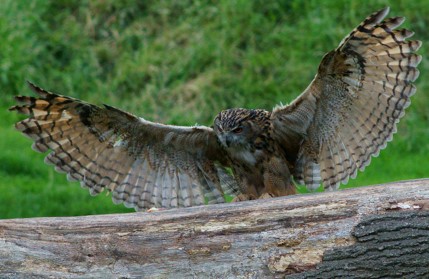
Listen to Episode 186 on PodBean, YouTube, Spotify, or wherever you listen to your favorite podcasts!
They’re among the world’s most recognizable and charismatic birds, and they’ve evolved to become some of the most effective aerial predators on Earth. This episode, we discuss the diversity and evolution of Owls.
In the news
New insights into the rapid and expansive evolution of snakes
Exceptional fossil site reveals polar life from the Ordovician
New method allows better understanding of dinosaur joint movements
Research compares the teeth of Komodo dragons and theropod dinosaurs
Who?
Owls are, in many respects, among the most successful birds in the world. They are found in nearly every habitat on Earth; they are extremely efficient predators hunting a wide range of prey; they come in a diversity of sizes from enormous eagle-owls to tiny elf owls; and on top of all that, they’re familiar and charismatic enough to be regularly featured in human cultural stories across millennia.

Top right: Burrowing owl. Image by Dario Sanches, CC BY-SA 2.0
Bottom left: Elf owl. Image by BBODO, CC BY 3.0
Bottom right: Great grey owl. Image by jok2000, CC BY-SA 3.0
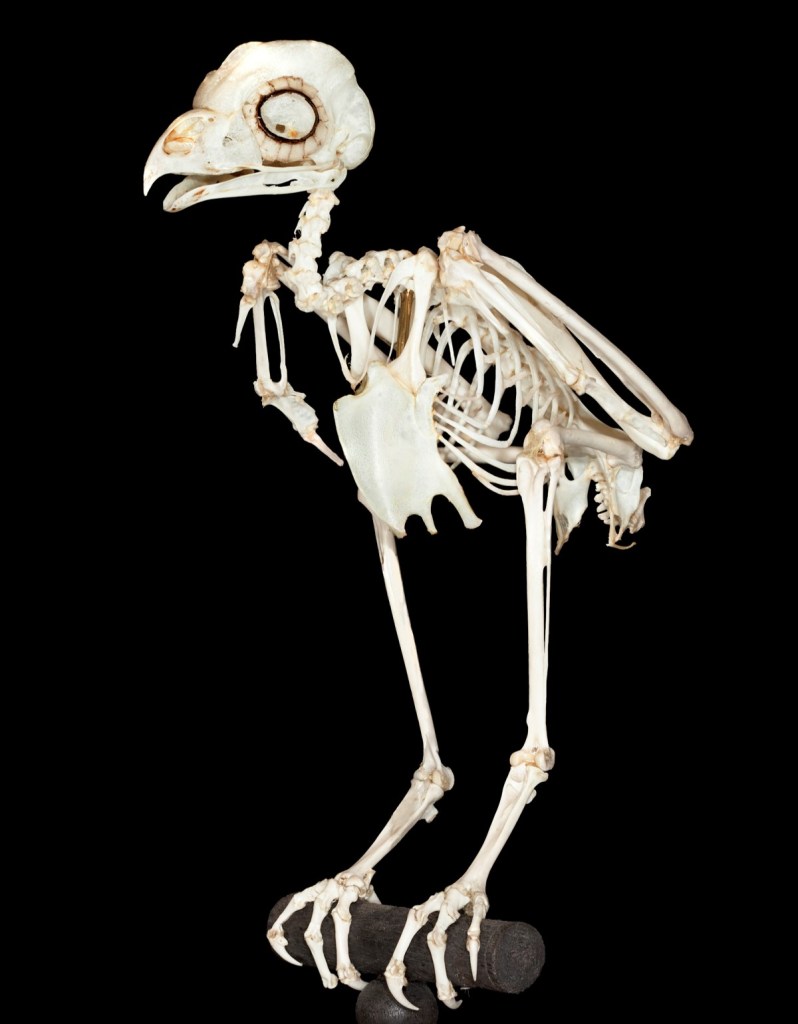
Owls are predators, typically hunting on the wing, and from top to bottom they are superbly adapted hunters in day or night. Owls have excellent vision and hearing supported by a suite of unique adaptations, and they are famously stealthy flyers with feathers whose structure allows them to cut through the air in near-complete silence. Owls also have very mobile necks, which allows them to point their incredible eyes in nearly any direction, and very mobile toes which make them adept at walking, perching, and grasping.

Right: Close-up of owl feathers showing off the “fluting” that reduces noise when these feathers cut through the air. Image by Snowyowls, CC BY-SA 2.5
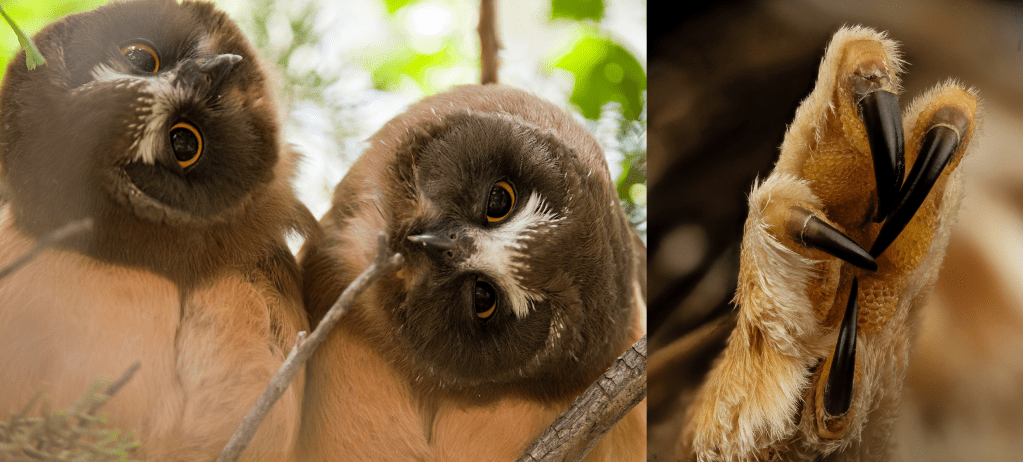
Right: The talons of an owl, displaying the very mobile second toe that can switch between facing forward (good for walking) or backward (good for gripping). Image by USGS Bee Inventory and Monitoring Lab, PDM 1.0
The owl fossil record goes back around 60 million years, making them one of the oldest modern lineages of birds. Most owl fossils are fragmentary, typically only foot bones, leaving us with lots of questions about the evolution of many of their unique skeletal adaptations, although these fossils do allow paleontologists to track adaptations of those mobile talons, a feature which seems to have evolved multiple times.
Some of the earliest known owls have a lot in common with modern-day hawks and eagles, and they were likely daytime hunters. There are also many examples, especially from the Pleistocene, of island owls growing to large sizes, including the flightless (or nearly-flightless) giant Cuban owls.
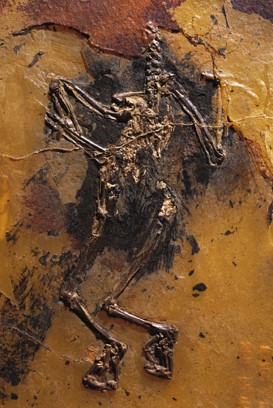
Image by Dieter Stefan Peters, CC BY-SA 4.0
Of course, owls are also famous for what they leave behind! Like many birds, owls regurgitate pellets containing undigestible parts of their food. Owl pellets are particularly rich in bones, especially those of small animals that they swallow whole. This habit makes owls excellent bioaccumulators, collecting skeletal remains of small animals and depositing them in convenient capsules. Owl pellets are useful for biologists (and students!) to study modern ecosystems, and they’re also a great tool for archaeologists and paleontologists, as preserved owl pellets can provide an excellent sampling of an ancient ecosystem.

Learn More
Videos:
How Does An Owl Fly So Silently? BBC
The Unbelievable Flight of a Barn Owl, BBC
How Does an Owl’s Hearing Work? BBC
And here’s the video we mentioned of the owl grabbing a hawk from a roost. WARNING this video is just a bit violent.
Some exceptional fossil owls:
Owl discovered that hunted like a hawk 55 million years ago
An Early Eocene diurnal owl (technical, open access)
Extinct giant owls from Cuba (technical, open access)
Evolution and Ecology of Silent Flight in Owls and Other Flying Vertebrates (technical, open access)
__
If you enjoyed this topic and want more like it, check out these related episodes:
We also invite you to follow us on Twitter, Facebook, or Instagram, buy merch at our Zazzle store, join our Discord server, or consider supporting us with a one-time PayPal donation or on Patreon to get bonus recordings and other goodies!
Please feel free to contact us with comments, questions, or topic suggestions, and to rate and review us on iTunes.
 The Common Descent Podcast


Leave a comment