
Listen to Episode 191 on PodBean, YouTube, Spotify, or wherever you listen to your favorite podcasts!
We humans have a complex and possibly unique form of communication that has been integral to the development of our culture and society. This episode, we discuss the details and deep history of Language.
In the news
Orangutan observed using medicinal plants on a wound
Fossil frogs reveal new insights into fossilization at Geiseltal
Exceptional new fossils of the giant Cretaceous shark Ptychodus
Researchers describe a new species of semi-soft dinosaur egg
Let’s Talk About It
Language is a complex form of communication which might – depending on your definition – be unique to humans. There are thousands of human languages, written and spoken and signed, which all share general features such as grammatical structures. Our language ability is what allows us to perform such communication super-feats as sharing original ideas or discussing far-off events and objects.

Many animal species exhibit complex forms of communication, and some share certain features with human language. Certain other primates, for example, have a variety of vocal calls that communicate specific concepts. And there are a number of famous individual primates whom humans have taught to communicate using signs or symbols, such as Kanzi the bonobo.
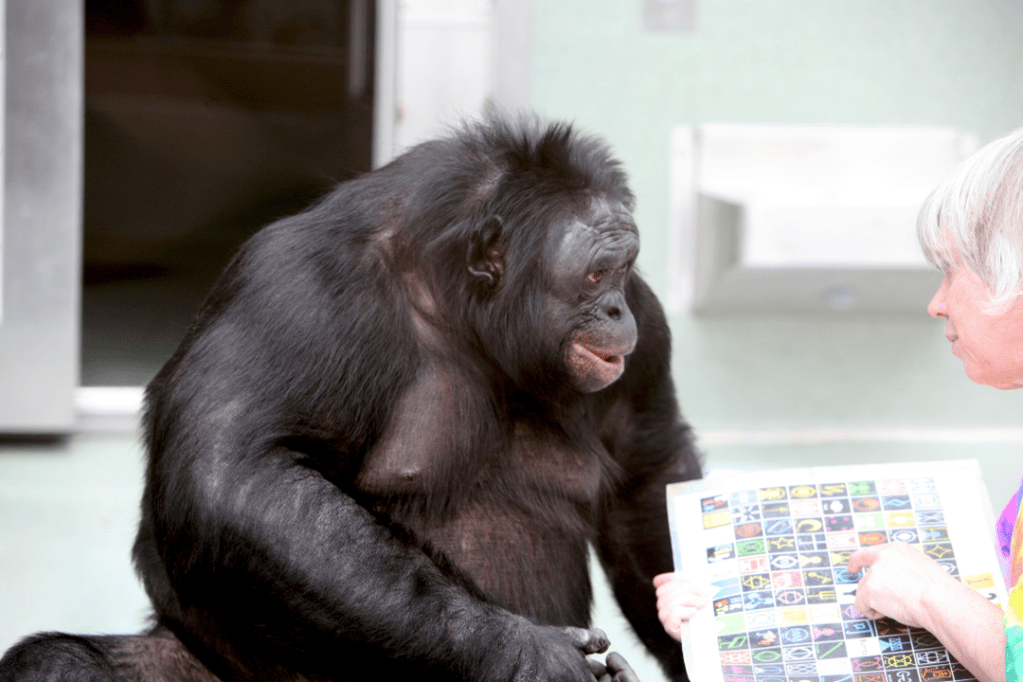
Image by William H. Calvin, PhD, CC BY-SA 4.0
Like living populations, language changes and diversifies over time. The tools and terminology used by linguistics researchers are surprisingly similar to those in evolutionary biology; historical linguistics is concerned with how languages are related to one another, how new languages emerge from old ones, and how languages go extinct.
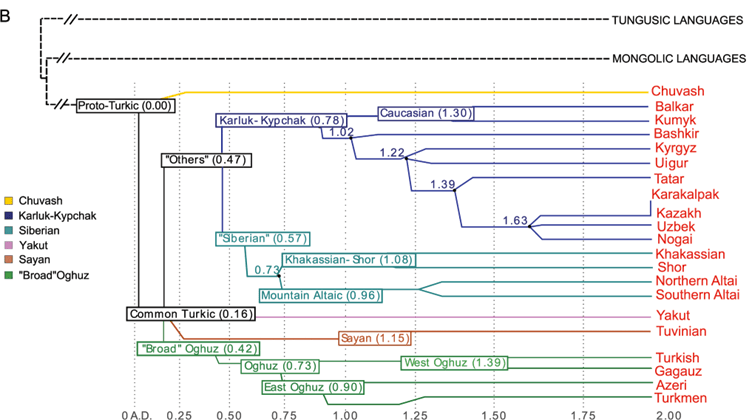
Studying the origins and deep history of language is difficult, as direct documentation of language only goes back several thousand years. Scientists look at indirect evidence – the shape of ancient hominin mouths and brains, evidence of symbolism and art, and language-linked parts of our genome, for example – to infer when and how language might have first evolved among our ancestors hundreds of thousands or perhaps even millions of years ago.
Learn More
How Did Language Evolve? Scientists Still Don’t Know (an article by our guest, Dr. Alex!)
The varied alarm calls of the vervet monkey (Audio)
Kanzi the bonobo following instructions in English (Video)
New language database narrows search for first speakers of Indo-European
The Indo-European database of cognates we discussed: https://iecor.clld.org/
Fitch 2017 Empirical approaches to the study of language evolution (technical, open access)
Markov et al 2023 Language: Its Origin and Ongoing Evolution (technical, open access)
Dediu and Levinson 2018 Neanderthal language revisited: not only us (technical
__
If you enjoyed this topic and want more like it, check out these related episodes:
- Episode 7 – Primates
- Episode 18 – Human Evolution
- Episode 52 – Sounds of the Past (Fossil Bioacoustics)
- Episode 177 – Neanderthals
We also invite you to follow us on Facebook or Instagram, buy merch at our Zazzle store, join our Discord server, or consider supporting us with a one-time PayPal donation or on Patreon to get bonus recordings and other goodies!
Please feel free to contact us with comments, questions, or topic suggestions, and to rate and review us on Spotify or Apple Podcasts!
 The Common Descent Podcast


Leave a comment