

Listen to Episode 199 on PodBean, YouTube, Spotify, or wherever you listen to your favorite podcasts!
Many animals have the ability to enter a period of dormancy to wait out difficult times. This episode, we discuss the various forms of Hibernation.
In the news
Ancient walruses were suction-feeders just like the living species
Clovis points might have been pikes instead of spears
Several new fossil grape species from across South and Central America
Tardigrades in amber provide insights to water bear evolution
A Long Rest
Many animals have the ability to enter a state of dormancy, during which their metabolic processes and certain bodily functions slow or stop. In some cases, dormancy might last only part of a day, while in others, it can go on for months. This dormant state is generally called torpor, though there are other terms used: diapause is a type of torpor seen in arthropods, brumation is long-term torpor exhibited by reptiles and amphibians, and the term hibernation typically refers to long-term dormancy in mammals.

Left: A colony of resting bats. Image by メルビル, CC BY-SA 4.0
Right: A resting ground squirrel. Image from Colorado State University Libraries, CC BY-SA 4.0
The main benefit of torpor is the ability to wait out difficult conditions. Hibernating mammals famously power down for the winter, and the various forms of torpor can allow animals to limit their energy expenditure during certain times of the day, certain times of the year, or even certain events such as wildfires or storms. Some species undergo particularly extreme versions of this, such as frogs and insects that freeze completely during the winter or tardigrades which enter an extreme state of resilient dormancy called cryptobiosis.
Note that torpor and hibernation are different from sleep. In fact, hibernating animals can sometimes suffer sleep deprivation because it’s hard to hibernate and sleep at the same time!

Right: Two tardigrades, whose dormant state allows them to survive extremely harsh conditions. Image by Willow Gabriel, Goldstein Lab, CC BY-SA 2.5
Similar tactics are employed by non-animals, including plants whose seeds can remain dormant for months or years before sprouting, and bacteria who can form cysts to wait out difficult times.
Torpor can be tough to identify in the fossil record, but there are some potential clues. Regular periods of dormancy can leave signs of low activity in bones and teeth, which can be preserved in fossils; this sort of potential evidence of torpor has been noted in fossil ground squirrels (whose modern relatives hibernate) and in some early synapsids, the forerunners of true mammals.
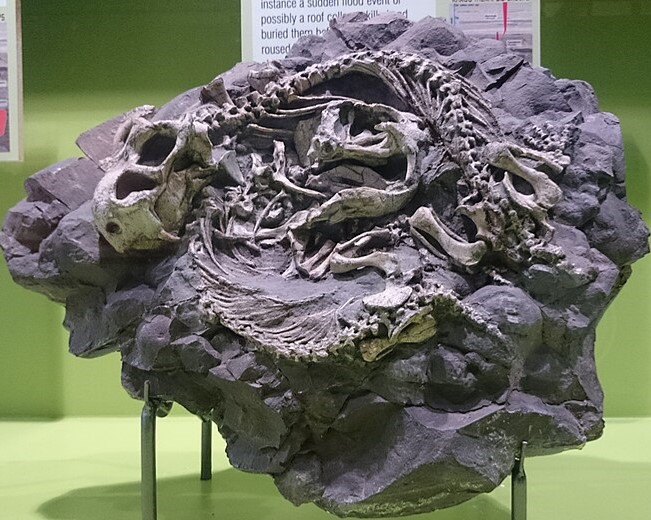
Image by Nkansahrexford, CC BY 3.0
The topic of hibernation and torpor are also relevant to mass extinctions. Animals who have the ability to go dormant for stretches of time might be more capable of surviving the difficult conditions during mass extinction events such as those at the end of the Permian and Cretaceous. There is some fossil evidence that suggests that species who are flexible in their energy needs and activity levels survived better through these extinction events.
Learn more
VIDEOS
Frogsicles: Frozen But Still Alive
Painted Turtles Defrost Back to Life | Frozen Planet II
These animals can freeze solid in winter. Here’s how they survive.
Hibernation (technical, open access)
More functions of torpor and their roles in a changing world (technical, open access)
Evidence of torpor in the tusks of Lystrosaurus from the Early Triassic of Antarctica (technical, open access)
The cave bear’s hibernation: reconstructing the physiology and behaviour of an extinct animal (technical, paywall)
__
If you enjoyed this topic and want more like it, check out these related episodes:
We also invite you to follow us on Facebook or Instagram, buy merch at our Zazzle store, join our Discord server, or consider supporting us with a one-time PayPal donation or on Patreon to get bonus recordings and other goodies!
Please feel free to contact us with comments, questions, or topic suggestions, and to rate and review us on Spotify or Apple Podcasts!
 The Common Descent Podcast


Leave a comment