

Listen to Episode 217 on PodBean, YouTube, Spotify, or wherever you listen to your favorite podcasts!
These mammals are incredible versatile, they come in record-breaking sizes, and they’re just so charismatic. This episode, we discuss the modern and ancient history of Bears.
In the news
The giant alligator Deinosuchus might not be an alligator after all
The complex evolution of rattlesnake venom on islands
Predatory land crocs from the ancient Caribbean
Fossil footprints reveal which pterosaurs were spending time on the ground
Possible new species of living crocs in the Caribbean
Bears!
Bears are mammals within the family Ursidae. Despite there only being eight living species, they’re found in forests all over the northern hemisphere, plus the Andean region of South America. Bears have stocky legs, flat feet, big claws, and often large bodies, commonly weighing more than 100kg. The largest bears weigh more than half a ton, making them the world’s biggest land predators.
Modern bears are typically categorized into three subfamilies: Ailuropodinae (giant pandas), Tremarctinae (spectacled bears), and Ursinae (all the rest).

Top, from left to right:
American black bear (Ursus americanus). Image by Diginatur, CC BY-SA 3.0
Brown bear (Ursus arctos). Image by Yathin S Krishnappa, CC BY-SA 3.0
Sun bear (Helarctos malayanus). Image by Mhdmzml, CC BY-SA 4.0
Sloth bear (Melursus ursinus). Image by Marieke IJsendoorn-Kuijpers, CC BY 2.0
Bottom, from left to right:
Asiatic black bear (Ursus thibetanus). Image by Joy Deep, CC BY-SA 3.0
Polar bear (Ursus maritimus). Image by Alan Wilson, CC BY-SA 3.0
Spectacled bear (Tremarctos ornatus). Image by Silvio Tanaka, CC BY 2.0
Giant panda (Ailuropoda melanoleuca). Image by J. Patrick Fischer, CC BY-SA 3.0
Bears are extremely versatile. They’re excellent climbers and capable swimmers, they can use their large claws to burrow into the ground, and they’re pretty fast runners. On top of that, bears have very flexible diets. Most species are omnivorous with a preference for plants, and their diets tend to change from season to season and region to region. And when times are tough, most bears can hibernate and wait for more favorable conditions. All of this behavioral flexibility allows bears to survive in a wide range of habitats and sustain their very large bodies.
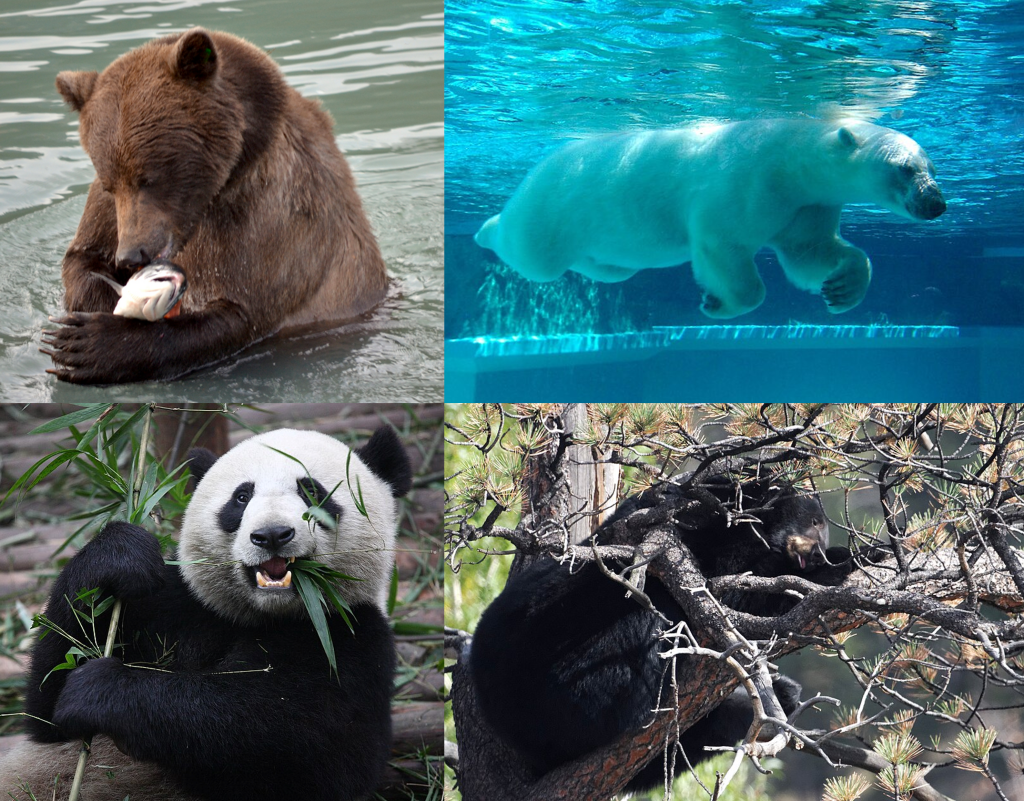
Top left: Grizzly bear grabbing salmon from a river. Image by Jonathan Chase, CC BY 2.5
Top right: Swimming polar bear. Image by Cmadler, CC BY-SA 3.0
Bottom left: Panda eating bamboo. Image by Chen Wu, CC BY 2.0
Bottom right: Black bear resting in a tree. Image by KimonBerlin, CC BY-SA 2.0
The fossil record of bears extends back to the Oligocene Epoch, around 40 million years ago. The ancestors of bears were probably small, weasel-like animals similar to the extinct amphicynodontids, which are either a very early branch of ursids or very close cousins. The first successful subgroup of bears were hemicyonines, the so-called “dog-bears,” which had legs and teeth similar to modern-day canids and probably lived a lot like wolves or foxes. (Not to be confused with Amphicyonids, the “bear-dogs.”)

Bottom left: Partial skull of Plithocyon. Image by Ghedo
Right: Cranium and jaw of Hemicyon. Image by Didier Descouens, CC BY-SA 4.0
The earliest known fossil pandas are from the mid-Miocene, around 10 million years ago. For a while, this ailuropodine lineage was a widespread group of omnivores, not unlike modern ursine bears. Starting around seven million years ago, ancient pandas became more adapted for eating plants, developing specialized features such as their complex molars and the extra “thumb” on their hands. Throughout the Pleistocene Epoch, pandas became gradually more herbivorous, eventually giving rise to our modern giant pandas, which eat almost nothing but bamboo.

Left: Skull of Indarctos. Image by Ghedoghedo, CC BY-SA 4.0
Top right: Skull of Ailuropoda microta. Image by Skye McDavid, CC BY-SA 4.0
Bottom right: Teeth of Ailuropoda baconi. Image by Jonathan Chen, CC BY-SA 4.0
Tremarctine bears also appear in the fossil record around 10 million years ago. Like modern spectacled bears, this group has mostly included small-to-medium-sized species that predominantly eat plants. Two notable exceptions are Arctodus simus and Arctotherium angustidens, the giant short-faced bears of the Pleistocene Epoch. These bears regularly weighed more than a ton – the largest bears in Earth history – and appear to have been more carnivorous than other tremarctines, though they were still omnivores.

Right: Skull of Arctodus simus. Image by Martin Cathrae, CC BY-SA 2.0
Ursine bears spread across the northern hemisphere starting around five million years ago, diversifying into a number of ancient species and, eventually, most modern bears. The most abundant and well-studied of ancient ursines is Ursus spelaeus, the cave bears of Ice Age Europe and Asia. Closely related to brown bears, cave bears were large, mostly herbivorous, and apparently spent lots of time in caves. Their fossils are extremely common in European caves, suggesting that they were denning or hibernating in them.

Bottom left: Skull of Ursus etruscus. Image by Ghedoghedo, CC BY-SA 3.0
Right: Skeleton of a cave bear, Ursus spelaeus. Image by Ra’ike, CC BY-SA 3.0
Cave bears and giant short-faced bears were among the notable casualties of the Pleistocene Megafaunal Extinction, though other species managed to persist. Brown bears did especially well in the transition from Pleistocene to Holocene, adapting to partially fill the roles their ancient cousins once did across Europe, Asia, and North America.
Learn More
Gene flow throughout the evolutionary history of bears (technical, open access)
Ursids evolved early to be low-protein omnivores (technical, open access)
The earliest ursine bear and the origins of plant-dominated herbivory (technical, open access)
Convergent evolution of giant short-faced bears (technical, open access)
Diets of cave bears (technical, partial access)
Fossil giant panda relatives (technical, open access)
The oldest known member of the panda clade (technical, open access)
The first skull of the earliest giant panda (technical, open access)
__
If you enjoyed this topic and want more like it, check out these related episodes:
We also invite you to follow us on Facebook or Instagram, buy merch at our Zazzle store, join our Discord server, or consider supporting us with a one-time PayPal donation or on Patreon to get bonus recordings and other goodies!
Please feel free to contact us with comments, questions, or topic suggestions, and to rate and review us on Spotify or Apple Podcasts!
 The Common Descent Podcast


.jpg)


_Hemicyon_stehlini_H%C3%BCrzeler,_1944_-_cr%C3%A2ne.jpg)


.jpg)


Leave a comment