
Listen to Episode 218 on PodBean, YouTube, Spotify, or wherever you listen to your favorite podcasts!
Take a deep breath and appreciate for a moment the organs that allow you to do it so efficiently. This episode, we discuss the evolution and function of Lungs.
In the news
Trilobite body size fluctuated with oxygen levels
Early Cretaceous polar forests of Australia
Lizard-like tracks are the earliest known reptile footprints
Earliest known fossil cicada identified at the Messel Pit
Deep Breaths
Lungs are the primary organs of the respiratory system in our bodies and in many of our fellow vertebrate bony animals. They’re typically a pair of organs with branching bronchi that carry air to and from special cells where oxygen diffuses into the bloodstream and carbon dioxide diffuses out. Unlike the gills of fish, which are in direct contact with their oxygenated medium (water), lungs are an enclosed internal space specialized for gas exchange.

Lung anatomy can vary quite a bit. Many reptiles and amphibians have simpler lungs with fewer internal divisions. Birds have a famously complex respiratory system where their lungs are supplemented by a series of air sacs that sit beside and inside their bones; as they breathe, air moves in and out of these air sacs in a pattern that reduces the mixing of new air and old air, giving them a very efficient respiratory system.
Animals can also lose their lungs. Snakes tend to have one functional lung and one vestigial lung; modern coelacanths have a vestigial lung; and the aptly-named lungless salamanders have lost these organs completely, relying mainly on cutaneous respiration (breathing through their skin).
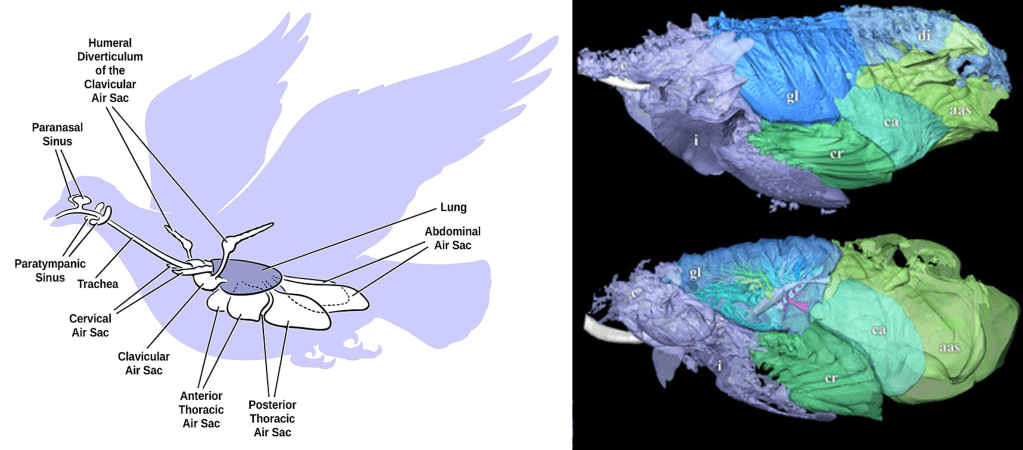
Right: CT-scans of the lungs and air sacs of a red-tailed hawk (top) and African grey parrot (bottom). Image from Schachner and Moore, 2025.
Beyond vertebrates, many invertebrate animals have independently evolved lung-like structures, internal chambers specialized for gas exchange. These include the book lungs of arachnids and the internal lung-like structures of land-dwelling snails. As various animal groups have moved onto land, lung-like respiratory systems have evolved over and over.

Studying ancient lungs can be tricky because these very delicate organs tend not to fossilize. There are exceptions, including preserved lung tissue in at least one fossilized bird and at least one salamander, but typically paleontologists look at other anatomical clues to interpret the respiratory styles of ancient animals. These clues can include the shape of skull or torso bones that might have been involved in pumping air in and out of the body.

(a) Fossil Axelrodichthys with preserved lung plates. (b) cross-section of the Axelrodicthys lung with preserved plates.
(f) 3D reconstruction of a modern coelacanth with (g) a reconstruction of the vestigial lung and plates, and closeups of the lung plates (h) and (i).
Images from Cupello et al 2017.
One major exception to the “lungs don’t fossilize” rule are coelacanths. Modern and ancient coelacanths have bony plates surrounding their lungs, which probably help to protect the organs from external pressure. These bony plates do fossilize quite well, and as a result, most fossil coelacanth species are known with preserved lungs.

Closeups of the fossil lung tissue in B, C, F, and H.
Closeups of modern bird lung tissues in D, E, G, and I.
The respiratory system of birds is also easier to study in fossils, since their air sacs invade specialized hollow spaces within their bones. Evidence for these spaces have been found in fossil birds, many groups of other dinosaurs, and the ancient flying pterosaurs. This has allowed paleontologists to interpret the bird-like respiratory system of these extinct animals.
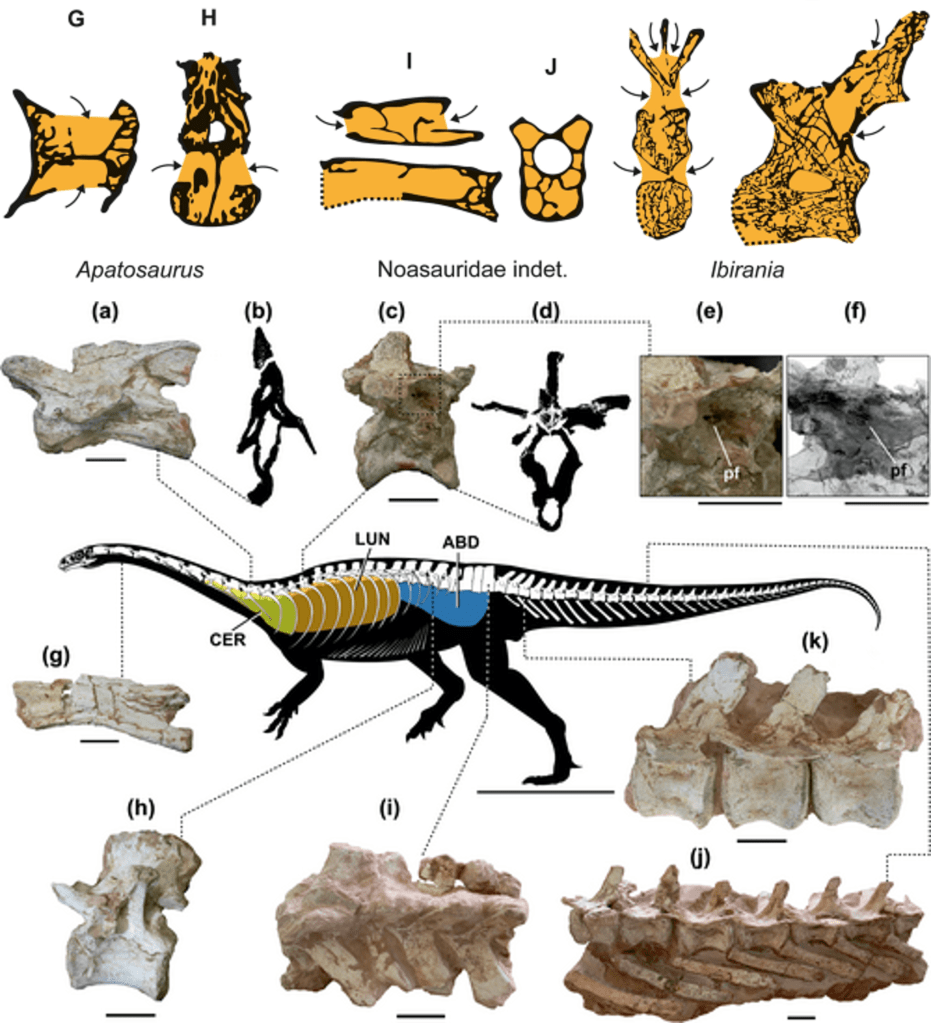
Bottom: Skeletal reconstruction of the dinosaur Macrocollum showing hypothetical position of its air sacs, along with closeups of bones that feature open spaces for air sacs to intrude. Image from Aureliano et al 2023
Learn more
Origin and evolution of vertebrate lungs (technical, open access)
Lung evolution in vertebrates and the water-to-land transition (technical, open access)
Evolution of air respiration organs in invertebrates (technical, open access)
Air breathing and lungs among fossil fishes (technical, request available)
The origin of air sacs in sauropod dinosaurs (technical, open access)
__
If you enjoyed this topic and want more like it, check out these related episodes:
- Episode 77 – Fins to Feet, the Fish-Tetrapod Transition
- Episode 121 – Brains
- Episode 130 – Sense of Smell
We also invite you to follow us on Facebook or Instagram, buy merch at our Zazzle store, join our Discord server, or consider supporting us with a one-time PayPal donation or on Patreon to get bonus recordings and other goodies!
Please feel free to contact us with comments, questions, or topic suggestions, and to rate and review us on Spotify or Apple Podcasts!
 The Common Descent Podcast


Leave a comment