
Listen to Episode 219 on PodBean, YouTube, Spotify, or wherever you listen to your favorite podcasts!
Today, the dry land of North America and Asia are just barely separated by ocean, but in the past, the region between the continents has provided home and passage to a wide variety of plants and animals. This episode, we explore the deep history of Beringia.
In the news
An early sperm whale from Patagonia
New plesiosaur species is the Provincial Fossil of British Columbia
Detailed diets of megatooth sharks
The oldest known Arctic-nesting birds
Deep Connections
Beringia is the name of the region that stretches from the Lena River in Siberia to the Mackenzie River in the Canadian Yukon. Today, that region includes the shallow ocean waters of the Bering Strait, the Bering Sea, and the Chukchi Sea, but at various times in the past, tectonic shifts and changing sea levels have exposed some of that sunken land, providing solid connections between Asia and North America.

The former presence of a dry land connection across Beringia (sometimes called the Bering Land Bridge) was first suspected when scientists noticed strong similarities between plants on either side of the Bering Strait. Since then, many more living and fossil plants and animals have revealed close relationships between ecosystems of East Asia and North America. By comparing geologic, fossil, and genetic evidence, researchers can estimate the timing of various groups passage between the continents across Beringia.
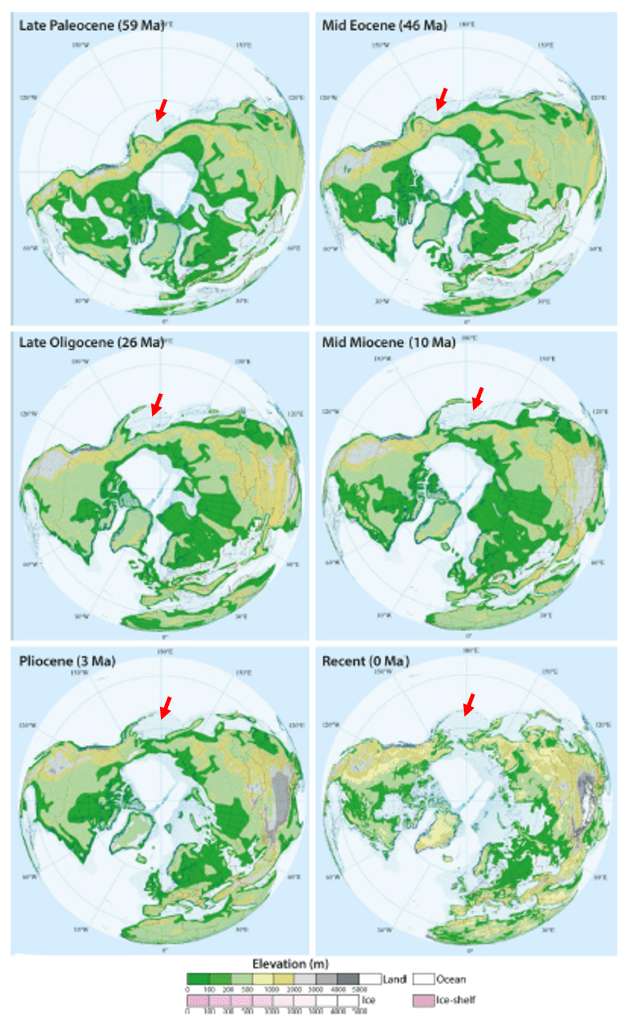
Red arrows are pointing at Beringia. Image from Wen et al 2016
The oldest evidence for a Beringian land connection is around 110 million years ago, during the Early Cretaceous Period. Around that time, there is evidence of dinosaur communities living in Beringia and dispersing between Asia and North America. Since that time, Beringia has allowed the intercontinental exchange of many groups of mammals, birds, reptiles, amphibians, insects, plants, and more. The modern distribution of species in the Northern Hemisphere owes quite a lot to this occasional land connection.

Before ~20 million years ago, Beringia was home to mixed mesophytic forests, similar to modern Appalachian forests (top image, from M0nk3yOSU).
For most of the last 20 million years, Beringia hosted temperate environments such as this style of Siberian taiga forest (middle image, by Elkwiki, CC BY-SA 3.0).
During the Pleistocene, the last ~2.5 million years, Beringia was a tundra environment, including biomes like the mammoth steppe, which persists today on the Ukok Plateau in Siberia (bottom image, by Kobsev, CC BY 2.5)
Beringia wasn’t simply a “bridge” between continents, it was a vast habitable region home to diverse ecosystems. During the Cretaceous and Paleogene, Beringia hosted warm mixed forests, which gave way in the Neogene to cooler temperate habitats, and then finally to the more familiar tundra environments we see today. These changing environments, along with rising and falling sea levels, determined which species could survive in Beringia and which could extend their range all the way into the neighboring continent.
Perhaps the most famous species to enter North America via Beringia is our own. Homo sapiens made the trip at least 15,000 years ago, and there is some evidence to suggest that human populations spent several thousand years surviving and thriving in ancient Ice Age Beringia.
Learn more
Beringia: Lost World of the Ice Age
Asymmetric biotic interchange between Eurasia and North America (technical, open access)
Lions and brown bears colonized North America in multiple waves of dispersal (technical, open access)
The De Geer, Thulean and Beringia routes (technical, open access)
Snake dispersal across Beringia (technical, paywall)
Human dispersal across Beringia (technical, paywall)
__
If you enjoyed this topic and want more like it, check out these related episodes:
We also invite you to follow us on Facebook or Instagram, buy merch at our Zazzle store, join our Discord server, or consider supporting us with a one-time PayPal donation or on Patreon to get bonus recordings and other goodies!
Please feel free to contact us with comments, questions, or topic suggestions, and to rate and review us on Spotify or Apple Podcasts!
 The Common Descent Podcast


Leave a comment