
Listen to Episode 237 on Podbean, YouTube, Spotify, or wherever you listen to your favorite podcasts!
In the mid-to-late 20th Century, the scientific and popular understanding of dinosaurs underwent a massive shift, giving rise to the modern conception of these extinct animals. This episode, Riley Black joins us for a review of the Dinosaur Renaissance.
In the news
Insights from jellyfish into the origins of sleep
Evolution of locomotion in American pronghorns and camels
Early evolution of modern facial features in birds
The importance of sauropods in Jurassic food webs
Dinosaur Science, Evolved
The term “Dinosaur Renaissance” generally refers to a period of time around the 1970s-1980s, during which the scientific and popular understanding of dinosaurs fundamentally changed. It marked the shift from the older image of dinosaurs as slow-moving, unintelligent beasts to a more modern understanding of them as active, intelligent, and social.
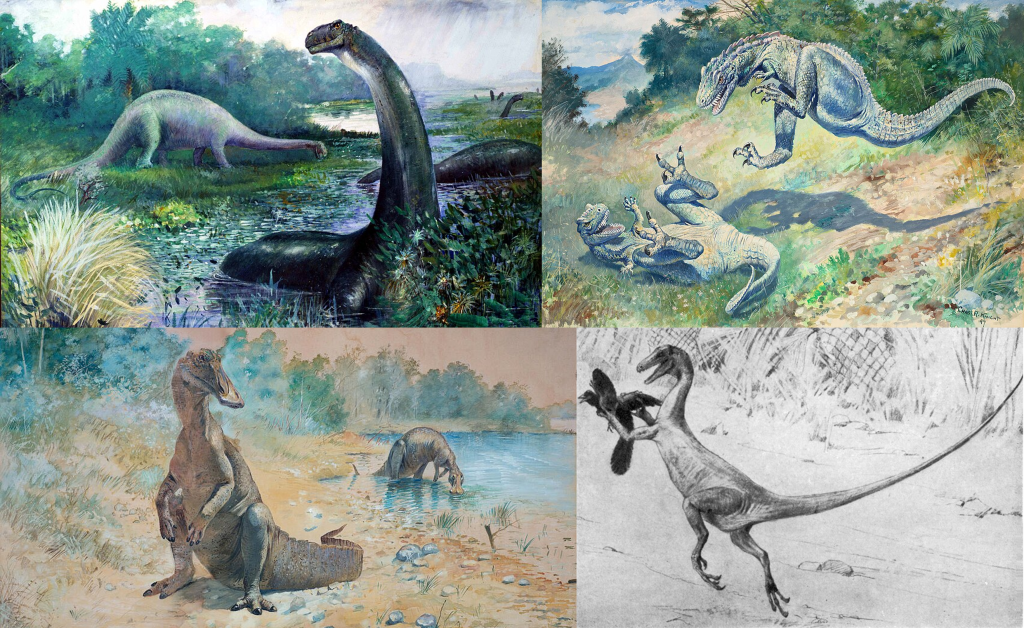
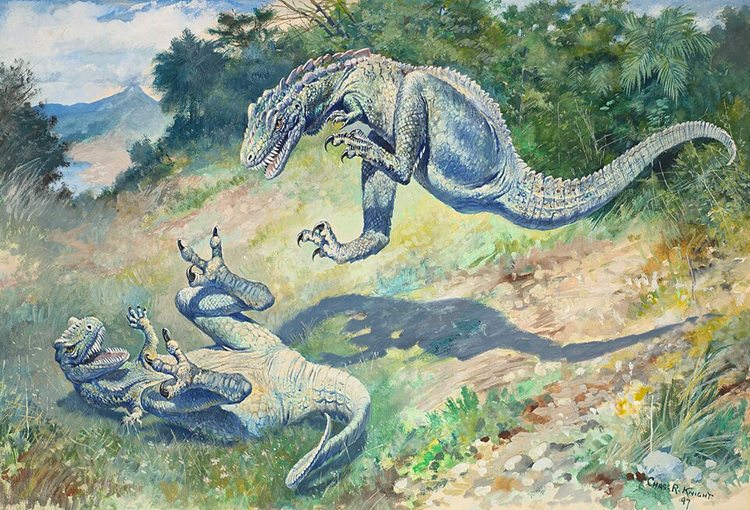
The early-1900s conception of dinosaurs is prevalent in early artwork, from the swamp-dwelling brontosaurs of Charles R. Knight paintings to the tail-dragging dinos of Disney’s Fantasia. But even back then, this wasn’t a universal image of dinosaurs. As far back as the 1800s, paleontologists had noted bird-like traits in ancient dinosaurs and had even suggested the possibility of active lifestyles or social behavior for some species, especially smaller theropods like Ornitholestes. But those ideas weren’t the norm, even among scientists.
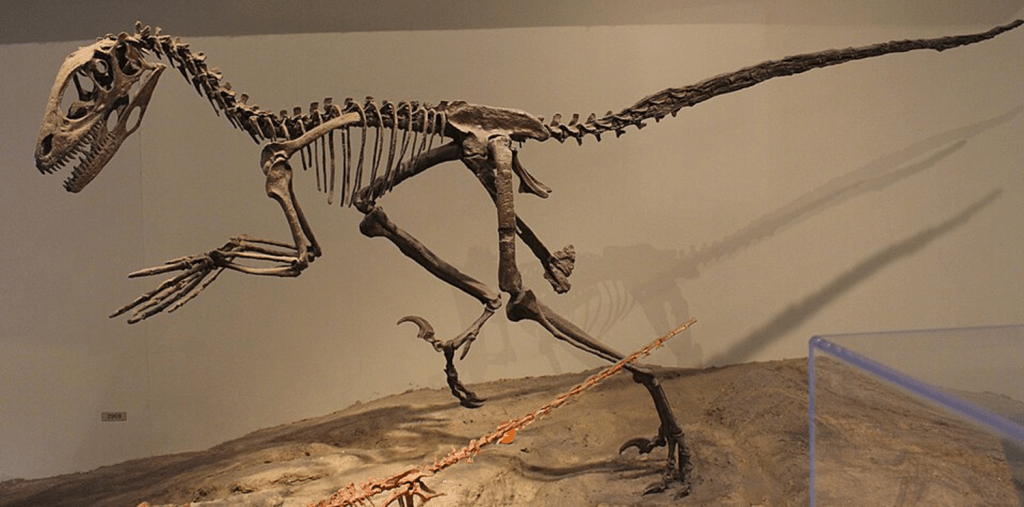
The “Renaissance” ramps up in the mid-1900s, spurred by a number of famous discoveries. John Ostrom’s 1960s description of Deinonychus as a swift and intelligent dinosaur is often credited as the first major step of the Renaissance, but it was accompanied by many others. The discoveries of horned dinosaur bonebeds and hadrosaur nesting sites in North America inspired new views on dinosaur social behavior. New research on early birds like Archaeopteryx revived old ideas about an evolutionary relationship between modern birds and extinct dinosaurs and inspired conversations about dinosaurs being more bird-like than lizard-like.
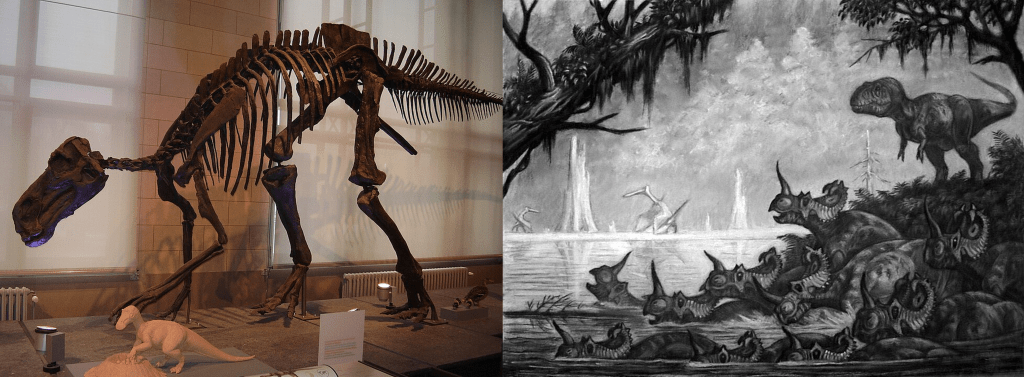
Right: Artwork of a herd of Centrosaurus. Image by ABelov2014, CC BY 3.0
This bounty of research was supported by new technology. Around this same time, computers became a viable resource for paleontologists, allowing for detailed mathematical analysis of dinosaur anatomy, locomotion, and evolutionary relationships.
And in the 1980s, another discovery overturned a major misrepresentation of dinosaurs. For decades, a common assumption had been that dinosaurs had gone extinct because they were simply unfit to survive. But the discovery of the asteroid impact that ended the Cretaceous Period proved that it took an unprecedented catastrophe to bring the Age of Dinosaurs to an end.
This shift wasn’t just a consequence of strict scientific research; art played a major role. Paleo-artists and animators drew inspiration from modern animals, which combined with new scientific data to provide a more realistic understanding than ever of how extinct species would have moved and looked. And, of course, art brought the news far beyond scientific circles.
By the 1980s, this updated vision of dinosaurs was prevalent in books and documentaries available to anyone with an interest in the science. And then there were movies. Films like Dinosaurs! and The Land Before Time expanded on ideas about dinosaur social behavior and ecosystems. And the global success of Jurassic Park cemented this updated view of dinosaurs in the public consciousness.
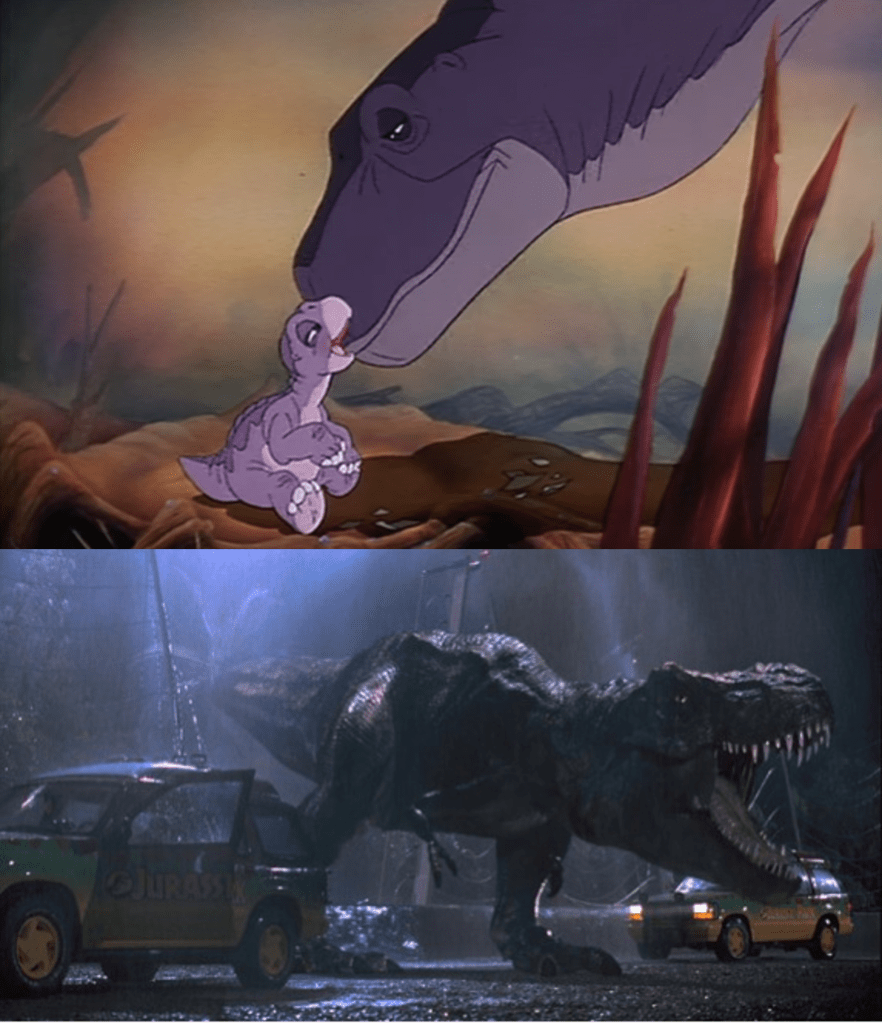
Some have suggested that we’re still in the midst of the Dinosaur Renaissance today, as dinosaur research is more prolific than ever. Others argue that we’re in a new period of dinosaur paleontological history, this one marked by – among other things – widespread development of paleontology in countries beyond Europe and North America.
Learn More
The hot-blooded dinosaurs : a revolution in palaeontology
Extreme Makeover: We bring T. rex and kin into the 21st century
The Origins of the “Dinosaur Renaissance”
The Infinite Voyage – The Great Dinosaur Hunt (1989)
Dinosaur! (Hosted by Christopher Reeve)
__
If you enjoyed this topic and want more like it, check out these related episodes:
- Episode 23 – Jurassic Park
- Episode 58 – The Bone Wars
- Episode 64 – Paleo-art
- Episode 228 – Dinosaur Provincial Park
We also invite you to follow us on Facebook or Instagram, buy merch at our Zazzle store, join our Discord server, or consider supporting us with a one-time PayPal donation or on Patreon to get bonus recordings and other goodies!
Please feel free to contact us with comments, questions, or topic suggestions, and to rate and review us on Spotify or Apple Podcasts!
 The Common Descent Podcast


Leave a comment