
Listen to Episode 240 on Podbean, YouTube, Spotify, or wherever you listen to your favorite podcasts!
For most of the Cenozoic Era, South America was home to a fascinating group of predatory birds which included some of the largest birds of all time. This episode, we explore the diversity, diets, and details of Terror Birds.
In the news
This plesiosaur took a fish bite to the throat
North American wildflowers rescued themselves from extinction
New species of croc lived alongside early hominins
Experimental investigation into dinosaur nesting habits
Birds of Unusual Size
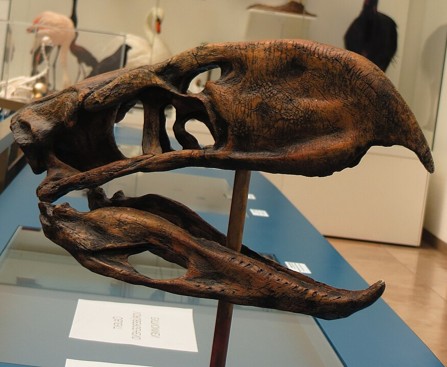
Around 15-20 species of ancient birds have been classified within the family Phorusrhacidae. These were ground-dwelling, predatory birds which ranged from the size of a chicken to the size of an ostrich or even larger. The most imposing of these have inspired the group’s nickname: terror birds.
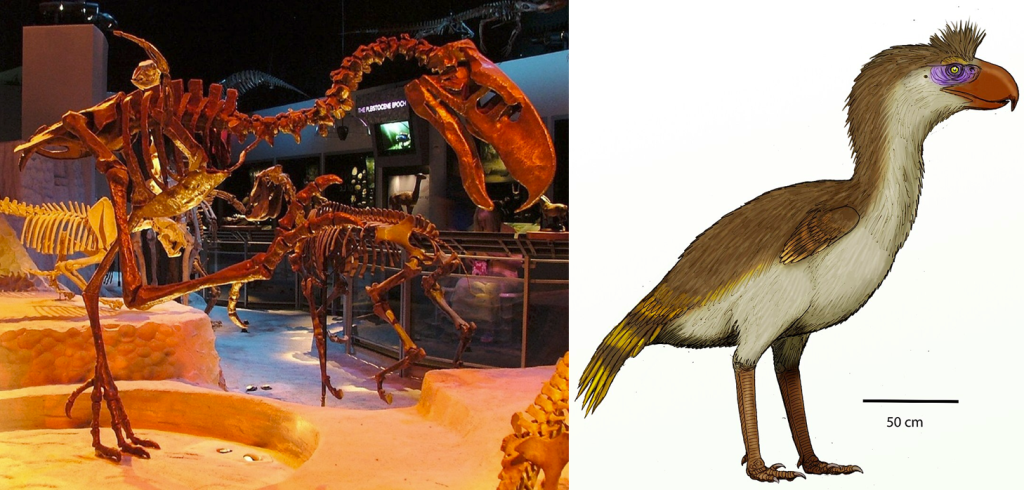
Right: Artist’s reconstruction of Andalgalornis by ДиБгд, CC BY 4.0
Overall, phorusrhacids had long legs, small wings, long necks, and large heads.Most of their evolutionary history took place in South America during the continent’s long period of isolation throughout the Cenozoic Era.
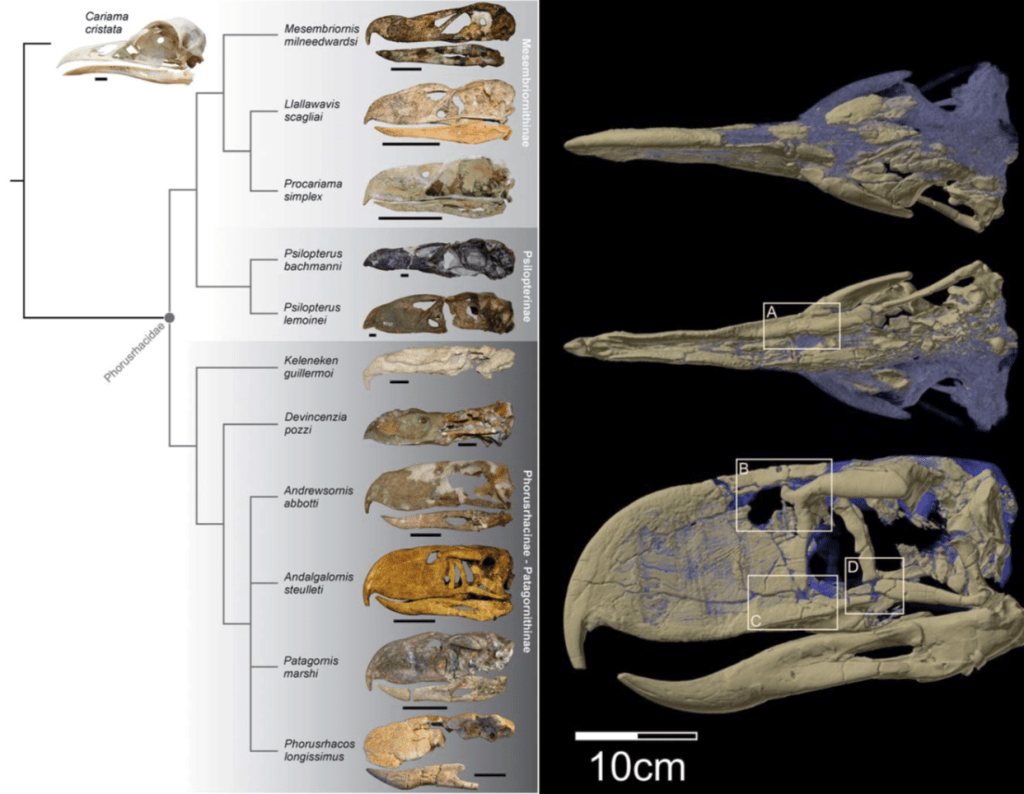
Right: CT-scans show the dimensions of the skull of Andalgalornis.
Images from Degrange 2021
The smallest phorusrhacids were very similar to their closest living relatives, seriemas, and they probably lived similar lives: foraging for food on the ground, eating whatever small prey they could find, and doing little to no flying.
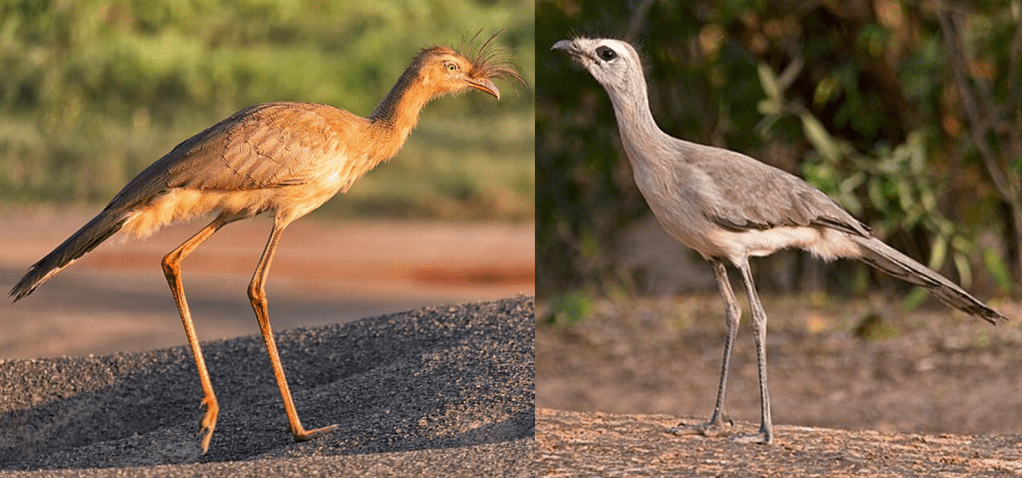
Left: A red-legged seriema (Cariama cristata). Image by Otávio Nogueira, CC BY 2.0
Right: A black-legged seriema (Chunga burmeisteri). Image by Guillermo Menéndez, CC BY-SA 4.0
The largest of these birds were enormous, standing between two and three meters tall (6-10 feet) and likely weighing over 300kg (650lbs). Their huge heads could be more than 60cm (two feet) long, with narrow, hooked beaks. These were some of the largest predators of ancient South America.
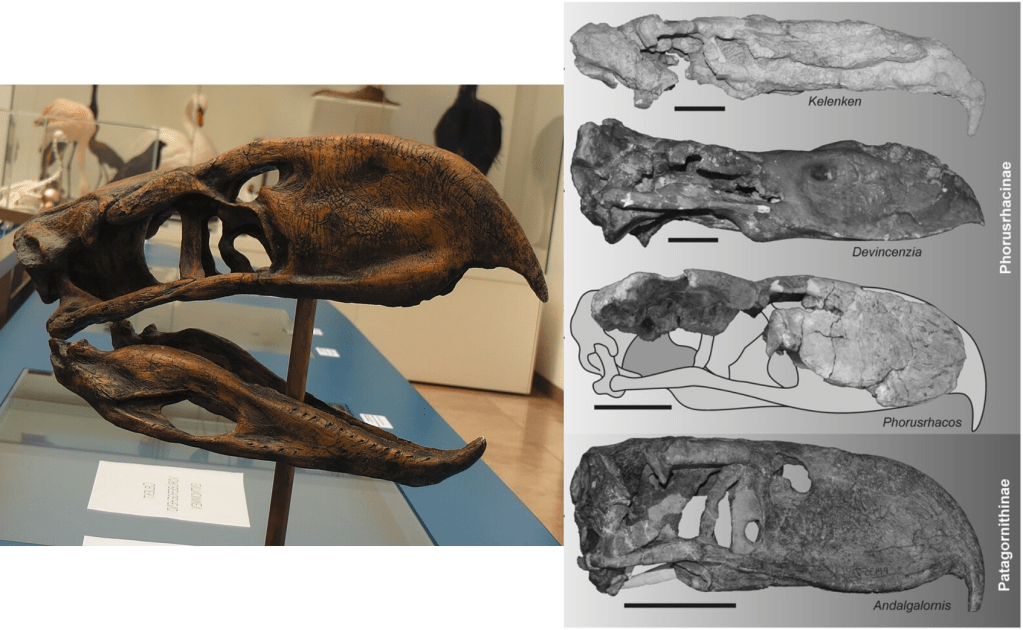
Right: Comparison of several phorusrhacid skull fossils. Scale bars are all 10cm. Image from Degrange et al 2019.
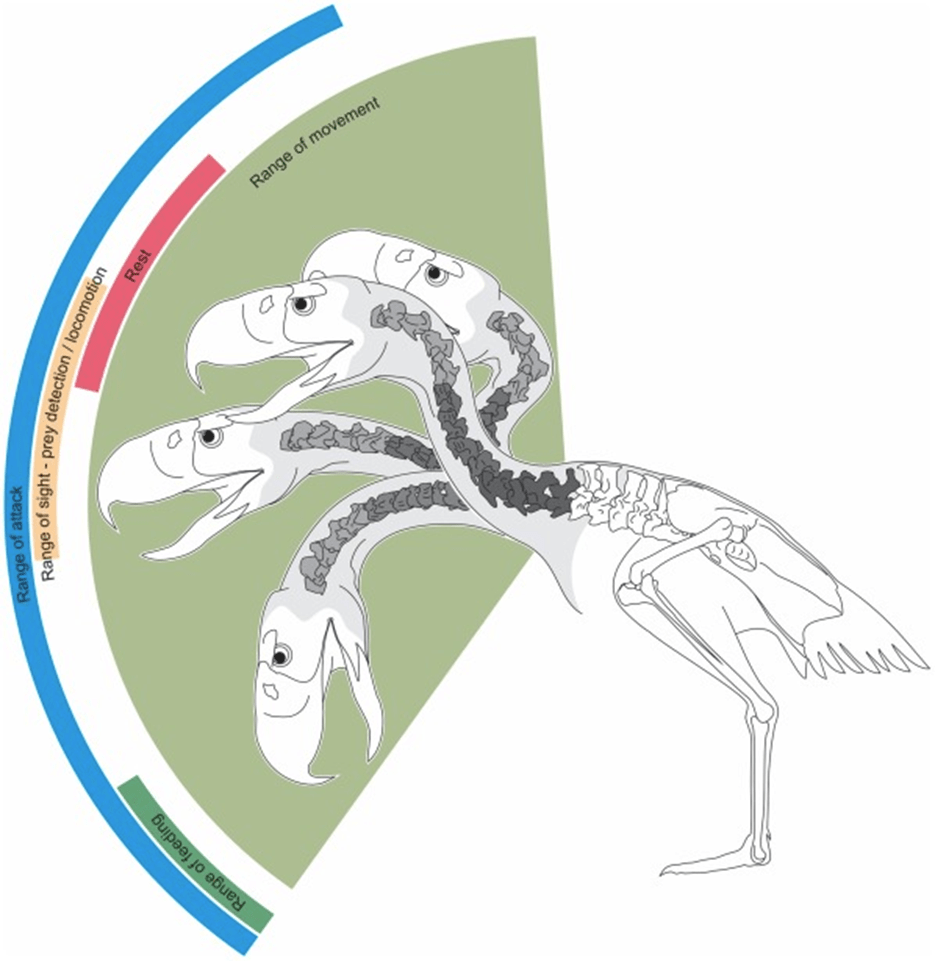
Anatomical research has shown that terror bird skulls were particularly sturdy, able to withstand powerful forces while striking at prey. Their narrow beaks, however, were susceptible to sideways pressure, so they may have been limited to smaller prey – or incapacitated prey – that couldn’t struggle too vigorously within their grasp. These birds also have exceptionally powerful legs that were well-adapted for running across ancient grasslands, and which might have been strong enough to deliver kicks to deter predators, capture prey, or ward off rivals.
Nearly all phorusrhacid fossils are known from South America. There are a handful of fragmentary remains reported from Europe, Africa, and Antarctica which might represent early members of this group, or perhaps close relatives. The only definitive example of these birds beyond their home continent is Titanis, which moved up to North America during the Great American Biotic Interchange.
Learn More
Terror Birds Ain’t What They Used to Be – A Titanis Take-Down
The evolution and ecology of gigantism in terror birds (technical, open access)
First terror bird footprints reveal functionally didactyl posture (technical, open access)
Mechanical Analysis of Feeding Behavior in the Extinct Terror Bird Andalgalornis (technical, open access)
Titanis walleri: Bones of Contention (technical, open access)
An attempt at calculating running speed in terror birds (technical, open access)
__
If you enjoyed this topic and want more like it, check out these related episodes:
We also invite you to follow us on Facebook or Instagram, buy merch at our Zazzle store, join our Discord server, or consider supporting us with a one-time PayPal donation or on Patreon to get bonus recordings and other goodies!
Please feel free to contact us with comments, questions, or topic suggestions, and to rate and review us on Spotify or Apple Podcasts!
 The Common Descent Podcast


.jpg)


Leave a comment