
Listen to Episode 79 on PodBean, Spotify, YouTube, or wherever you find your favorite podcasts!
Around the same time that the first dinosaurs were walking around, another group of reptiles was doing something no vertebrates had ever done before: taking flight. For more than 150 million years, they ruled the skies, and we’ve spent the last 200 years or so learning ever more about just how bizarre and fascinating they were. This episode, we talk Pterosaurs.
In the news
New and surprising data on the evolution of cassowaries
The oldest known scorpion and clues to the earliest animals on land
A taphonomy experiment: alligators on the sea floor
Tools made of shells suggest Neanderthals went diving for resources
The first vertebrate flyers
Pterosaurs first took to the sky in the Late Triassic, at least 225 million years ago. That’s a good 70 million years before birds and 125 million years before bats. They are the first vertebrates to evolve flight (of course, insects beat them by at least 100 million years, but this episode isn’t about insects).
Pterosaurs are generally thought to be close cousins of dinosaurs, although their origins are a mystery. Like bats, the earliest known pterosaurs in the fossil record are already true pterosaurs, with no transitional forms yet discovered to hint at how they took to the air. But once they did, they were extremely successful, filling the skies worldwide for most of the Mesozoic Era, until their extinction at the end of the Cretaceous.
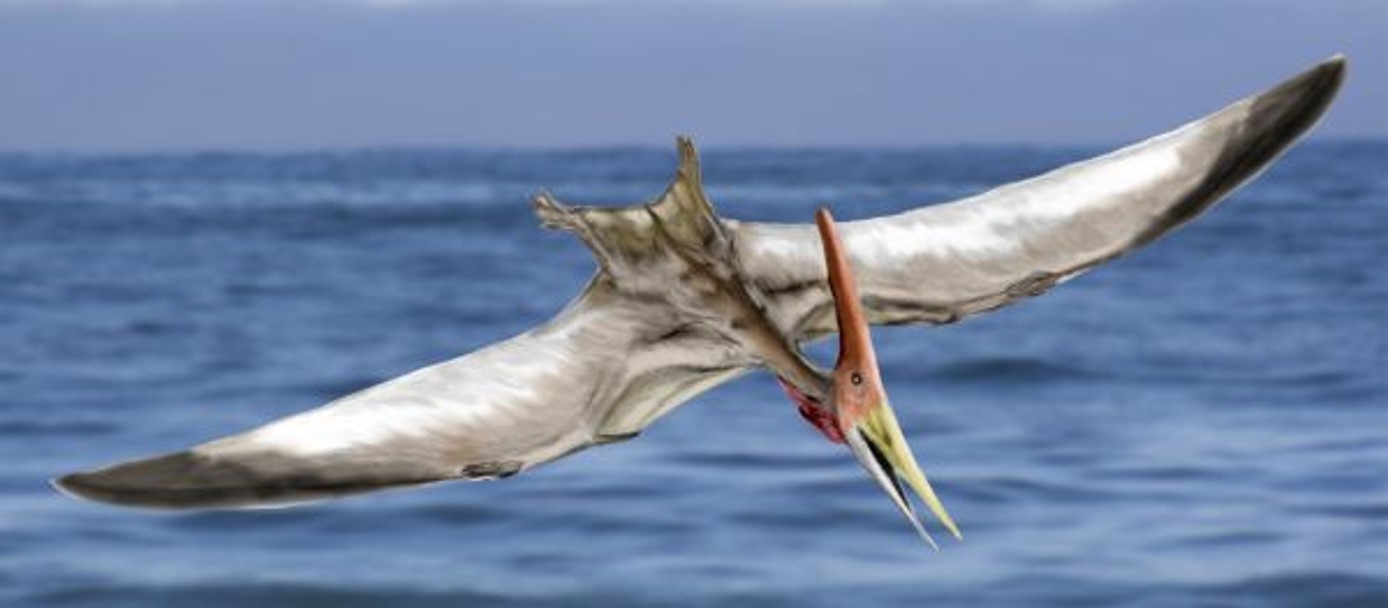
Anatomically, pterosaurs are bizarre. Their front arms and shoulder girdles are enormous to support their wings, and they often have long necks and heads and relatively small hind legs. Like birds, their bones are hollow, very thin-walled, and infiltrated by a series of air sacs that keep their bodies lightweight and aid with their efficient respiratory system
They’re also fuzzy! Many pterosaur fossils have been found covered with bristle-like integument called pycnofibers. A study in 2019 found evidence that pycnofibers might be evolutionarily related to feathers, which would suggest a feathery coat is a very ancient feature for the lineage that gave rise to pterosaurs and dinosaurs.
Endless forms most beautiful
Pterosaurs of the Triassic and Jurassic mostly fall into a group called the “non-pterodactyloid pterosaurs” (formerly called “rhamphorhynchoids”). These were generally small, with wingspans under two meters (6 feet) and sometimes much smaller. Most had long tails, short necks, and large uropatagia between their legs.
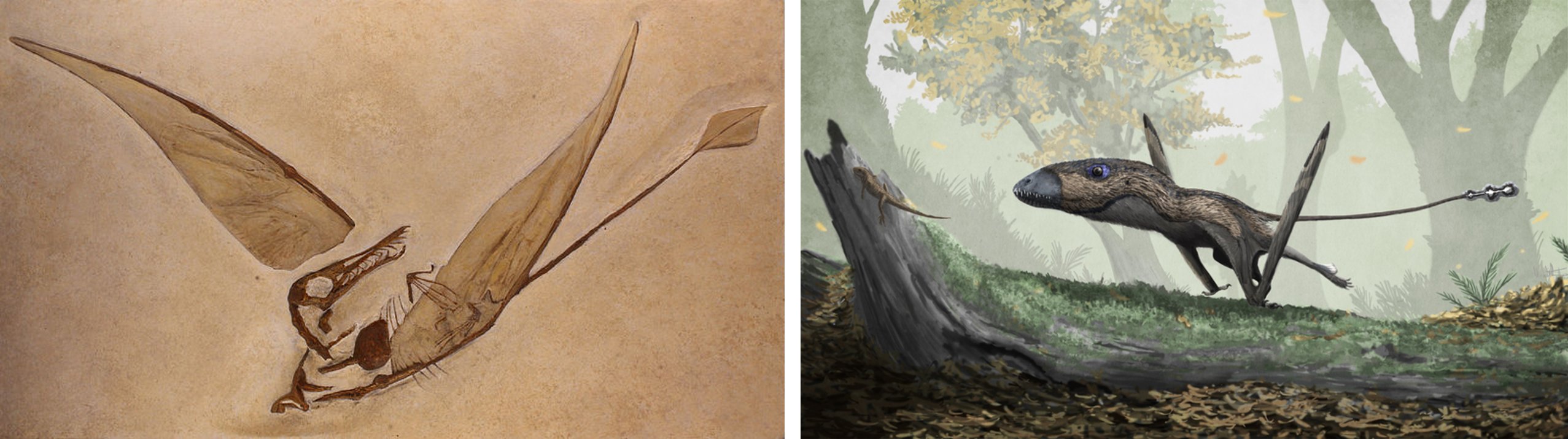
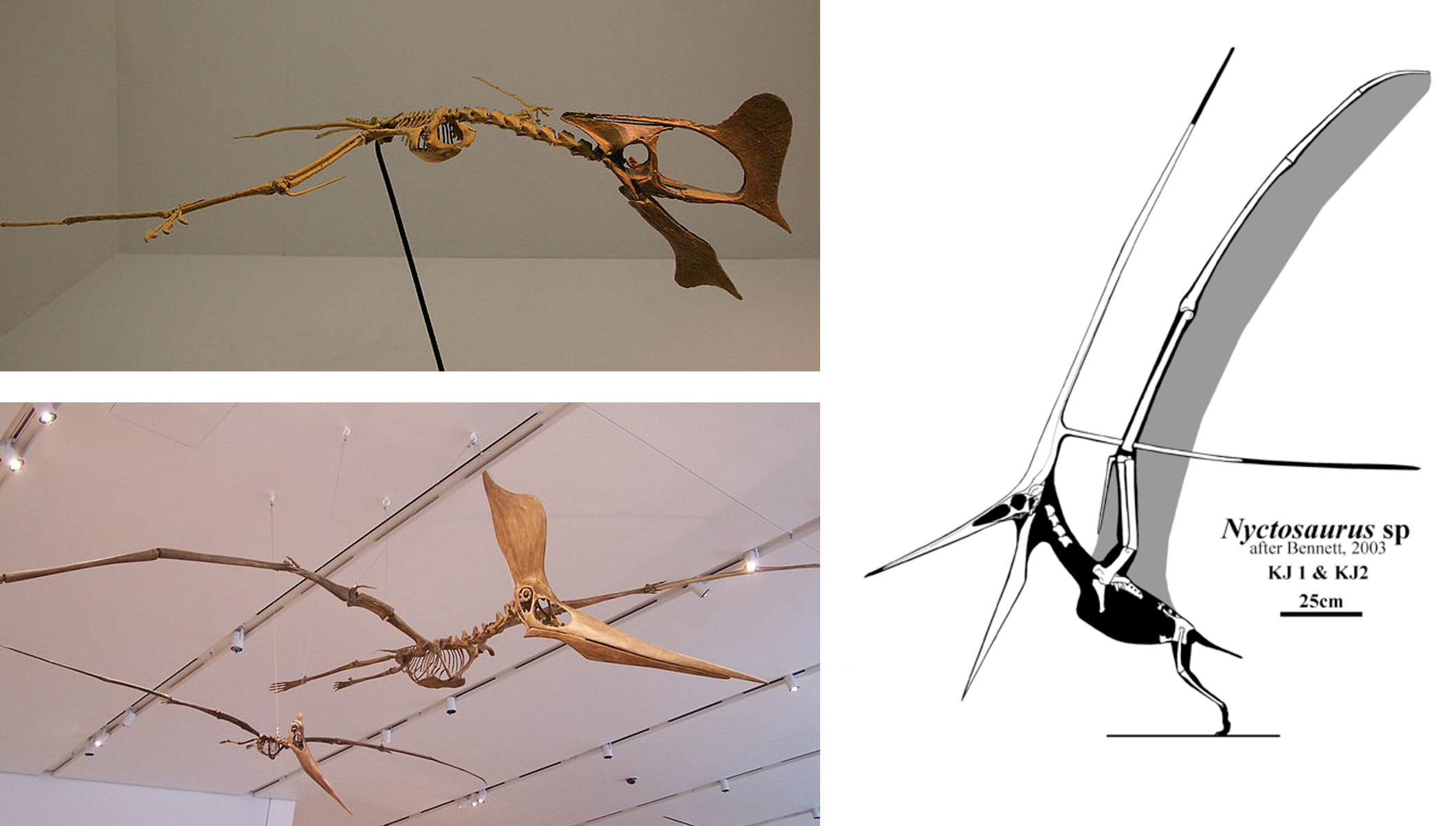
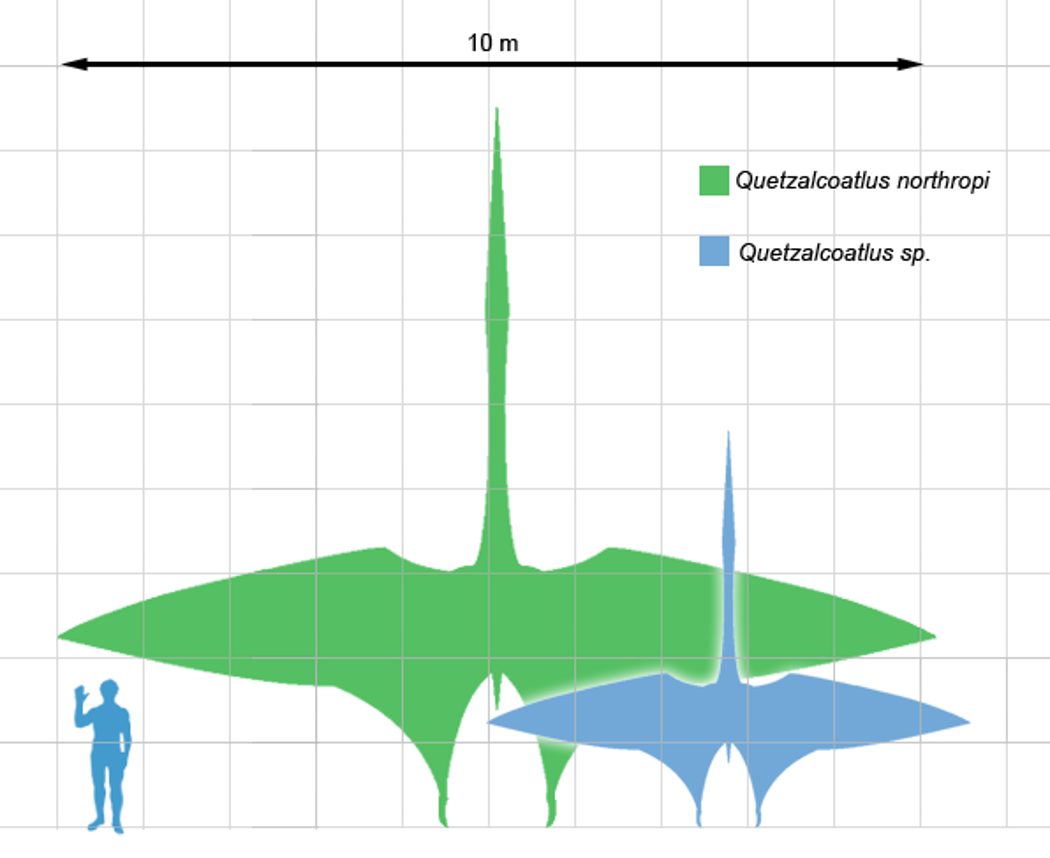
From the Late Jurassic through the Cretaceous, pterosaur diversity was dominated by another group, the pterodactyloid pterosaurs. These were generally short-tailed, long-necked forms. Many were toothless, many had bizarre headcrests, and at the very end of the Cretaceous, a handful grew preposterously large.
From some amazing trackways, we know that pterodactyloid pterosaurs were adept on the ground, walking on their hands and feet with their wings folded. For a long time, no trackways were known to clue us in on early pterosaur walking habits, but that changed this month with a new discovery of Late Jurassic trackways!
A lot of research has gone into the question of how pterosaurs took to the skies. Inspired by modern-day bats, scientists have suggested that pterosaurs used a “quad launch” to get off the ground, using their enormous arms to do a take-off push-up. Here’s a video!
Some pterosaurs even appear to have maintained nesting colonies on the ground!
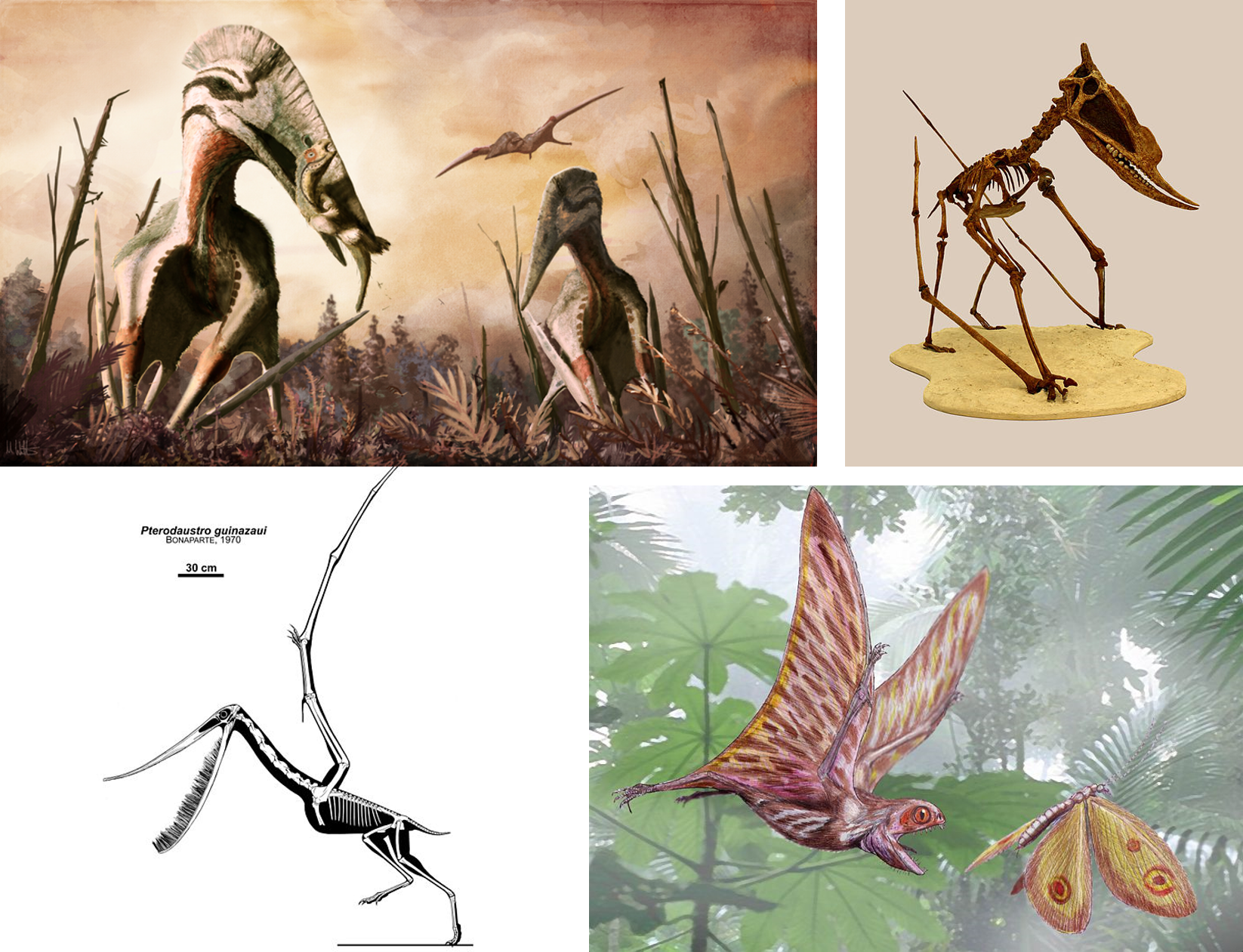
Images by Mark Witton [CC BY-SA 4.0]; Dmitry Bogdanov [CC BY-3.0]; Jaime A. Headden (User:Qilong) [CC BY 3.0]; and H. Zell [CC BY-SA 3.0]
Learn more
Pterosaur.net is a great resource with lots of general information about pterosaurs.
Mark Witton’s blog is another great place for scientific discussion on pterosaurs. Here are a few blog posts that we used as reference for this episode:
Why we think giant pterosaurs could fly
The life aquatic with flying reptiles
Quetzalcoatlus: the media concept vs. the science
Some technical papers on pterosaur lifestyles:
Bestwick et al. 2018 provides an overview of what we know – and think we know – about pterosaur diets.
Prondvai et al 2012. Life history of Rhamphorhynchus.
Zhou et al. 2017. Coprolites of filter-feeding pterosaurs
Mazin & Pouech 2020. The first non-pterodactyloid pterosaur trackways
With the release of this episode, we donated our December 2019 Patreon earnings to WIRES to help with wildlife recovery during Australia’s current environmental crisis.
—
If you enjoyed this topic and want more like it, check out these related episodes:
- Episode 6 – Evolution of Flight
- Episode 37 – Evolution of Birds
- Episode 59 – Bats
- Episode 99 – Evolution of Insects
We also invite you to follow us on Twitter, Facebook, or Instagram, buy merch at our Zazzle store, join our Discord server, or consider supporting us with a one-time PayPal donation or on Patreon to get bonus recordings and other goodies!
Please feel free to contact us with comments, questions, or topic suggestions, and to rate and review us on iTunes!


 The Common Descent Podcast
Leave a reply to commondescentpc Cancel reply