
Listen to Episode 171 on PodBean, YouTube, Spotify, or wherever you listen to your favorite podcasts!
As the world’s continents have shifted and changed shape over time, so have the oceans. This episode, we discuss the history and study of the various iterations of one of Earth’s most famous ancient body of water: The Tethys Sea.
In the news
Orinoco crocodile breeding program maintains healthy genetic diversity
Fossil mammal and dinosaur seemingly locked in combat
Whales and dolphins might have passed evolutionary point-of-no-return
Rare bird footprints show possible interactions between individuals
Tethys Through Time
The Tethys Sea (or Tethys Ocean) is an ancient body of water surrounded by landmasses that have since been reorganized. The name commonly refers to the specific ocean that existed between the supercontinents of Laurasia and Gondwana during the Mesozoic Era, but there have in fact been many iterations of Tethyan seas over the past 600 million years.
The earliest, the Proto-Tethys, is a sea that existed on the margin of Gondwana during the Late Proterozoic and Early Paleozoic, over 500 million years ago.
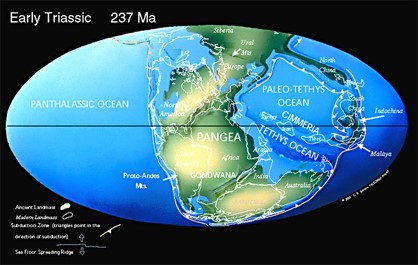
As continents reorganized throughout the Paleozoic, diverging landmasses opened a new ocean basin that became the Paleo-Tethys Ocean. By the end of the Paleozoic, this ocean had become a tropical sea nestled in the curve of Pangaea.

Plate tectonic maps by C. R. Scotese, PALEOMAP Project (www.scotese.com)
As the Mesozoic began, continental rifting along the edge of Gondwana opened up a new ocean basin to the south of the Paleo-Tethys. As these continental chunks (called Cimmeria) drifted northward, they gradually closed the Paleo-Tethys and opened the Neo-Tethys, which is often simply called the Tethys. This sea became home to ichthyosaurs, plesiosaurs, mosasaurs, and other famous marine life of the Mesozoic.
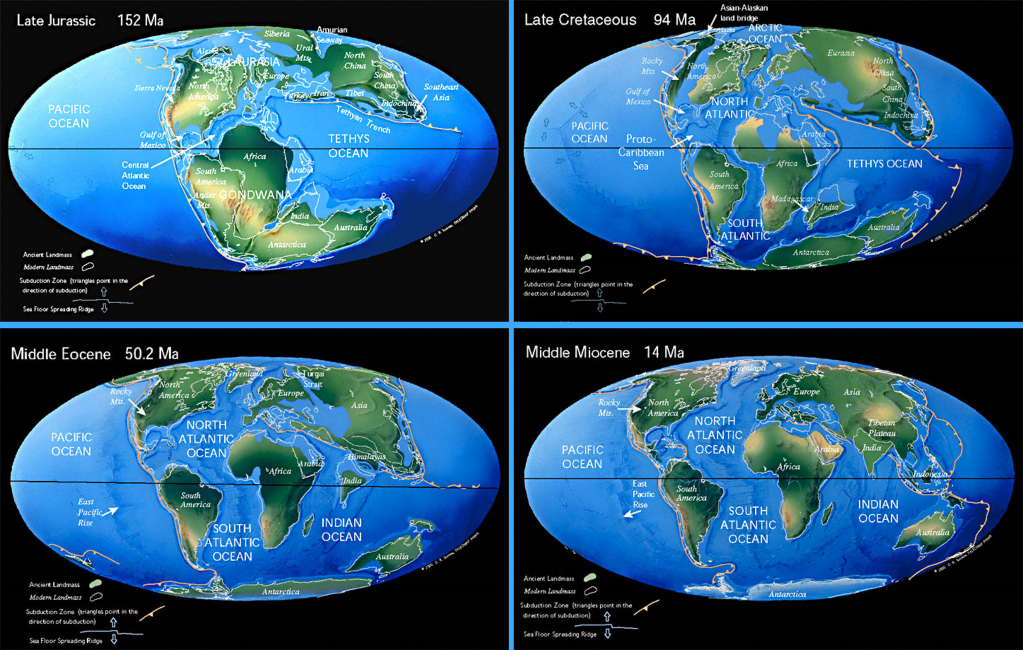
Plate tectonic maps by C. R. Scotese, PALEOMAP Project (www.scotese.com)
During the Cenozoic, the modern shapes of the continents came together. The Tethys disappeared as Africa drifted into Eurasia and as more landmasses (like India) collided with southern Asia. For a while, a northern section of the Tethys remained as an inland sea called the Paratethys, which covered much of Europe and was home to a unique ancient ecosystem. The Paratethys shrank over time, ultimately leaving behind smaller, separate bodies of water, including the modern Aral, Black, and Caspian Seas.
Geologists study the Tethys by examining the clues left behind by shifting shorelines: coastal sediments represent the margins of the sea, orogenic belts reveal where and when landmasses collided and created mountain ranges, and the distributions of marine and terrestrial fossils provide insights into ancient connections by land or sea. The famous marine deposits of the Alps, Himalayas, and Sahara are remnants of the Tethyan shorelines, and the extensive oilfields of North Africa, Arabia, and the Middle East formed from the organic remains of plankton and other microorganisms that lived in the Tethys.
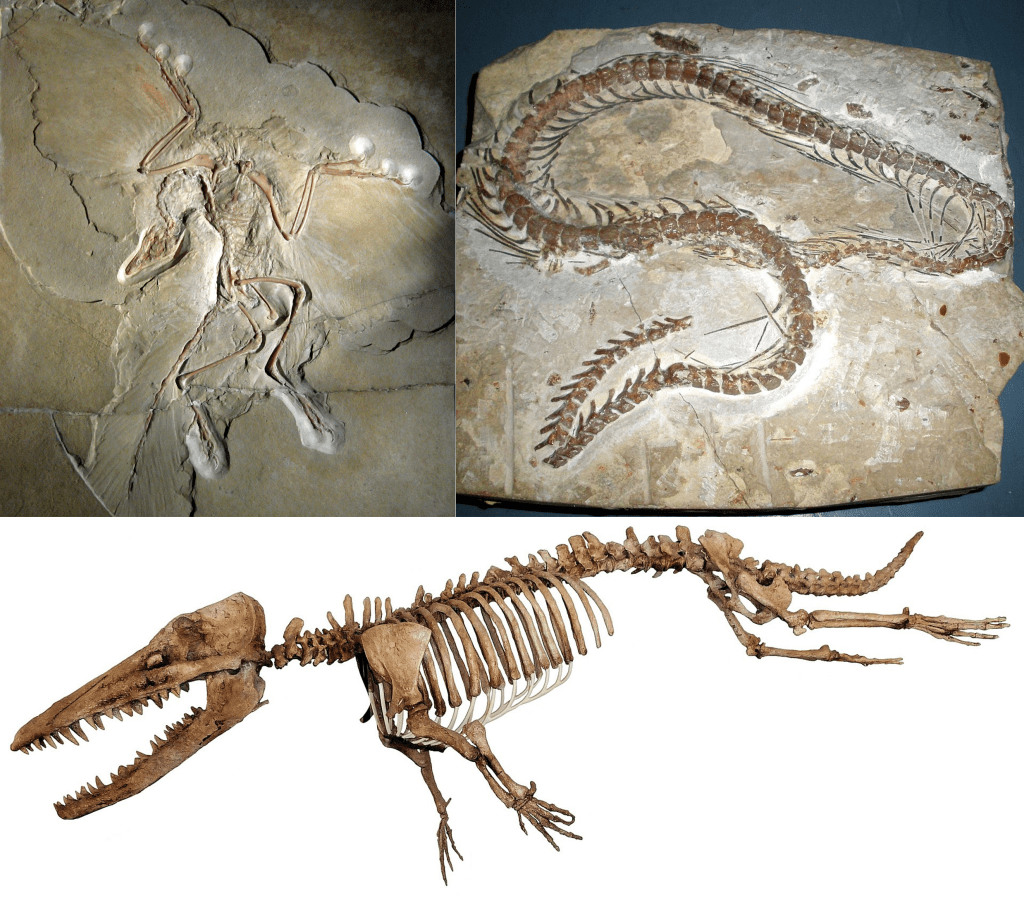
Top left: Archaeopteryx is found in the Solnhofen Limestone, formed along the shores of the Jurassic Tethys. Image by H. Raab, CC BY-SA 3.0
Top right: Cretaceous sea snakes like Eupodophis inhabited the Tethys Sea during the Cretaceous Period. Image by Ghedoghedo, CC BY-SA 3.0
Bottom: The earliest whales, including Ambulocetus, are found in Eocene Tethys deposits of the Middle East and North Africa. Image by Notafly, CC BY-SA 3.0
The changing shape of the Tethys over time had major impacts on life on Earth. Shifting connections across land and sea determined the distribution of ancient organisms, and some living species’ modern ranges can even be traced back to the shape of the ancient Tethys. As the Tethys ultimately shallowed and closed, it also altered global patterns of ocean circulation, cutting off a source of warm water and likely contributing to the cooling trends that eventually allowed for the development of polar ice caps as we know them.
Dive Deeper
Tethys Sea – Britannica
The Tethys Sea: the Story of the Ocean that Covered Ancient Earth
Paratethys: The rise and fall of the world’s largest lake
The Evolution of the Tethys Region throughout the Phanerozoic (technical, PDF available)
The role of eastern Tethys seaway closure in the Middle Miocene Climatic Transition (technical, open access)
Cenozoic Tethyan changes dominated Eurasian animal evolution and diversity patterns (technical, open access)
__
If you enjoyed this topic and want more like it, check out these related episodes:
- Episode 71 – The Western Interior Seaway
- Episode 122 – Plate Tectonics
- Episode 128 – The Deep Sea
- Episode 141 – Supercontinents
We also invite you to follow us on Twitter, Facebook, or Instagram, buy merch at our Zazzle store, join our Discord server, or consider supporting us with a one-time PayPal donation or on Patreon to get bonus recordings and other goodies!
Please feel free to contact us with comments, questions, or topic suggestions, and to rate and review us on iTunes.

 The Common Descent Podcast
.jpg)

Leave a reply to Mark Cancel reply