

Listen to Episode 231 on Podbean, YouTube, Spotify, or wherever you listen to your favorite podcasts!
Ever since an unusual group of fish gave rise to the first land-dwelling vertebrates, their descendants have been returning to the water. This episode, we explore the many evolutionary paths of Secondarily Aquatic Vertebrates.
In the news
Rapid ocean recovery after the Permian Extinction
The oldest known fossil croc eggs, from Australia
Spine injuries maybe caused by dinosaurs climbing atop each other
How some dung beetles evolved to eat meat
Back to the Water
Nearly 400 million years ago, a group of fish gave rise to the first land-dwelling vertebrates. Since then, many of their descendants have made the transition back to aquatic lifestyles. These secondarily aquatic vertebrates include some of the most successful groups of animals in Earth history.
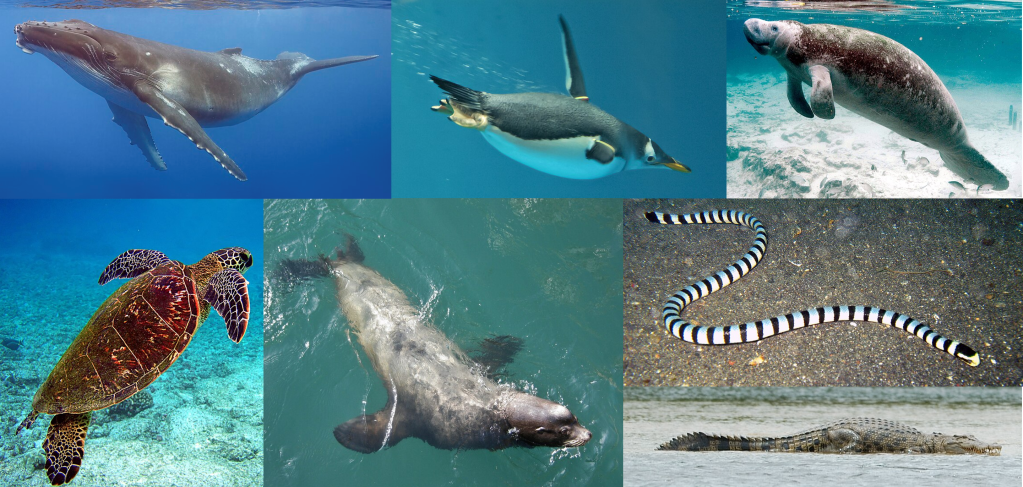
Top middle: Gentoo penguin. Image by Ken Funakoshi, CC BY-SA 2.0
Top right: Manatee. Image by Ramos Keith, CC0
Bottom left: Green sea turtle. Image by Brocken Inaglory, CC BY-SA 3.0
Bottom middle: California Sea Lion. Image by Mike Baird, CC BY 2.0
Bottom right (top): Banded sea krait. Image by Jens Petersen, CC BY-SA 3.0
Bottom right (bottom): Saltwater crocodile. Image by Richard.Fisher, CC BY 2.0
The shift from land to water involves a host of challenges for which these groups have evolved remarkably similar solutions. Paddle-like flippers and tails allow these animals to swim efficiently, while dense fur or blubber help them retain heat in the water. Salt glands prevent the body from taking in too much salt from seawater, and various changes to the respiratory system allow for deep breaths between dives.
Some swim primarily using undulations of their bodies, such as cetaceans, crocodilians, and (of course) sea snakes. On the other hand, rigid-bodied animals like sea turtles and penguins propel themselves mainly using their flippers. Due to the differing structure of their spinal columns, aquatic mammals tend to undulate up-and-down while reptiles swim side-to-side like their distant fish ancestors.

Top right: Bottlenose dolphin skeleton. Image by James St. John, CC BY 2.0
Bottom left: Magellanic penguin skeleton. Image by H. Zell, CC BY-SA 3.0
Bottom middle: California sea lion skeleton. Image by H. Zell, CC BY-SA 3.0
Bottom right: Loggerhead sea turtle skeleton. Image by Di, CC0
The fossil record is full of extinct examples among mammals, birds, and reptiles. In some cases, aquatic lifestyles are easily inferred from the flipper-like shape of the limbs, the density of the bones, and the location of the fossils in sediments that formed underwater. But this lifestyle is so variable that the details – such as how these ancient species swam, reproduced, or kept warm – can be difficult to determine.
Some fossils present a confusing mixture of signals, leading to lots of debate about just how aquatic they really were. Famous examples include the Triassic tanystropheids, the mammalian desmostylians, and of course the dinosaur Spinosaurus.

Top middle: Mosasaur skeleton. Image by MCDinosaurhunter, CC BY-SA 3.0
Top right: Hesperornis skeleton. Image by Quadell, CC BY-SA 3.0
Bottom left: Pliosaur skeleton. Image by Ghedoghedo, CC BY-SA 3.0
Bottom right: Marine croc skeleton. Image by Ghedoghedo, CC BY-SA 3.0
Fully terrestrial vertebrates began evolving back into the water almost as soon as they had left it. Semi-aquatic reptiles are known from the Late Carboniferous Period, mere millions of years after the origins of their ancestors who had left behind amphibious habits. The oldest fossils considered to be fully aquatic reptiles are the mesosaurs of the Early Permian Period. Then, in the Triassic, several more lineages of marine reptiles spread through the seas.

Learn More
The locomotion of extinct secondarily aquatic tetrapods (technical, open access)
The Role of Ancestry on Secondarily Aquatic Transitions (technical, open access)
Sensory biology of aquatic mammals (technical, open access)
Was Mesosaurus a Fully Aquatic Reptile? (technical, open access)
__
If you enjoyed this topic and want more like it, check out these related episodes:
- Episode 70 – Convergent Evolution
- Episode 77 – Fins to Feet: the Fish-Tetrapod Transition
- Or the many episodes we’ve done on secondarily aquatic tetrapod groups: marine crocs, sea snakes, turtles, ichthyosaurs, plesiosaurs, mosasaurs, pinnipeds, penguins, whales, and specifically toothed whales
We also invite you to follow us on Facebook or Instagram, buy merch at our Zazzle store, join our Discord server, or consider supporting us with a one-time PayPal donation or on Patreon to get bonus recordings and other goodies!
Please feel free to contact us with comments, questions, or topic suggestions, and to rate and review us on Spotify or Apple Podcasts!

 The Common Descent Podcast


_Naturhistorisches_Museum_Wenen_7-06-2023_10-28-52.jpg)
Leave a reply to Kayla Cancel reply