
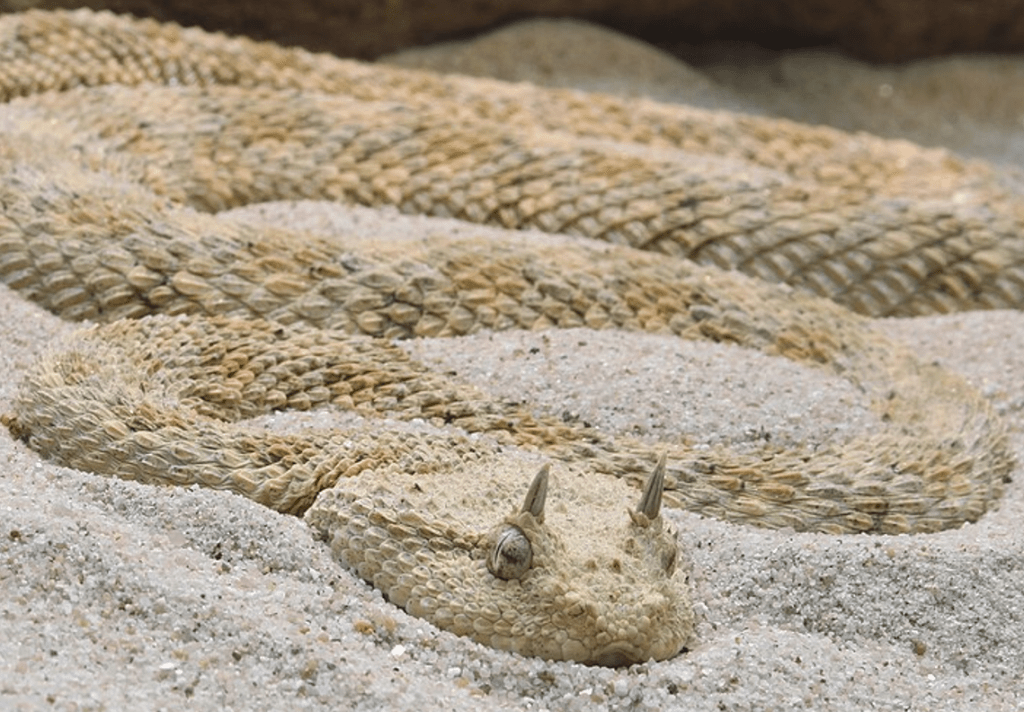
Listen to Episode 247 on Podbean, YouTube, Spotify, or wherever you listen to your favorite podcasts!
This episode, we explore the diversity and adaptations of this group that includes some of the world’s most specialized, most famous, and most dangerous snakes: Vipers.
In the news
Colors and sensory organs in an exceptional croc fossil
Brooding larvae in Cretaceous freshwater mussels
Cretaceous mites marching in a line
An unexpected large python from Pleistocene Taiwan
Venomous, Heat-Sensing Snakes
The family Viperidae includes around 350 modern species of snakes commonly called vipers. These snakes occupy a variety of habitats from jungle to desert, they can be found on most landmasses outside of polar regions, and they include some of the most notoriously dangerous reptiles on Earth.
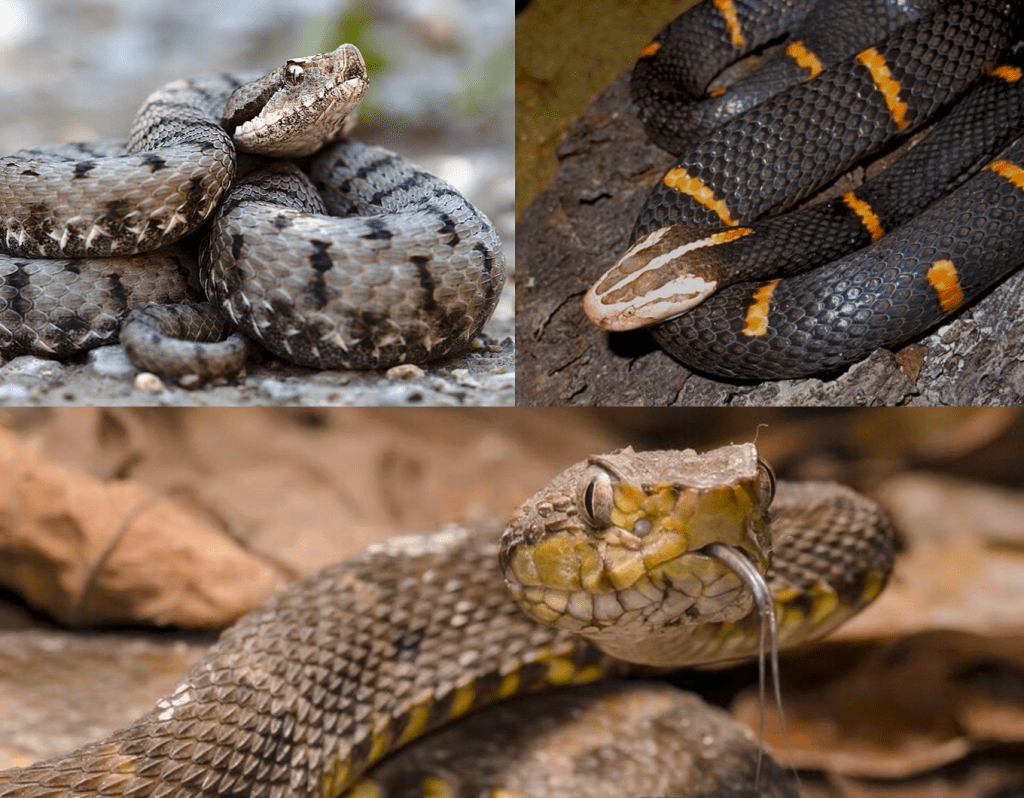
Top right: Fea’s viper (Azemiops feae) from Southeast Asia, a member of the subfamily Azemiopinae. Image from Teynié et al 2017
Bottom: A common lancehead (Bothrops atrox) from South America, a member of the pit vipers (subfamily Crotalinae). Image by Dario De la Fuente, CC BY-SA 4.0
The most famous feature of vipers is their venom, stored in glands at the back of the head – which give their heads a distinctive triangular shape – and delivered through unique fangs which are hollow like needles and can fold against the roof of the mouth when not in use.
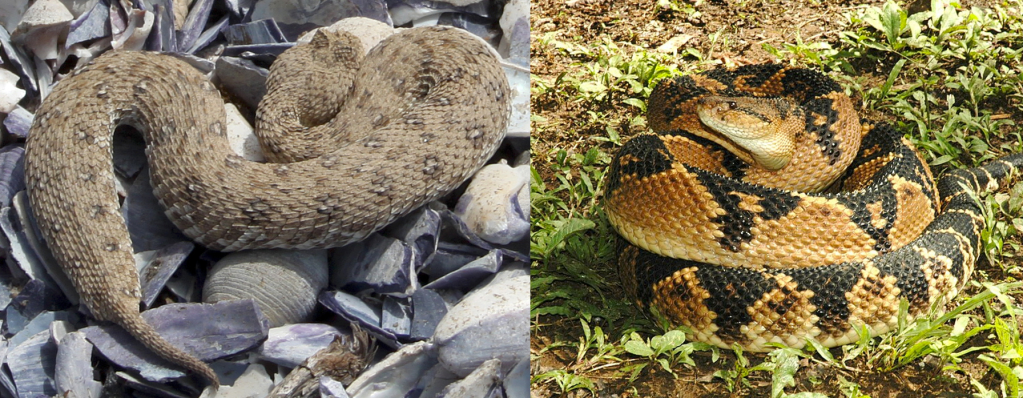
Right: A bushmaster (Lachesis muta) from South America. This species includes the largest known vipers, reaching lengths of over 3.5 meters (11.5 feet). Image by Christopher Murray
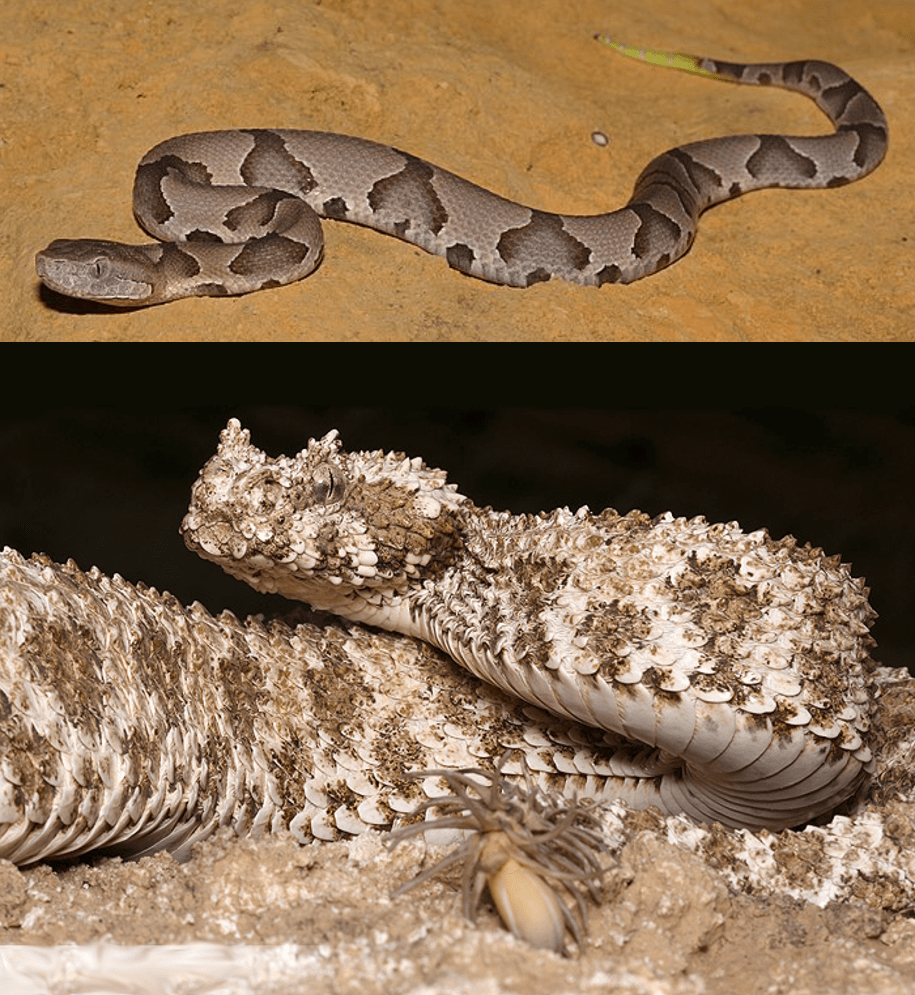
Vipers are very specialized ambush hunters. They will sit and wait, sometimes for days, in a spot where prey is likely to pass by. When the opportunity arises, they quickly strike their prey, sinking in their fangs and immediately releasing, then sitting back and waiting for their venom to incapacitate the victim before moving in to eat.
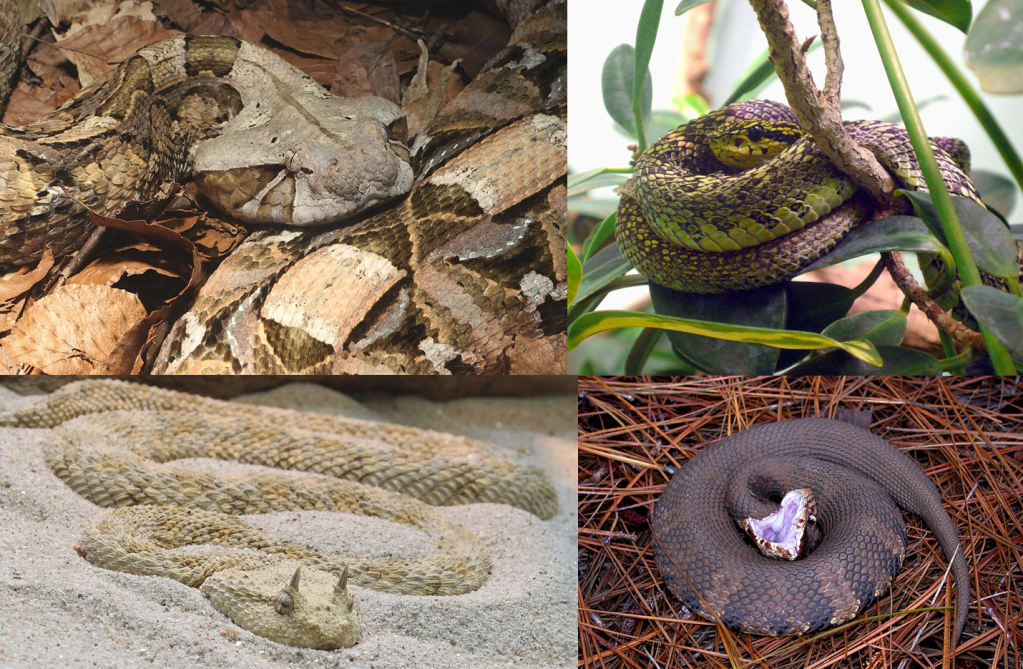
Top left: A Gaboon viper (Bitis gabonica) camouflages against dry leaf litter. Image by Holger Krisp, CC BY 3.0
Top right: An arboreal black-speckled palm pitviper (Bothriechis nigroviridis) camouflaged among leaves and branches. Image by TimVickers
Bottom left: A Saharan horned viper (Cerastes cerastes) half-buried and camouflaged in sand. Image by Holger Krisp, CC BY 3.0
Bottom right: A cottonmouth (Agkistrodon piscivorus) which was well-camouflaged amidst wet vegetation before it was startled into performing a threat display with its white-colored mouth. Image from the CDC.
The composition of viper venom varies very extensively, but commonly includes a variety of enzymes that break down organic molecules and proteins that inhibit cellular activity, which can cause excessive blood flow or blood clotting and disrupt the activity of muscles and vital organs. Venom ingredients can be quite different between related species and even members of the same species, often related to each snakes’ diet and habitat.
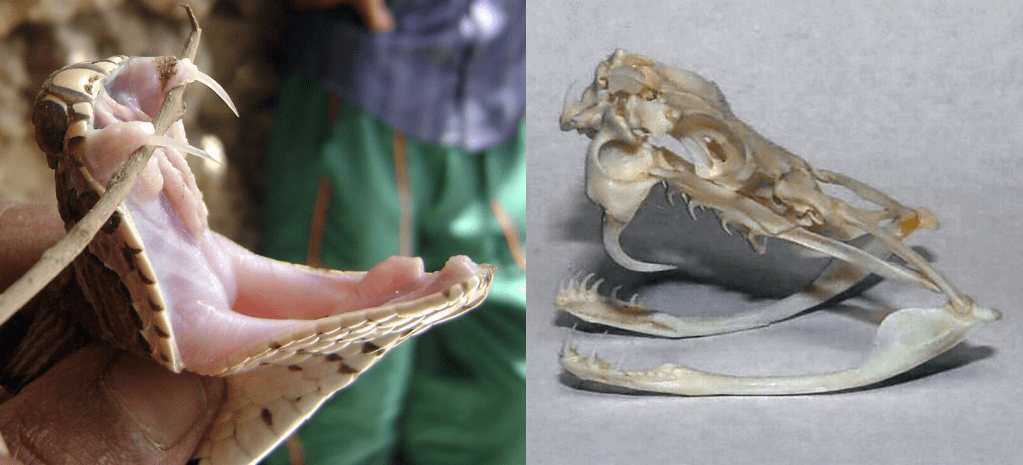
Right: The skull of a rattlesnake. Most of a viper’s teeth are small and thin like typical snake teeth, while their massively enlarged fangs are suspended from a flexible maxillary bone that can fold the teeth against the roof of the mouth when they’re not being used. Image by Mokele, CC BY-SA 3.0
Vipers include some of the world’s most medically relevant snakes, primarily due to the danger their venom poses to humans and pets, but also because of the pharmaceutical value of their venom. The first drug ever developed from animal venom was a blood pressure medication called captopril, designed in the 1980s to mimic proteins from the venom of South American jararacas (Bothrops jararaca). Since then, many more medicines have been developed by studying and copying the behavior of viper venom components.
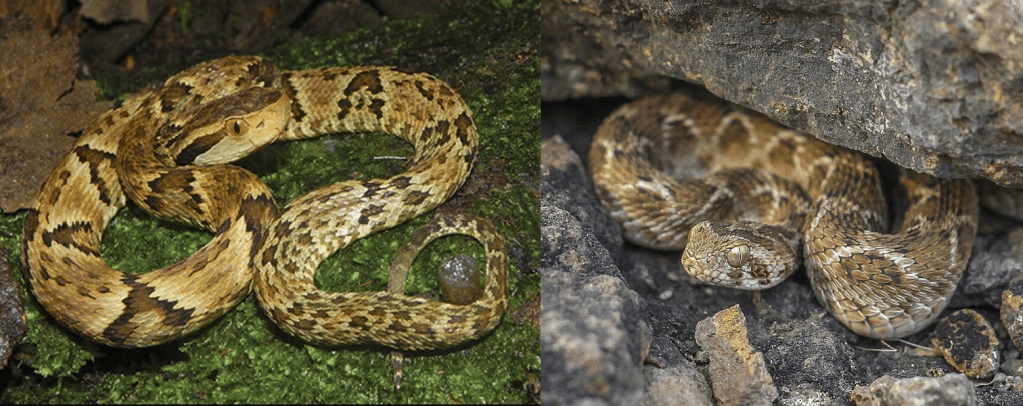
Right: The venom of Indian saw-scaled vipers (Echis carinatus) has been used to develop anti-blood-clotting medication. Image by Sagar Khunte, CC BY-SA 4.0
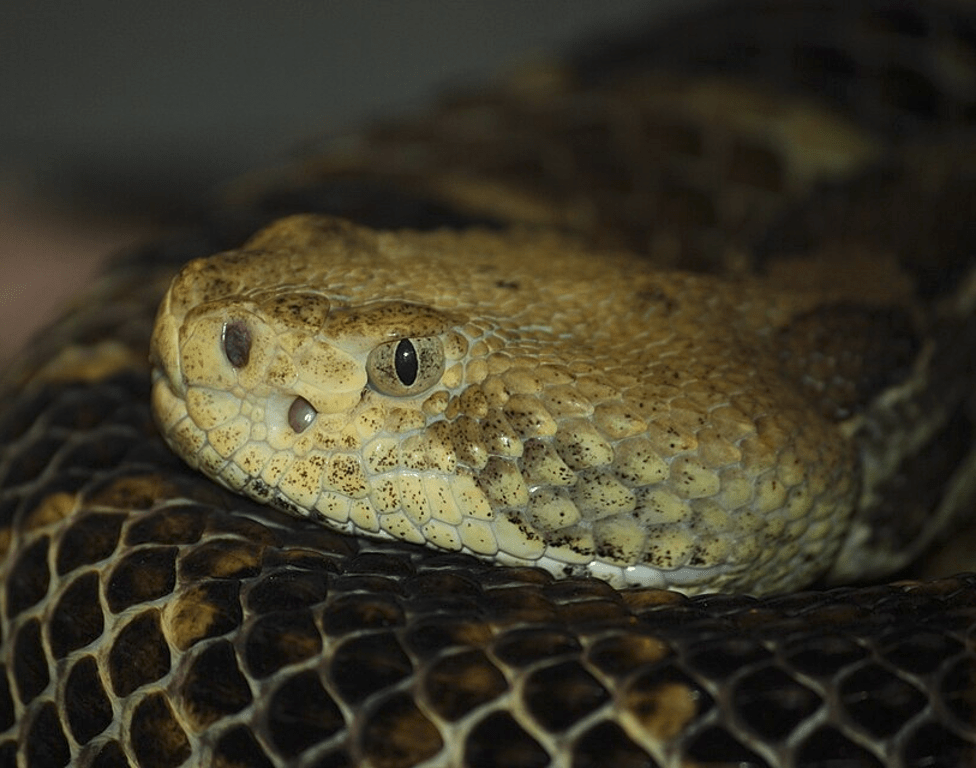
In addition to the rest of the viper toolkit, pit vipers of the subfamily Crotalinae possess a pair of loreal pits between their eyes and nostrils. With a structure somewhat similar to an eyeball, these pits detect infrared radiation, giving these animals built-in heat sensors. Pit vipers are known to use this “heat vision” to follow prey, to guide their strikes against prey, to select ambush sites, and to find suitable places for basking.
Besides the many adaptations on their heads, lots of vipers have also modified their tails. In many species, juveniles’ tails are brightly-colored and used as a lure to attract prey such as frogs and lizards, and some continue using tail-lures as adults. The most spectacular of these lures belong to spider-tailed horned vipers, whose wriggling, spiny tails create do an extraordinary imitation of a tasty spider, which they use to lure in birds.
Bottom: The body of a spider-tailed horned viper (Pseudocerastes urarachnoides) is well-camouflaged against its rocky surroundings, except for its tail which does an incredible impression of a spider. Image by Omid Mozaffari.
But by far the most famous tail structures among vipers belong to rattlesnakes, including several dozen species in the genera Crotalus and Sistrurus, widespread throughout the Americas. As these snakes shed, segments of dead scales accumulate at the tip of their tails to form a series of interlocking and loosely-connected rings which – when vibrated by specialized “tailshaker” muscles anchored to a bundle of fused tail bones – produce an iconic rattling sound. Unlike tail lures, which are meant to attract prey, these rattles are a threat display, intended to discourage dangerous animals from getting too close.
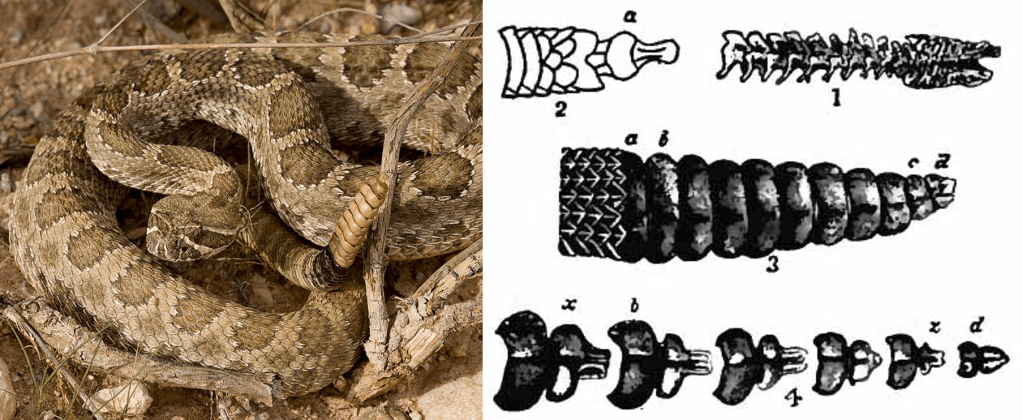
Right: A diagram of a rattlesnake rattle, including the internal tail bones (top) and the interlocking rattle segments (bottom). Image from Encyclopedia Britannica
Like most snakes, the fossil record of vipers consists almost entirely of individual vertebrae, although numerous examples of skull bones and fangs are also known. The oldest known viper remains are from the Early Miocene, just over 20 million years ago, and soon afterward these snakes are known from fossils across most of their modern range.
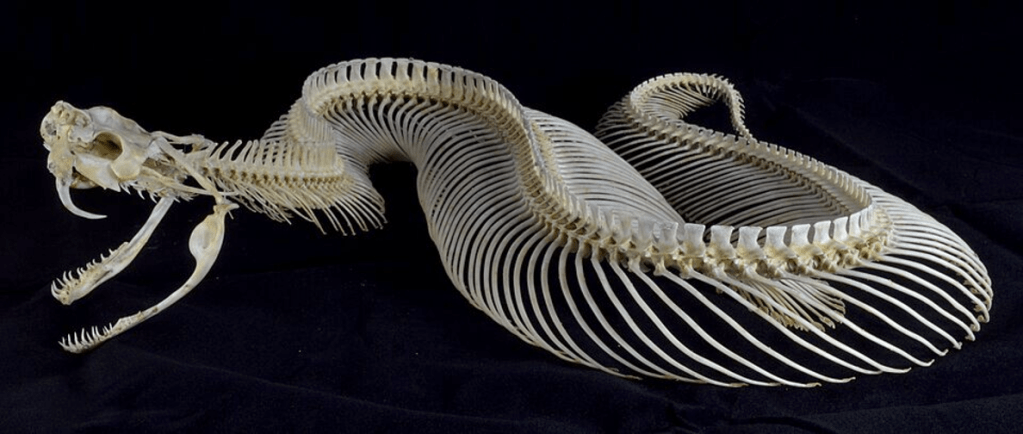
The rapid diversification of vipers can probably be attributed to changing habitats – for example the spread of forests in Southeast Asia – and to the evolution of their distinctive features, including their specialized venom system, the loreal pits of pit vipers, as well as their habit of giving live birth and their repeated shifts into tree-dwelling or desert-dwelling habits.
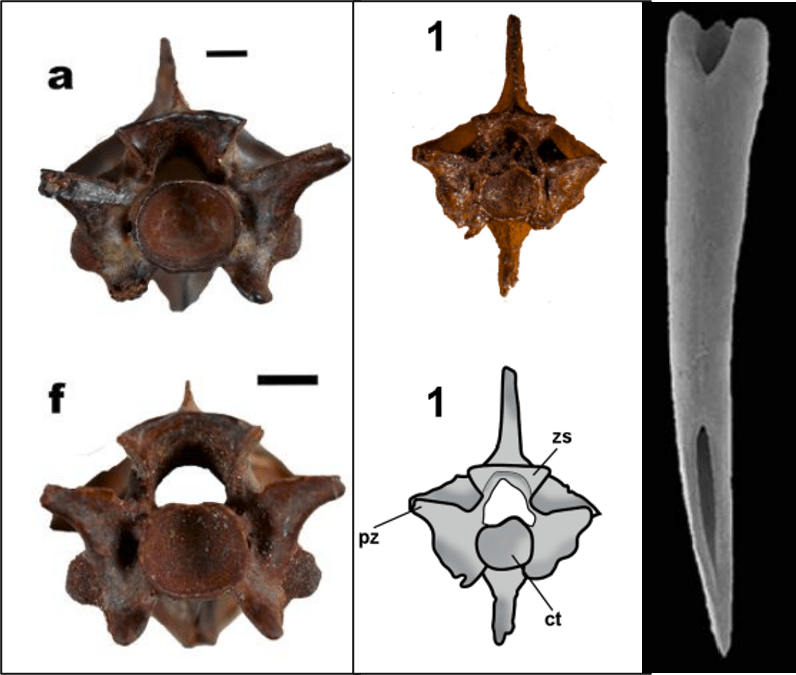
Middle: Fossil and schematic drawing of a viper vertebra from Venezuela tar pits. Image from Onary et al 2018
Right: A fossil viper fang from Miocene Germany. Image from Kuch et al 2006
Learn More
Striking Beauties: Venomous Snakes
Evolution of vipers and the role of key innovations in their diversification (technical, open access)
Diversification in vipers (technical, paywall)
A Review of Rattlesnake Venoms (technical, open access)
Structure, Ontogeny, and Evolutionary Development of the Rattlesnake Rattle (technical, open access)
Molecular Basis of Infrared Detection by Snakes (technical, open access)
Fossil Record of the True Vipers (technical, open access)
__
If you enjoyed this topic and want more like it, check out these related episodes:
We also invite you to follow us on Facebook or Instagram, buy merch at our Zazzle store, join our Discord server, or consider supporting us with a one-time PayPal donation or on Patreon to get bonus recordings and other goodies!
Please feel free to contact us with comments, questions, or topic suggestions, and to rate and review us on Spotify or Apple Podcasts!


.jpg)


.jpg)


.jpg)

.jpg)


Leave a Reply