

Listen to Episode 178 on PodBean, YouTube, Spotify, or wherever you listen to your favorite podcasts!
The world is full of sounds, and life has evolved numerous strategies for detecting and interpreting them. This episode, we discuss the deep history and varying forms (and uses) of Ears.
In the news
Two new species of large carnivorous lampreys from the Jurassic
Developmental study examines the origins of caterpillars’ “extra legs”
This Late Triassic dragonfly is among the first of its lineage
The evolution of sea stars has seemingly rendered them mostly head
All the Better to Hear You With
The world around us is full of sounds, and the ability to detect and interpret those sounds carries many benefits. So, it’s no surprise that life on Earth has evolved organs to do this – many times, in fact!
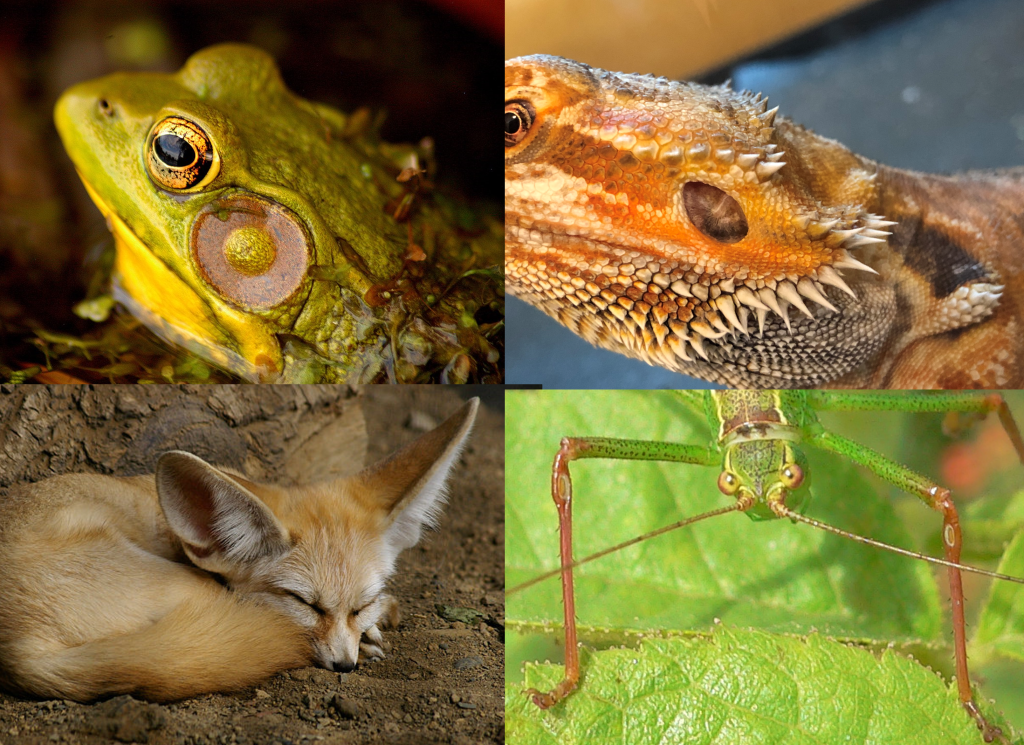
Top left: The tympanum (effectively the ear drum) of a frog. Being very vocal animals, frogs benefit from a good sense of hearing. Image by Paul Anderson, CC BY-SA 4.0
Top right: The external ear opening of a bearded dragon. This opening is effectively the ear canal. Image by Mbrickn, CC BY 4.0
Bottom left: The very obvious ears of a fennec fox. Most mammals have pinnae, the expanded external tissue of the ear, which help to capture sound. Image by su neko, CC BY 2.0
Bottom right: Sound-sensing organs have evolved many times in insects, in many parts of the body. This katydid has “ears” on its legs (those circular organs). Image by Georg Slickers, CC BY-SA 4.0
Ears, in their many forms, are often equipped with structures that help to collect sound waves and deliver them to the nerves that transmit signals to the brain. In our own ears, these include the ear drum, inner ear bones, and the spiral-shaped cochlea. These structures allow us to not only receive and understand sounds of many frequencies, but also to determine information like the distance and direction of the origin of a sound.
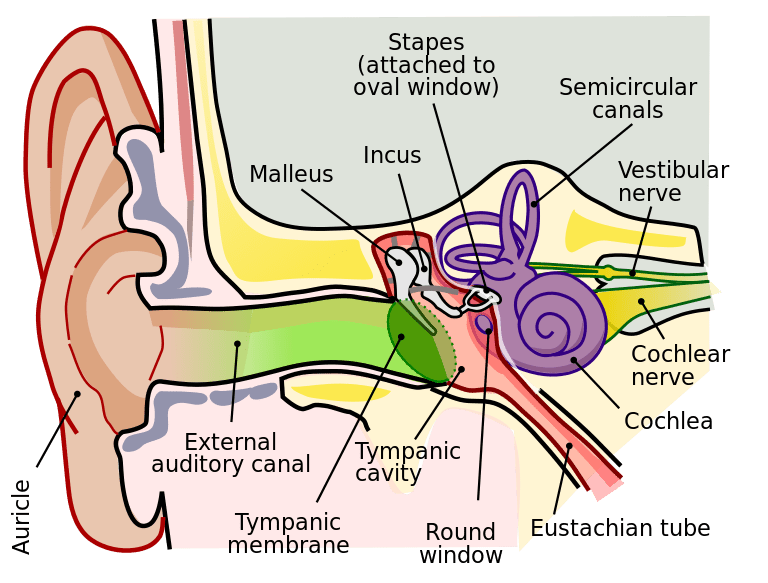
The earliest known hearing-adapted structures in the fossil record belong to early fish, over 400 million years old. Later, in jawed fish, the bones within and near the jaws became part of the sound transmission system, early versions of vertebrate ears. These early ears were inherited by tetrapods, and from there they diversified into many forms, some simple and some far more complex. Mammals are especially notable for their complex ear structures, including our famous three inner ear bones (the incus, malleus, and stapes) and our external pinnae (the flappy part of our ears that helps collect sound), which make mammals well-adapted for hearing high-frequency sounds.
Meanwhile, among arthropods, insects have evolved various forms of “ears” several times in several groups! Among both vertebrates and invertebrates, there is a tendency for very vocal animals to develop more complex and specialized ears – frogs, birds, cicadas, etc. – as hearing is an essential component of vocal communication.
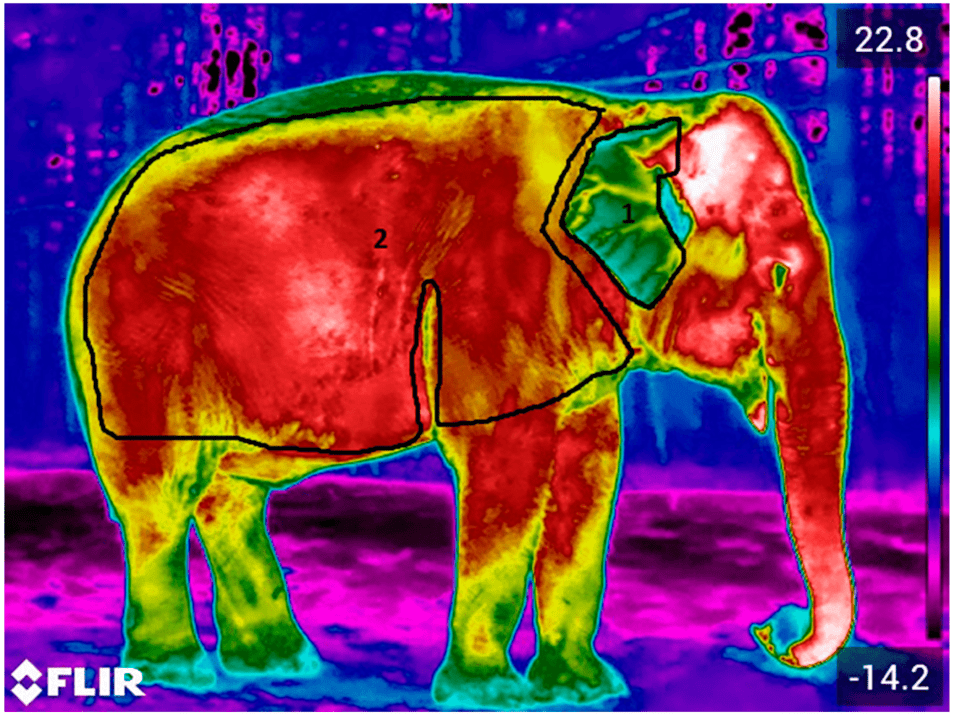
Of course, ears do other things besides hearing. Many mammals have big mobile external ears that can function as display structures, temperature regulators, fly-swatters, and more. And, of course, our inner ears are also home to our vestibular system, a series of structures that help us to maintain our balance and coordination.
When we study fossil animals, if we’re lucky enough to find fossils that preserve the very delicate structures of ears, we can learn quite a lot about their behavior and lifestyle by examining their auditory and vestibular systems.
Learn more
The evolutionary tuning of hearing, 2023 (technical, open access)
Evolution of the Mammalian Ear, 2023 (technical, open access)
The early origin of a birdlike inner ear, 2021 (technical, open access)
Bridging the Gap Between Mammal and Insect Ears – A Comparative and Evolutionary View of Sound-Reception, 2021 (technical, open access)
Mesozoic katydid hearing, 2022 (technical, open access)
Sound perception and its effects in plants and algae, 2020 (technical, open access)
__
If you enjoyed this topic and want more like it, check out these related episodes:
- Episode 52 – Sounds of the Past (Fossil Bioacoustics)
- Episode 68 – Evolution of Eyes
- Episode 130 – Sense of Smell
We also invite you to follow us on Twitter, Facebook, or Instagram, buy merch at our Zazzle store, join our Discord server, or consider supporting us with a one-time PayPal donation or on Patreon to get bonus recordings and other goodies!
Please feel free to contact us with comments, questions, or topic suggestions, and to rate and review us on iTunes.


Leave a Reply