
Listen to Episode 252 on Podbean, YouTube, Spotify, or wherever you listen to your favorite podcasts!
Earth is a generally warm planet, but every now and then it is overtaken by ice. This episode, we explore the causes and effects of icy conditions over time, with a special look at the recent (and ongoing) event called The Ice Age.
In the news
Distant celestial objects record early Solar System conditions
Why do snake embryos coil?
The sounds of Jurassic insects
Dinosaur nests in the far south
Everybody Chill
In the modern world, about 10% of the Earth’s land surface is covered in persistent ice in the form of glaciers. This is an unusual state of our world. For most of our planet’s history, Earth has been in “greenhouse conditions,” where global climate conditions prevented the formation of long-lived bodies of ice. But periodically over time, the planet has entered an “icehouse” with persistent ice at the poles and on mountaintops. These time periods are sometimes called Ice Ages.
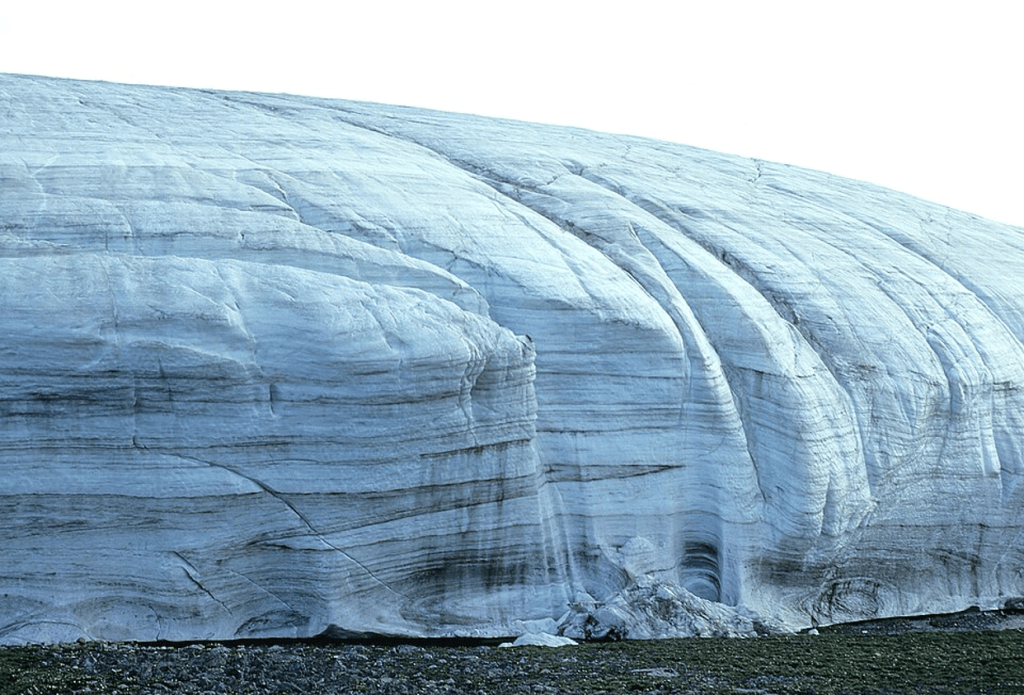
A glacier forms where snow and ice accumulate faster than they erode or melt away, typically at high altitudes or high latitudes where temperatures remain cold year-round. Glaciers can be hundreds of meters to hundreds of kilometers wide.
Under the right conditions, glacial bodies can form enormous ice sheets, covering an area of hundreds of thousands of square kilometers. In our modern world, there are two ice sheets sitting over Greenland and Antarctica, both reaching thicknesses of over two kilometers.
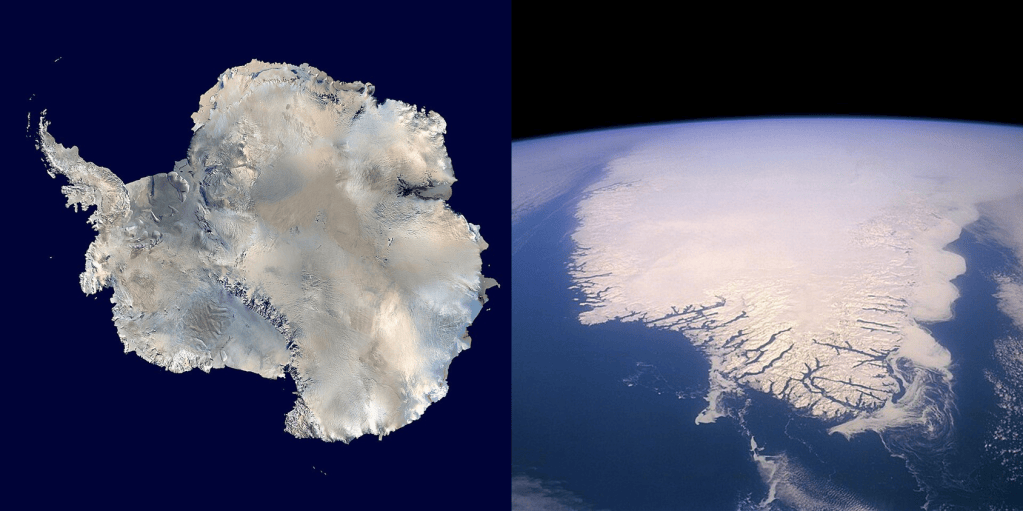
Left: The Antarctic Ice Sheet covering the continent of Antarctica contains almost 90% of the ice on Earth. Image by Dave Pape.
Right: The Greenland Ice Sheet covering most of the island of Greenland contains about 10% of the ice on Earth. Image from USGS.
Glacial ice expands as more snow accumulates, and it shifts and flows downhill under the pull of gravity, and it can retreat as the ice melts or erodes away. This dynamic motion leaves behind tell-tale glacial landforms. As the ice carves up the underlying land, it creates striations, valleys, and basins in the landscape. At the edges of a glacier, the ice deposits large stones or piles of sediment.
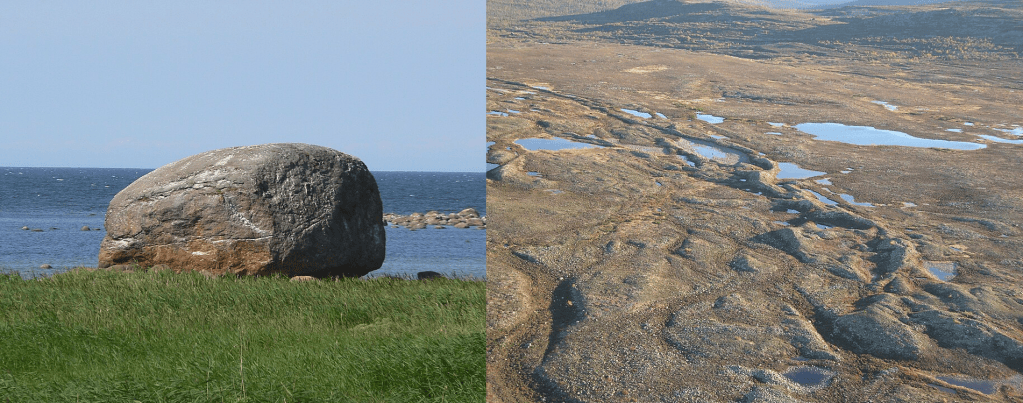
Right: A winding ridge of sediment (an esker) laid down by glacial movement in Sweden. Image by Hanna Lokrantz, CC BY 2.0
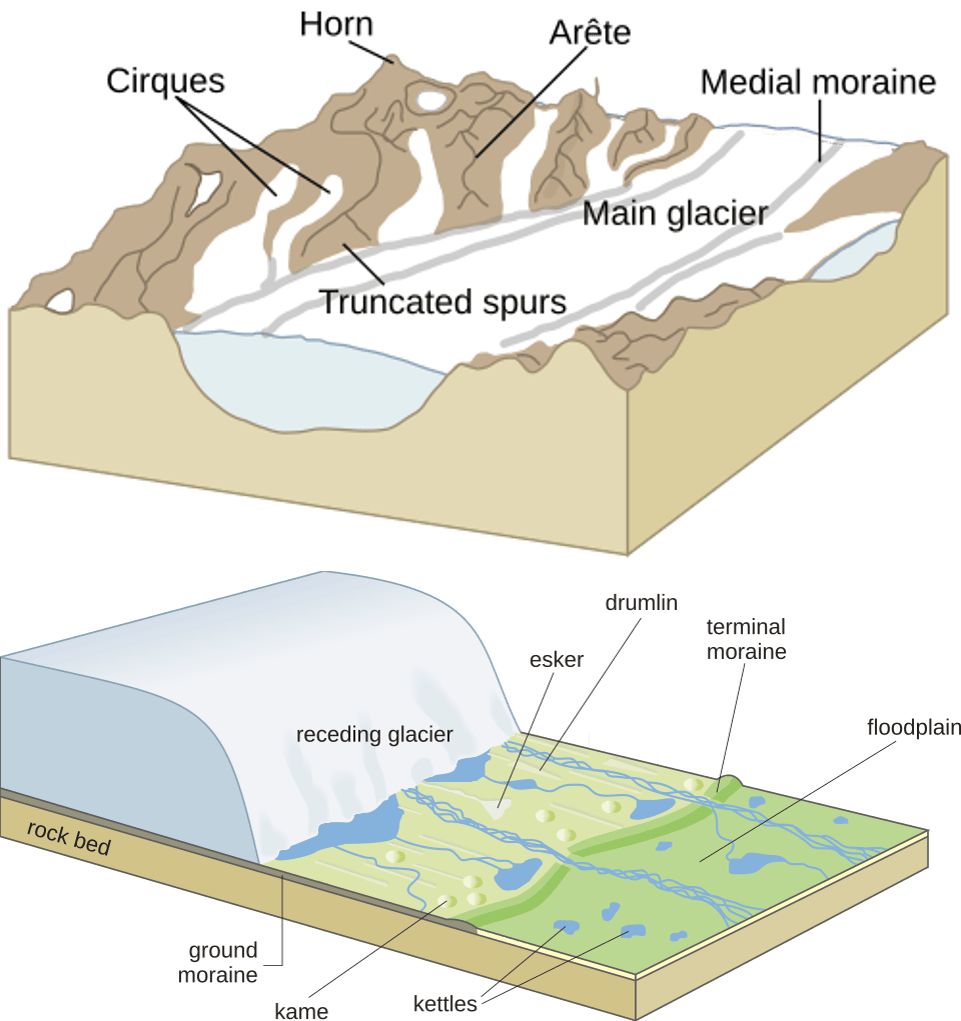
Bottom: Geographical features left behind by a retreating glacier. Image by Hans Hillawaert, CC BY-SA 3.0
Glacial deposits around the world provide evidence of glaciations (ice ages) of the distant past. Many of these are associated with particularly dramatic events in Earth history, such as the Great Oxidation Event alongside the Huronian Glaciation; the extraordinary Snowball Earth events of the Cryogenian Period; and the ice-induced Ordovician Mass Extinction.
The most recent icehouse began 34 million years ago with the formation of a permanent ice sheet over Antarctica. But the time period commonly referred to as “The Ice Age” began 2.5 million years ago when climate conditions favored the formation of extensive and persistent Arctic ice as well. Since then, our planet has had two polar ice caps.
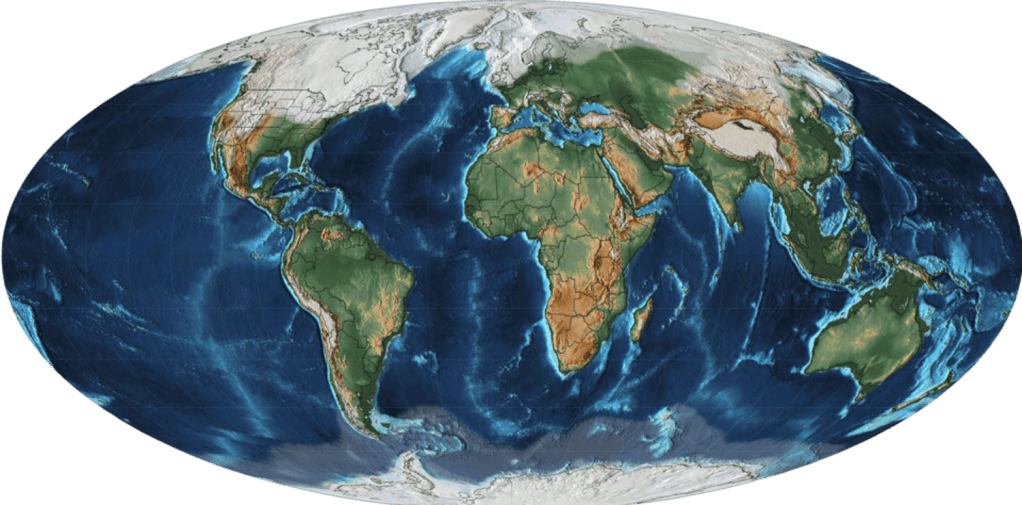
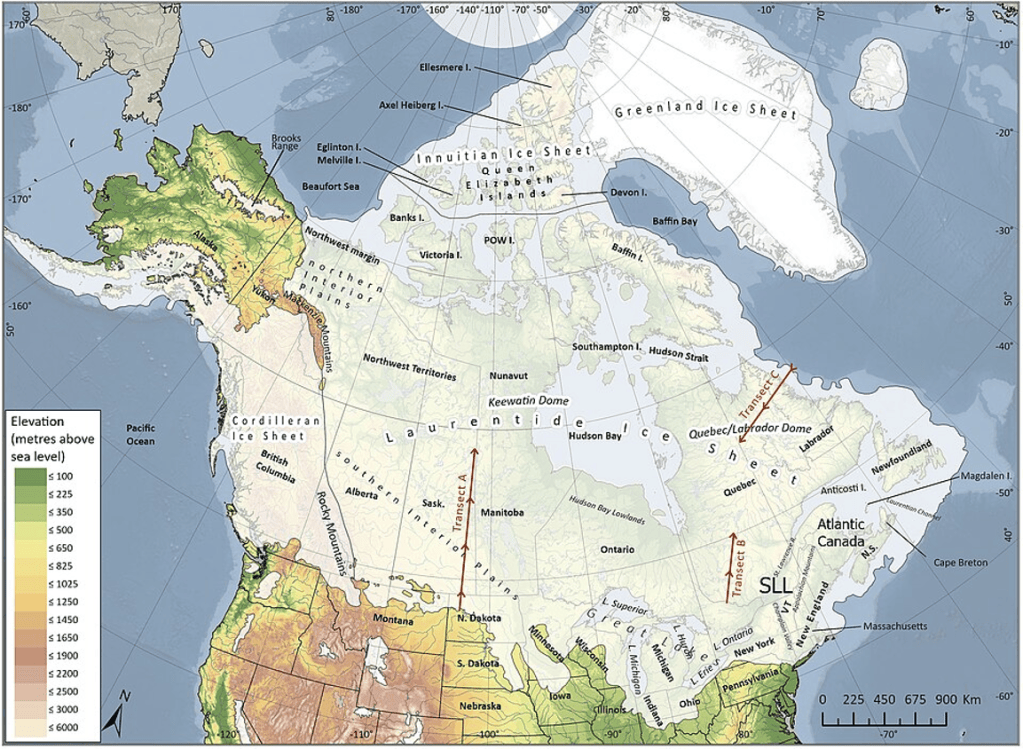
Today, the northern continents are covered in basins, ridges, and valleys carved by the motion of ice sheets during the Last Glacial Period. At their greatest extent, northern ice sheets extended as far south as 40 degrees North latitude, with global ice covering around 30% of the Earth’s land surface. With so much water locked up in ice, sea levels dropped as low as 125 meters below present conditions, and global temperatures got as low as 6 degrees Celsius below modern averages.
This time period, the Quaternary Glaciation, is characterized by fluctuations of glacial conditions, bouncing between glacial periods with extensive ice cover and interglacial periods with less ice cover. This back-and-forth pattern seems to have been largely driven by changes in the Earth’s orbital relationship with the sun, and these periods also coincided with significant ups and downs in atmospheric carbon dioxide levels. These changes also resulted in changes to life on Earth as populations were repeatedly separated and reunited by the shifting of ice sheets and the rising and falling of sea levels.
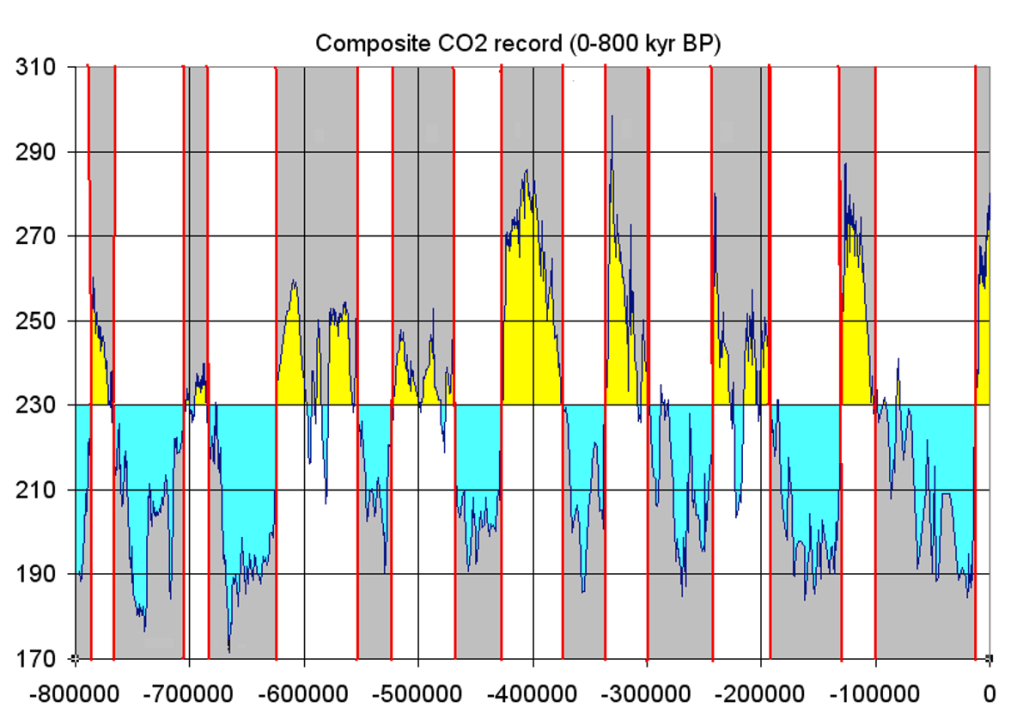
The Last Glacial Period ended 11,700 years ago as the Earth entered the current Holocene interglacial period. Under normal conditions, researchers predict the planet would enter the next glacial period in another several thousand years, but this pattern is likely to be disrupted by the current human-mediated flooding of the atmosphere with CO2.
Learn More
USGS – Glaciers and Icecaps
NSIDC – Glaciers
Greenhouse gas effects on Quaternary climates
The Great Ice Age (USGS)
__
If you enjoyed this topic and want more like it, check out these related episodes:
- Episode 25 – The Pleistocene Megafaunal Extinction
- Episode 113 – Paleoclimate
- Episode 124 – Snowball Earth
We also invite you to follow us on Facebook or Instagram, buy merch at our Zazzle store, join our Discord server, or consider supporting us with a one-time PayPal donation or on Patreon to get bonus recordings and other goodies!
Please feel free to contact us with comments, questions, or topic suggestions, and to rate and review us on Spotify or Apple Podcasts!


.png)


Leave a Reply